
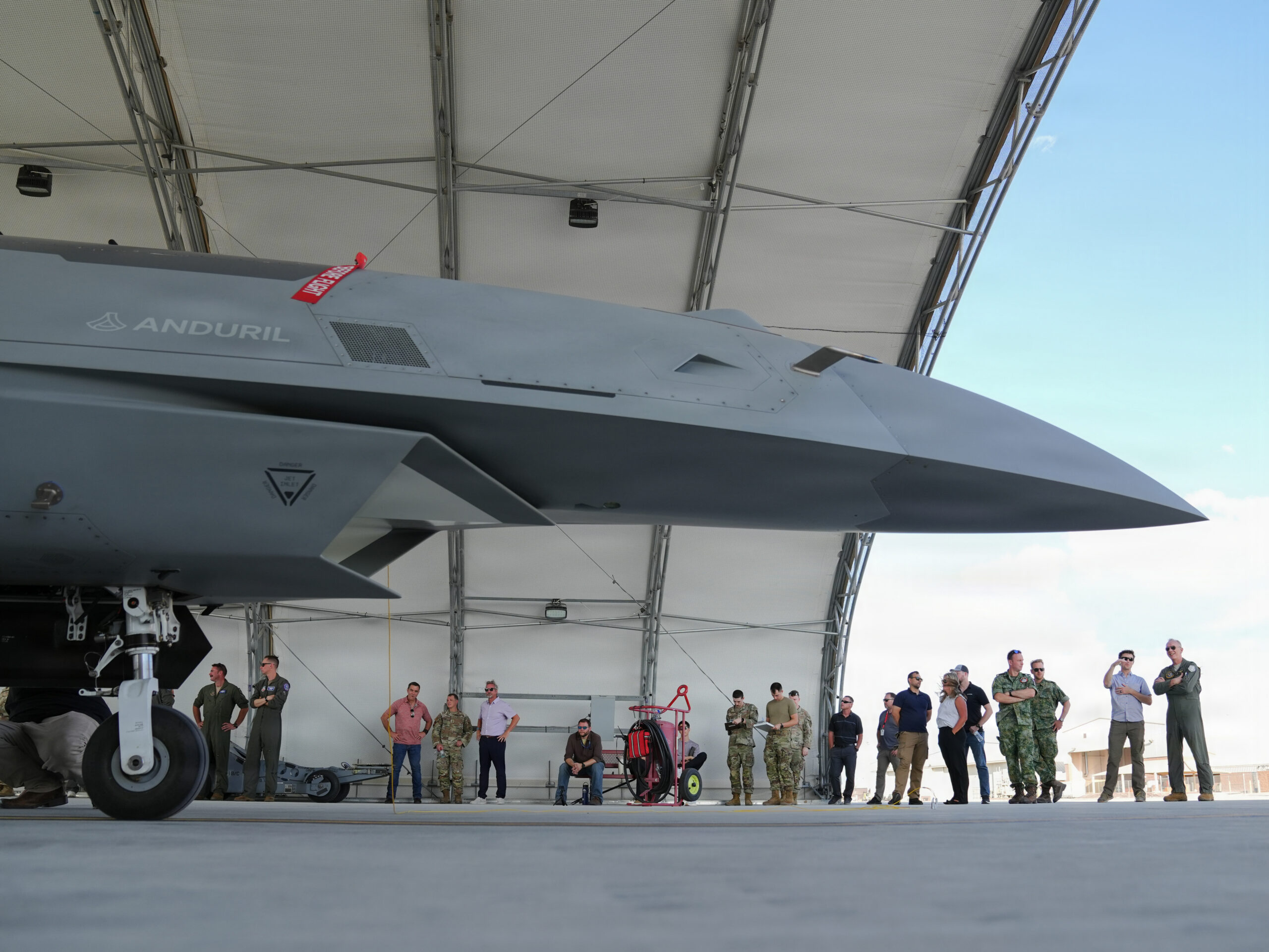
A seemingly routine military change of command ceremony at Creech Air Force Base in Nevada on July 31, 2026, underscored a profound shift in the United States Air Force’s strategic trajectory. While the traditional passing of a guidon unfolded, the backdrop featured two semi-autonomous Collaborative Combat Aircraft (CCAs), symbolic of a new era of air warfare. The event marked the first leadership transition for the Experimental Operations Unit (EOU) since its establishment in June 2025—a unit specifically tasked with pioneering the integration and operational deployment of these cutting-edge autonomous platforms.
The ceremony, which saw Lt. Col. Lyndon Bartlett assume command of the EOU from outgoing commander Lt. Col. Matthew Jensen, signals the rapid maturation of the CCA concept. What began as a nascent idea is quickly becoming an entrenched component of the Air Force’s structure, moving beyond initial experimentation to tackle fundamental operational questions. The focus is now shifting from demonstrating the novelty of autonomous flight to addressing the intricate challenges of sustainment, deployment logistics, and the optimal human-machine teaming required for high-tempo combat operations.
This leadership change occurred just over a week after a pivotal exercise at Creech, where the Air Force’s initial prototype CCAs—General Atomics’ YFQ-42A and Anduril Industries’ YFQ-44A—engaged in advanced simulated operational environments. This marked the EOU’s second such exercise, building upon a foundational event in April, and demonstrated a significant leap in capabilities and operational readiness. An August 18 blog post from Anduril highlighted that the weeklong July exercise incorporated tasks of greater complexity than previous iterations, concurrently expanding the scope of responsibilities assigned to Air Force personnel in directing these autonomous assets.
Crucially, the exercise showcased the potential for disaggregated control, with EOU operators assigning tasks to CCAs from multiple, dispersed locations. This innovative approach promises to reduce manpower requirements and enable the control of drones from austere, less vulnerable bases, thereby enhancing survivability and flexibility in contested environments. For the first time, operational users directly oversaw daily mission autonomy flights of the prototype YFQ-44A, successfully generating multiple sorties on several days—a testament to the increasing confidence in their autonomous capabilities. Anduril affirmed that, “The latest EOU exercise is tangible evidence that the operational procedures and trust required to field FQ-44 [the production version of Anduril’s CCA] at scale are taking shape. Regular testing and experimentation with operational end users is central to how the CCA program will deliver a combat credible capability quickly.”
As the Air Force transitions from developmental testing to operational readiness, critical questions surrounding maintenance and personnel arise. The deployment of actual CCAs to Airmen necessitates a re-evaluation of established practices, particularly in aircraft upkeep. Col. John Cummings, the autonomous collaborative platforms division chief at Air Combat Command, addressed this challenge in an August 15 podcast from the Mitchell Institute for Aerospace Studies, describing the shift as “a tough cultural paradigm to break.” Traditionally, the Air Force relies on highly trained, specialized maintainers for its advanced manned aircraft. However, the operational model envisioned for CCAs—small teams operating from remote locations—demands a different approach. “We really just need that generalist maintainer, so we need everybody to be able to do everything,” Cummings emphasized, signaling a fundamental change in maintenance philosophy to support distributed and agile operations.
Complementing this shift in maintenance is a re-conception of the human element in CCA operations. Col. Scott Gunn, commander of the 53rd Wing, which oversees the EOU, further elaborated on the diverse composition of the new experimental unit during the same podcast. The EOU comprises a broad spectrum of Airmen, including fighter pilots, weapons systems officers (WSOs), remotely piloted aircraft (RPA) pilots, engineers, maintainers, security specialists, analysts, and intelligence and cyber personnel. This eclectic mix reflects the Air Force’s deliberate effort to avoid preconceived notions about what a CCA unit should look like. “If we model this after a fighter squadron, or a maintenance squadron, or an RPA squadron, we’d probably be missing the mark,” Gunn stated, underscoring the need for a fresh organizational paradigm that doesn’t attempt to fit “a square peg into a round hole” of existing structures.
The increasing autonomous capabilities of CCAs also dictate an evolving role for human controllers. Gunn noted that in the near future, operators will be capable of directing multiple CCAs simultaneously. Cummings suggested that navigators or WSOs, traditionally tasked with managing complex systems in manned aircraft, could be ideally suited for this new command role. However, both officers acknowledged the “cultural headwinds” inherent in changing long-standing mindsets within the Air Force. Ultimately, Gunn stressed, CCA controllers must internalize that they are not “pilots” in the traditional sense. “We’re going to get to a point—how soon remains to be seen—where we all need to get comfortable with the fact that it is semi-autonomous, and so there is a human-machine interaction, but humans are not the ones flying the aircraft. It’s the algorithms that humans have been a part of designing and developing [that are] actually piloting,” he concluded, outlining a future where human oversight guides sophisticated AI rather than directly manipulating flight controls.
Why This Matters
The maturation and integration of Collaborative Combat Aircraft (CCAs) by the U.S. Air Force represent more than just the introduction of new hardware; they signify a profound and irreversible transformation in global military doctrine and the future of airpower. This initiative is crucial for several interconnected reasons:
- Strategic Transformation of Air Warfare:CCAs are poised to fundamentally redefine air combat by establishing an integrated human-machine teaming paradigm. This shift acknowledges that future conflicts, particularly against sophisticated adversaries, will necessitate operating in highly contested environments where the risk and cost of deploying solely manned aircraft may be prohibitive. CCAs offer a pathway to massed airpower, expanded sensor-shooter networks, and enhanced survivability for manned platforms by acting as loyal wingmen, decoys, or forward scouts, without directly endangering human pilots.
- Enhanced Deterrence and Global Power Projection:By providing a more attritable and potentially cost-effective capability, CCAs bolster the U.S. Air Force’s ability to project power across vast distances and deter potential aggressors. This is particularly vital in strategically critical regions like the Indo-Pacific, where maintaining a technological and numerical edge against peer competitors is paramount. The ability to field numerous semi-autonomous systems alongside manned aircraft complicates adversary defense strategies and presents a more formidable force.
- Pioneering Military Innovation and AI Integration:The CCA program is a vanguard for integrating advanced artificial intelligence and autonomy into military operations at scale. The challenges of developing resilient algorithms, secure communication links, and intuitive human-machine interfaces are pushing the boundaries of defense technology, with potential spillover benefits for other defense sectors and even civilian applications of AI.
- Organizational and Cultural Evolution:Beyond the technological advancements, the successful deployment of CCAs demands a radical rethinking of military organization, training, and culture. The Air Force’s efforts to cultivate “generalist maintainers” and embrace new control methodologies challenge decades of established practices. This internal evolution is critical for adapting to the rapid pace of technological change and serves as a blueprint for how other branches of service may integrate similar autonomous systems, fostering a more agile and adaptable fighting force.
- Redefining Risk and Cost in Conflict:CCAs offer a means to accomplish dangerous missions with reduced risk to human life, potentially altering the political and ethical calculus of military engagement. Moreover, if produced at scale and at a lower unit cost than traditional manned fighters, they could offer a more economically sustainable path to maintaining air superiority and projection capabilities in an era of escalating defense budgets and geopolitical competition.