
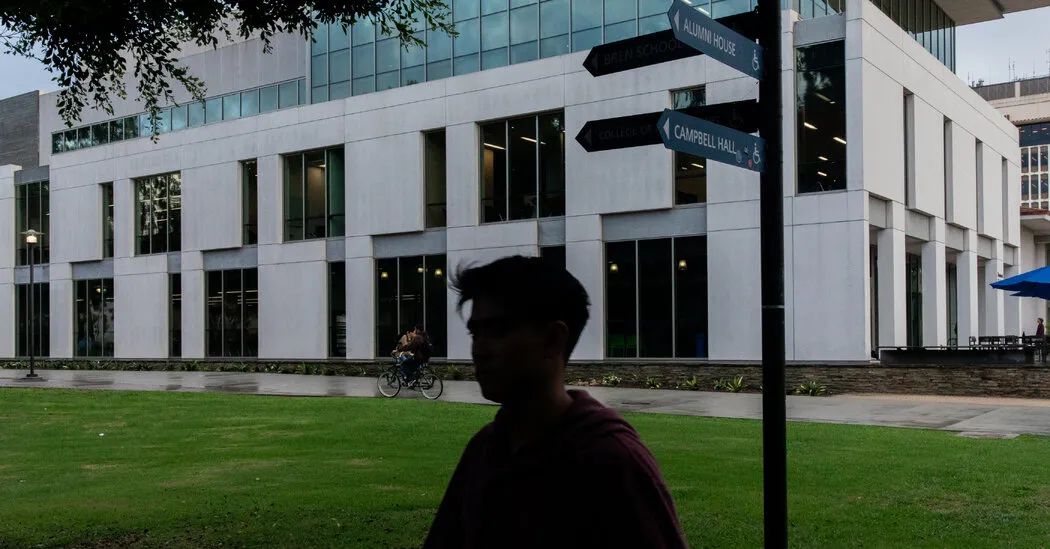
In the 1960s, students attending the University of California system often incurred minimal or no direct tuition costs, a stark contrast to today’s financial landscape. Grandparents accustomed to that era, now potentially assisting their descendants with university expenses, are likely to encounter a dramatically different financial reality when examining current costs.
For the current academic year, the University of California, Berkeley, has announced an “all-in” cost of attendance for new in-state students residing in campus housing. This comprehensive figure, encompassing tuition, room, board, mandatory fees, and estimated personal expenses, stands at $54,674. This represents the full projected cost for a student living in a campus residence hall.
Similarly, the University of California, Santa Barbara, lists an all-inclusive price of $50,946. At the University of California, Irvine, the cost of attendance has also surpassed the $50,000 threshold, reaching $50,130 for students living off-campus, a relevant detail given that undergraduates are currently guaranteed on-campus housing for only two years. This annual cost, exceeding $50,000, represents a significant financial benchmark that may challenge long-held perceptions among families who traditionally viewed public state universities as a more affordable higher education option compared to private institutions.
It is important to acknowledge that these listed prices are “sticker prices” and do not reflect the actual out-of-pocket expenses for many students. A substantial portion of attendees receive financial aid, including grants and scholarships, which can significantly reduce their net cost. Furthermore, the estimated costs often incorporate health insurance premiums, an expense many students can waive if already covered by family plans, further reducing their personal contribution.
The elevated costs also reflect California’s generally high cost of living, which impacts operational expenses for institutions, such as salaries and utilities, and subsequently increases personal expenses for students. For context, the College Board reports that the average list price for tuition and fees at a four-year public university across the United States for the 2025-26 academic year stood at $11,950. The University of California campuses in question show tuition and fees alone to be considerably higher than this national average, contributing significantly to the overall financial burden.
Despite these mitigating factors and comparisons to national averages, a primary driver ensures that many in-state families will indeed face cumulative expenses potentially exceeding $200,000 over a four-year degree program. For out-of-state students, costs could easily climb upwards of $300,000. This pivotal factor is the cost of student housing, which, even within university-owned residential facilities, can often surpass the combined expense of tuition and mandatory academic fees. This situation underscores a broader trend in the United States where housing costs increasingly influence the affordability of essential services and opportunities. For public universities offering a residential undergraduate education, the provision of academic instruction has become inextricably linked with the challenge of providing accessible and affordable living spaces.
A critical question arises regarding the extent of housing a university should provide, and whether a state-funded institution bears a special responsibility to offer accommodations at a subsidized rate to all enrolled students who desire them. From the perspective of prospective students and their parents, the assumption often leans towards a significant provision of affordable, on-campus housing. However, the reality at campuses such as UC Santa Barbara frequently contradicts this expectation.
The severity of the situation at the University of California, Santa Barbara, is highlighted by the institution’s own Blum Center on Poverty, Inequality and Democracy, which published an 85-page “people’s guide” in 2024 specifically addressing the university’s “housing crisis.” In response to growing pressures, the university recently announced an extension of its on-campus housing guarantee for incoming undergraduates from one year to two. This expansion, however, is contingent on the completion of long-planned, though delayed, construction of new campus residences, illustrating the ongoing challenges in meeting student housing demand.
While many universities globally do not guarantee four years of housing, the historical context around the Santa Barbara campus is notable. Decades ago, private landlords and developers near the university constructed and rented out single-family homes and apartment complexes at a pace that outstripped the university’s own housing development efforts, establishing a reliance on the private market.
However, as the university’s enrollment expanded significantly, the supply of both on-campus and off-campus housing failed to keep pace. This shortfall is exacerbated by the region’s geographical constraints; the campus and its immediate surroundings are bordered by an airport, mountains, and the Pacific Ocean, severely limiting available land for new development. The primary residential area within walking distance is Isla Vista, an unincorporated community often referred to as “U.C.S.B.’s college town” by the university’s admissions office.
Comprising approximately 50 square blocks of predominantly older homes and low-rise apartment buildings, Isla Vista’s housing market is largely controlled by private landlords. Rents are notably high; for instance, at complexes like Breakpointe & Coronado, a shared room within a small two-bedroom apartment can start at $1,336.65 per person per month. Demand is so intense that interested parties can already join a waitlist for the fall 2027 academic year, indicating a severe and persistent housing shortage.
Another example, “The Penthouse,” illustrates the market’s current state. A recent visit revealed a weathered exterior leading to a top-floor landing amidst exposed electrical wires and a few palm trees. A sign outside directs prospective tenants to a website, albeit one with grammatical errors, announcing that the company “will begin leasing all 330 of it’s apartments, townhouses and duplex’s on a first come, first served basis in early January” for a future academic year.
For students, securing housing in this environment is a highly competitive and often stressful process, akin to a literal race. Landlords in Isla Vista leverage the known scarcity of on-campus housing, initiating the leasing process for academic years far in advance, thereby capitalizing on student uncertainty and urgency. Nicole Meng, a student team leader at the UC Santa Barbara Blum Center, describes the intense pressure: “After October, you start hearing, ‘Have you found housing for next year?’ All of my friends were like: ‘What do we do? We’re 18. We don’t really have any resources. I’m first generation, low income — how am I going to come up with deposits? And I need to find roommates?’” Meng herself pays $2,988 per month, split three ways, for a 450-square-foot one-bedroom apartment.
Jasmine Hsieh, external vice president for statewide affairs for the Associated Students of U.C. Santa Barbara, further emphasizes the severe lack of choice: “This is to findaspot. You’re not selecting. You’re just hoping to be able to continue to go to school.” This sentiment highlights the existential nature of the housing search for many students.
University Strategies for Housing Provision
When universities allow their undergraduate housing market to be predominantly managed by nearby private landlords for extended periods, especially amidst rising student populations, they invariably forfeit a degree of control over a crucial aspect of the student experience and the overall cost of attendance. This eventually precipitates a crisis where the total cost of attending the institution approaches or exceeds the $50,000 mark, compelling universities to actively reclaim influence over student housing provision.
According to Kyle Gibson, the director of strategic communications for U.C. Berkeley’s administration division, University of California campuses employ several methods to develop new student residences. These strategies include soliciting significant philanthropic donations, securing grants from the state government, borrowing funds through bonds, and potentially partnering with private developers. The fundamental aim in these construction projects is to establish a financial model where student rents are sufficient to cover the costs of building maintenance and loan repayment, thereby attempting to stabilize housing costs and potentially undercut the rates charged by private landlords, a complex endeavor in California’s high-cost environment.
Why This Matters
The escalating “all-in” costs at public universities, particularly highlighted by the University of California system, represent a critical national concern that extends far beyond the individual students and families directly affected. Public institutions of higher education have historically served as crucial engines of social mobility, providing accessible pathways to advanced knowledge and economic opportunity. When the cost of attendance, primarily driven by soaring housing expenses, reaches prohibitive levels, it risks undermining this fundamental role and creating significant societal repercussions.
Firstly, rising educational costs exacerbate student debt, which has become a substantial burden on the American economy and individual financial futures. Graduates entering the workforce already saddled with significant debt may delay major life milestones such as homeownership, marriage, or starting families, impacting broader economic activity and consumer spending. Secondly, the increasing financial barrier disproportionately affects low-income and first-generation students, potentially limiting their access to prestigious state universities despite academic merit. This perpetuates cycles of inequality and hinders the socioeconomic diversity of student bodies, which is vital for a robust intellectual environment and a representative future workforce.
Furthermore, the phenomenon described, where housing costs eclipse tuition, signals a broader systemic issue: the failure of urban planning, local governance, and university expansion to adequately address housing supply in high-demand areas. It forces public universities to act as de facto real estate developers, diverting resources and focus from their core educational mission. This also raises critical questions about the long-term sustainability of the public university model, where state funding often fails to keep pace with operational costs, infrastructure needs, and enrollment growth, leading to increased reliance on student fees.
For policymakers, this situation necessitates a comprehensive reevaluation of public university funding models, state-level housing policies, and strategies for sustainable campus growth. It calls for innovative solutions that balance educational excellence with genuine affordability, ensuring that state universities remain accessible to all qualified students, regardless of their socioeconomic background. The affordability of higher education is not merely an individual problem; it is a societal challenge with profound implications for economic competitiveness, social equity, innovation, and the intellectual capital of a nation.
Across major university towns, the struggle for affordable student housing has intensified, pushing institutions to re-evaluate their role in providing stable living environments. This challenge is starkly illustrated by developments at the University of California, Berkeley, where a long-standing debate over land use has culminated in the construction of a new dormitory on a site previously designated as a small park.
After decades of planning and considerable public discourse, the University of California, Berkeley, has commenced construction on a new student dormitory. The chosen site, a small parcel of land known as People’s Park, has been owned by the university for decades but has served as a community green space and a symbol of counterculture for over 50 years. The decision to proceed with development ignited a series of protests from community activists and student groups who argued for the preservation of the park.
In response to anticipated and actual protests over the development, the university implemented significant security measures around the construction site. These included surrounding the area with large, reinforced shipping containers, deployed as a barrier against entry. These containers were further fortified with barbed wire along their tops, a measure typically seen in high-security environments, indicating the university’s determination to proceed with the project despite opposition. This approach, while effective in securing the site, has drawn criticism for its stark appearance and perceived heavy-handedness in a university setting.
The context of student housing struggles is not new to California’s university communities. In 1970, Isla Vista, a community adjacent to the University of California, Santa Barbara (UCSB), experienced significant unrest, including the arson of a Bank of America branch. This act was, in part, a response to rising rents and a perceived lack of affordable housing for students and residents. Today, while protests may manifest differently, the underlying issue of housing affordability remains a critical concern for students across the state. The current wave of new campus housing initiatives, like Berkeley’s dorms, aims to alleviate these pressures, with the hope that students will view these developments as a positive step towards addressing their housing needs.
Universities are increasingly recognizing their role in mitigating the housing crisis. Willie Brown, the Santa Barbara associate vice chancellor for housing, dining, and auxiliary enterprises, articulated this strategy for UCSB. He indicated that new on-campus housing units would be priced significantly lower than typical rents in the notoriously expensive Isla Vista market. “For us, this works well, because Isla Vista is so overpriced,” he stated, highlighting the university’s intent to offer a more accessible alternative and potentially influence the local rental market.
Similarly, in Berkeley, there are indications that increased housing supply might be having an effect on the wider market. Off-campus rents for older properties in Berkeley have reportedly seen a decline in recent years. Mr. Gibson, a university housing official involved in new developments, acknowledged the impact of campus construction on market dynamics. When asked if he took pride in the role his new housing projects played in creating competition and stabilizing rents, he responded, “I do,” suggesting a conscious effort to influence the local housing ecosystem.
The provision of stable and affordable housing is considered fundamental to student well-being and academic success. Gaye Theresa Johnson, director of the Blum Center and a professor of Black studies, emphasized this point, stating, “Stable housing is fundamental to people feeling good and, for students, performing well.” She also underscored the responsibility of institutions in addressing this challenge: “When you want to propose a solution, whose feet do you hold to the fire? The one steady to me is the university.” This perspective places the onus on universities to actively solve, rather than merely respond to, the housing crisis impacting their student bodies.
The challenge extends beyond California. Many flagship state universities across the United States are grappling with escalating costs, not just for tuition but for living expenses. In several states, including Colorado, Connecticut, Illinois, Michigan, New Jersey, Pennsylvania, and Virginia, some undergraduate programs at flagship state schools have posted total annual costs exceeding $40,000 for in-state students. This figure often includes tuition, fees, and estimated living expenses, with housing being a substantial component. This financial burden raises questions about the accessibility of public higher education for a wide range of students.
Prospective students and their families are increasingly being encouraged to engage critically with universities regarding housing provisions and costs. This proactive questioning, particularly in public forums such as campus visits or information sessions, can serve as a valuable service to other visitors and may pressure institutions to offer greater transparency and solutions. Recommended questions include:
“I hear this is a tough real estate market. Why not build more housing and guarantee four years of availability?”
“Does the lack of a guarantee put lower-income students at a disadvantage?”
“Just how hard and expensive will it be to find housing off campus?”
“Does your on-campus housing lottery coincide with lease-signing season off campus, or will I need to go all in on one or the other?”
The importance of asking these questions is underscored by experiences like that of Ms. Meng, who, along with her friends, arrived on the Santa Barbara campus unaware of the intense competition and challenges awaiting them in the local housing market.
Ultimately, the principle that academically qualified students should be able to attend the best public state schools without fear of insolvency or homelessness remains paramount. Should students opt for alternative educational paths due to unresolved housing or affordability concerns, it is crucial that they communicate their reasons to both the universities and their state legislators, thereby contributing to a broader understanding of the systemic challenges in higher education access.
Why This Matters
The escalating cost and scarcity of student housing in university towns represent a critical challenge with far-reaching implications for individuals, institutions, and society. Firstly, it directly impacts student well-being and academic performance. The stress of securing affordable housing can lead to increased anxiety, financial strain, and reduced focus on studies, potentially undermining the educational experience and leading to higher dropout rates. When students are forced to live far from campus or in substandard conditions, their ability to fully engage with campus life, utilize resources, and collaborate with peers is diminished.
Secondly, the housing crisis threatens equitable access to higher education. As overall costs, particularly housing, continue to rise, flagship public universities, traditionally seen as pathways to upward mobility, become less accessible to lower and middle-income students. This exacerbates existing inequalities and limits diversity within student bodies, contradicting the mission of public institutions to serve all qualified residents of their states. If talented students are deterred from attending their state’s best universities due to insurmountable housing costs, the quality and representativeness of the future workforce and leadership could be compromised.
Furthermore, the issue highlights the evolving role and responsibility of universities within their communities. As major landowners and economic drivers, institutions like UC Berkeley and UCSB face pressure to balance their educational mission with community needs, local housing markets, and historical land use. Their decisions—whether to build on contested spaces, implement extensive security measures, or actively compete in the rental market—have significant social, political, and economic consequences for both students and long-term residents.
Finally, the situation serves as a bellwether for the broader affordability crisis in higher education. Housing costs are but one component of a larger financial burden that includes tuition, fees, and living expenses. The ability of students and their families to afford higher education is a fundamental question for national economic competitiveness, social mobility, and the health of democratic societies. By demanding transparency and accountability from universities and policymakers, prospective students and their advocates can play a crucial role in shaping a future where quality higher education remains within reach for all who seek it.