
While the expansion of artificial intelligence (AI) often manifests physically as sprawling data centers filled with hardware, a more human-centric aspect of this technological boom is evident in cities like Karur, located in southern India. Here, a burgeoning workforce is actively contributing to AI’s development, representing a significant shift in the global labor landscape.
In Karur, hundreds of technology workers, predominantly young men and women in their twenties, populate the streets during breaks, identifiable by their corporate identification cards. Beyond traditional office settings, some individuals supplement their income by performing tasks from home, such as recording themselves performing domestic activities like chopping vegetables or making a bed, often using head-mounted iPhones to capture footage.
These individuals are employed in the rapidly expanding field of data annotation, a domain where human input remains crucial for the foreseeable future. As a vital human component in AI development, data annotators play an essential role in identifying errors, rectifying bugs, and uncovering “blind spots” within AI models. Their work directly enhances and refines AI programs used in diverse applications, including autonomous vehicles, automated factory assembly lines, and retail inventory management systems.
The work involved in data annotation can be repetitive and generally requires less specialized training than engineering roles. It often demands hours spent in front of a screen, meticulously examining video footage frame by frame. However, as AI capabilities transform product design and manufacturing processes, leading to the automation and potential disappearance of traditional jobs like coding for college graduates, data annotation emerges as a critical avenue. It illustrates how nations such as India, characterized by large youth populations and a demand for entry-level employment, are adapting to the evolving demands of the global technology sector.
Aiswarya Palaniswamy, a 25-year-old holding a master’s degree in data analytics, secured employment last year with Objectways Technologies, a Karur-based data annotation firm. Objectways primarily serves American companies integrating AI into their products. The company has experienced rapid growth, currently employing 2,600 individuals, with 300 new hires added in the most recent month alone.
Ms. Palaniswamy expressed confidence in the resilience of her career choice, stating, “There will always be data. There will always be information.” Her perspective reflects an understanding of data annotation’s enduring necessity, especially as AI increasingly automates roles previously filled by Indian workers, such as payroll processing and data entry. She and her colleagues analyze footage from advanced physical AI products, including self-driving cars and humanoid robots, meticulously assessing the AI model’s performance in each frame of video.
Entry-level skilled office positions at Objectways offer monthly salaries ranging from approximately $210 to $260. This income provides a comfortable standard of living in Karur, a city with a population of around 440,000. For unskilled freelance work, such as self-recording activities at home, compensation is approximately $2.50 per hour for usable footage.
The challenge of securing consistent employment for India’s rapidly expanding young adult population is a pressing concern for the government. With approximately 2 million Indians reaching the age of 18 each month, creating sufficient job opportunities is a key objective for Prime Minister Narendra Modi and his Bharatiya Janata Party. The recent “cockroach” protests concerning education, driven by a perceived lack of opportunities for young people, underscore this urgency. While Prime Minister Modi, who has championed India’s modernization and prosperity, responded by replacing his education minister, the fundamental issue of inadequate skilled jobs for graduates remains unresolved.
Although data annotation companies like Objectways primarily serve international clients, the Modi government prioritizes the development of indigenous AI businesses. The aim is to foster homegrown applications, thereby maximizing the economic impact within India. S. Krishnan, who leads the country’s information and technology ministry, stated in an interview that India possesses a unique opportunity to leverage its vast human capital—a population of 1.4 billion—in areas of the AI economy that specifically require human expertise. He cited examples such as translating India’s numerous languages or monitoring patients in intensive care units, both of which are currently being undertaken by Indian companies.
Mr. Krishnan also cautioned against India accumulating too many AI-related jobs that could eventually become obsolete, similar to how previous back-office roles were affected by technological advancements. He emphasized the need to “look for higher-value-added jobs.” A 2025 report from a government think tank projected that AI disruption could lead to the loss of up to 1.5 million jobs in information and technology services.
The scope of activities that artificial intelligence can enhance for efficiency is extensive, as are the entrepreneurial possibilities it presents. Puneet Jindal, CEO and founder of Labellerr, a data annotation company based in Punjab, highlighted that as AI increasingly powers devices and systems in both professional and domestic environments, there will be a growing demand for data collected from diverse populations and across multiple languages.
Mr. Jindal noted, “India is one of the most diverse countries on planet Earth, and people have so many different ways of working. The kind of scale you can get from India is phenomenal.” This diversity is particularly valuable in the emerging market for robotic devices designed to perform tasks currently carried out by humans.
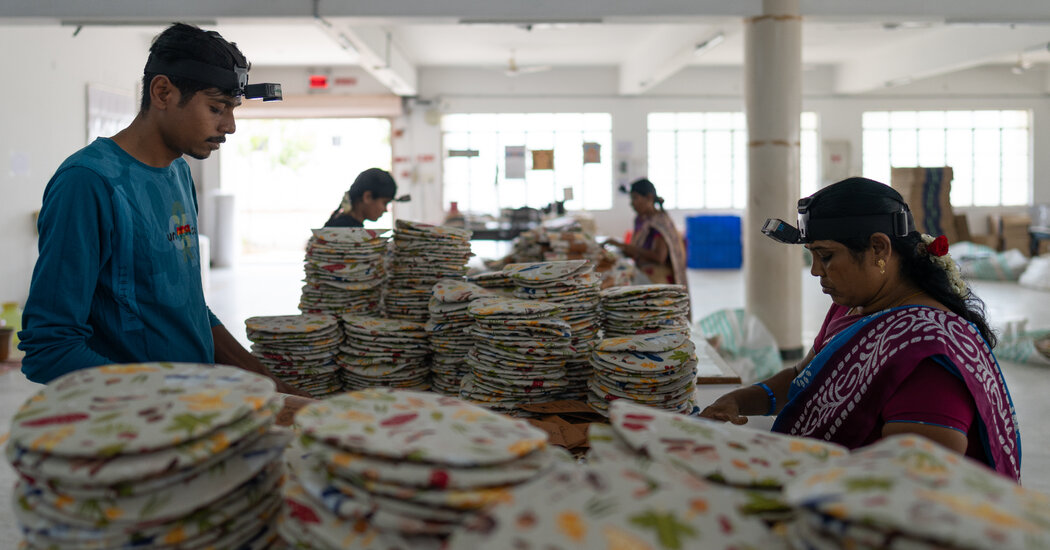
At Objectways’ laboratories in Karur, which New York Times reporters visited in July, many employees dedicate their workdays to annotating data for a humanoid robot being developed to execute household chores. Other projects include annotating data for devices intended to assist visually impaired individuals by describing their surroundings.
During a recent morning, a worker in a test kitchen operated robotic pincers equipped with cameras. The purpose was to record and subsequently analyze video footage of these pincers performing various household tasks, such as picking up plates, unscrewing a water bottle cap and pouring its contents into a cup, and arranging food. Employees replicated these tasks in Objectways’ dedicated test bathroom and bedroom facilities.
Ravi Rajalingam, the founder and chief executive of Objectways, explained the core principle: “We are giving the robot the data and saying ‘learn from this.'” Rajalingam developed an interest in the field after collaborating with a lending company to streamline its application process using AI. He established Objectways in his hometown of Karur in 2019, recognizing an opportunity to employ recent graduates. His wife played a key role in recruiting the initial 20 employees.
“India is the back office for the world, no longer,” Mr. Rajalingam asserted. While acknowledging that many of his company’s positions do not necessitate engineering degrees, he emphasized, “It is technical, and they can learn about models of A.I.” He also noted that many employees advance within the company.
Mohamed Afsar, 29, is an example of such progression; he has been promoted and now oversees 600 employees engaged in projects at the company’s offices in Coimbatore, a larger city situated about two and a half hours west of Karur. Mr. Afsar commented, “It’s an immense process and we need a huge work force.”
Mr. Afsar, who grew up nearby and was the first in his family to attend college, highlighted the scale of operations. He stated that 200 people can process 70 hours of video daily, originating from sources such as robots performing tasks or self-driving cars. This output, however, still falls short of the demand to analyze the 1,000 hours of video data received daily from the company’s clients.
Analysts project that data annotation could contribute up to $10 billion to India’s economy by the end of the current decade. Nevertheless, its current scale is considered insufficient by some economists and policymakers to provide India with a significant competitive advantage in the broader global AI race.
Several major Asian economies were slow to invest in AI, with India notably described as a “laggard” in a Morgan Stanley report. India’s first substantial AI development initiative, a $1.25 billion, five-year plan, was not announced by the government until 2024. This late start meant India had less buffer to absorb the technology jobs displaced or rendered obsolete by AI advancements.
Despite these larger economic considerations, new hires at Objectways appear content with their current roles, recognizing their vital human contribution to a fundamental aspect of AI development. Hari Prasad, 25, an engineering graduate from last year, acknowledged that he had not envisioned his career would involve tasks akin to science fiction.
Mr. Prasad reflected, “If someone had told me that 10 years down the road a robot would be bringing you coffee, I wouldn’t have believed them.” His current job, however, is directly involved in making such advancements a reality. With a smile, he concluded, “We need a man to train the robot.”
Why This Matters
The rise of data annotation in India highlights a critical, often overlooked, aspect of the global artificial intelligence boom: the indispensable role of human labor. While AI promises widespread automation, its development inherently relies on vast amounts of meticulously labeled and refined data, a task currently best performed by humans. This phenomenon has profound implications for global employment, economic development, and the future of work.
For nations like India, with large and growing youth populations facing significant job shortages, data annotation provides an immediate source of entry-level employment and an avenue for integrating into the high-tech economy. It represents a new wave of “back-office” services, distinct from traditional IT roles, that can absorb a segment of the educated workforce. This mitigates some of the immediate pressures of job displacement caused by AI’s automation of other sectors. However, it also raises questions about the long-term sustainability and value of such roles, as governments like India’s aim for higher-value contributions in the AI ecosystem.
Globally, the reliance on human annotators underscores that AI’s capabilities are not entirely autonomous; they are shaped and improved by human intelligence and oversight. The need for diverse data, particularly from varied cultural and linguistic backgrounds, positions countries like India as crucial players in developing truly robust and unbiased AI systems. As AI applications expand into physical devices like humanoid robots and assistive technologies, the demand for human training data will likely continue to grow, making these human-led processes central to the practical implementation of future AI innovations. Understanding this human-AI partnership is essential for comprehending the true nature of technological progress and its societal impact.