
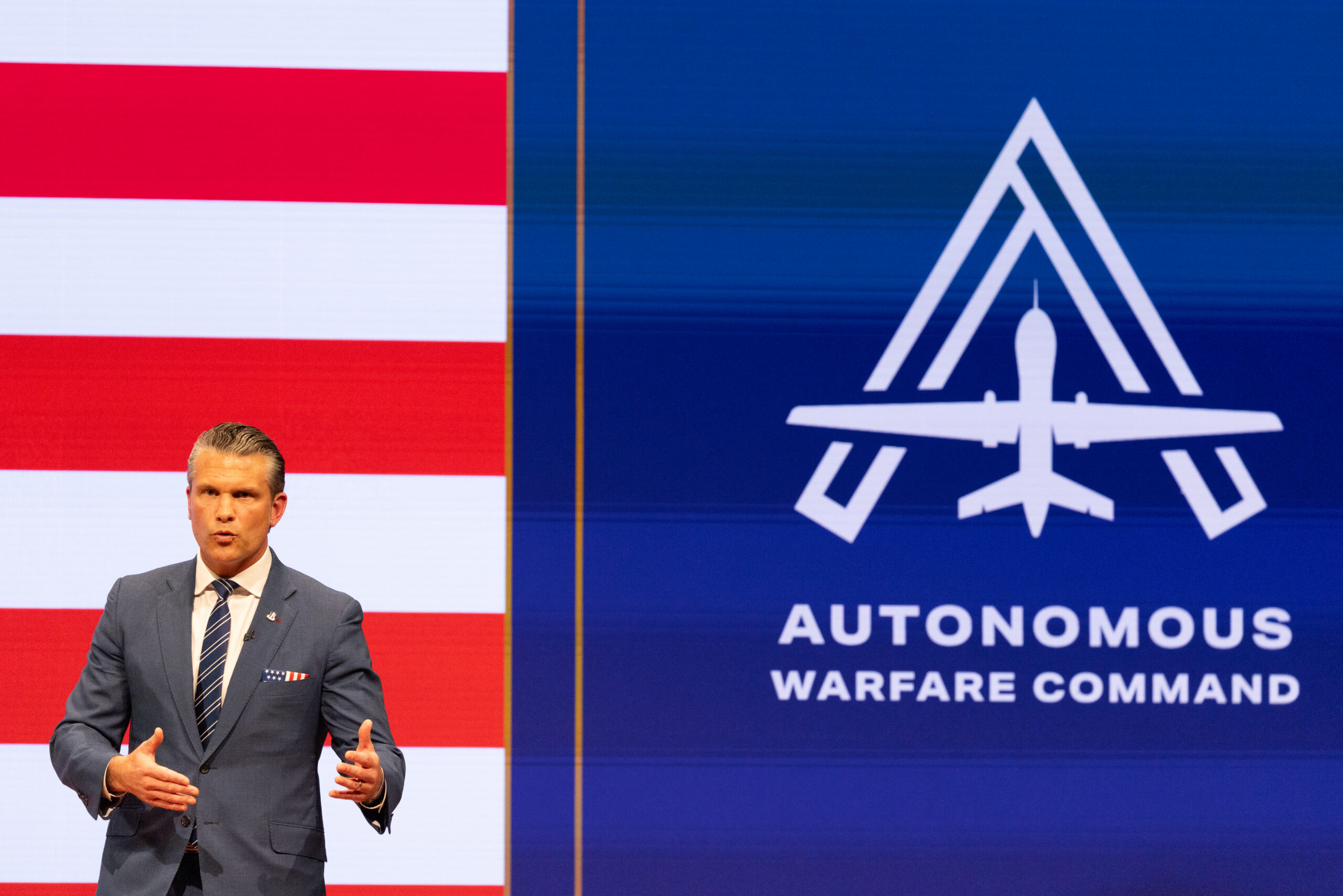
MARINE CORPS BASE QUANTICO, Va.—Secretary of Defense Pete Hegseth announced the establishment of a new four-star command dedicated to advancing autonomous military systems, signaling a significant focus on artificial intelligence and drone warfare within the Pentagon. The announcement was part of what Secretary Hegseth stated would become an annual “State of the Force” address, during which he unveiled five additional initiatives on Sept. 30.
Within the next year, Secretary Hegseth plans to launch the Autonomous Warfare Command (AWC). This new combatant command will be granted “service-like authorities” to facilitate the widespread integration of autonomous and robotic capabilities across all branches of the U.S. military. Its mandate will encompass the development and deployment of drones, artificial intelligence, and related command and control systems.
Another key initiative detailed by Hegseth involves the creation of a new program office, to be led by a two-star officer. This office will be responsible for ensuring military installations can generate their own power, enabling them to operate independently during potential disruptions to public utility grids. This measure reflects a growing concern that domestic military bases could become targets in an era characterized by sophisticated cyberattacks and hybrid warfare tactics from adversaries.
Secretary Hegseth also confirmed plans to reduce the total number of generals and admirals across the armed forces by 20 percent. This reduction had been previously reported by various media outlets in anticipation of his speech.
Other initiatives announced include:
- A new advisory group, named “Project Meridian,” tasked with studying the future of warfare. This group will include notable technology leaders Palmer Luckey and Elon Musk, alongside former Speaker of the House Newt Gingrich, all of whom were present at the event.
- An initiative called the “Next Great American Base,” which aims to construct a new military installation designed to host between 15,000 and 25,000 service members. Governors and adjutant generals from every state are expected to be invited to the Pentagon to propose potential locations.
- The establishment of five new corps of cadets at Hillsdale College, Louisiana State University, Liberty University, Mississippi State University, and Tuskegee University. Graduates from these programs will receive priority for officer commissioning.
- A new “Office of Religious Affairs” that will report directly to the Secretary of Defense, intended to improve chaplains’ access to senior military leadership.
The address marked one year since Secretary Hegseth convened senior officers and enlisted personnel from around the globe at Quantico to outline his vision for the military. This year’s audience consisted of approximately 600 E-6 enlisted members and O-3 officers, identified by their units for their performance and leadership potential. Chairman of the Joint Chiefs of Staff, Air Force Gen. Dan Caine, offered brief remarks and introduced Secretary Hegseth.
Emphasis on Autonomy
The new Autonomous Warfare Command is designed to be the primary driver for the conception, development, and deployment of autonomous and semi-autonomous military capabilities and systems.
“The autonomous and robotic revolution has enormous implications for equipment, doctrine, organization, and the assumptions that have governed warfare for decades,” Hegseth stated. He added that while “civilian leaders can provide direction and urgency, lasting change must be anchored in military command structures and operationalized by leaders across our joint force.”
The Pentagon is already increasing its investment in autonomous technologies, and the AWC is intended to significantly accelerate these efforts. The concept of such a combatant command has received attention in Congress, with lawmakers in the Senate proposing its creation during deliberations for the 2027 defense policy bill. While the measure cleared the relevant committee, the bill is still pending, requiring House approval for authorization.
Specific details regarding the AWC’s structure, leadership, or its coordination with existing autonomy initiatives within individual military services have not yet been fully clarified. In a memo, Secretary Hegseth indicated that the Pentagon plans to collaborate with Congress to establish the command by October 1, 2027.
As an interim measure, Hegseth announced “Project Agincourt,” named after the 1415 battle. This project will leverage existing efforts such as the Defense Innovation Unit (DIU) and the Drone Dominance program. Project Agincourt aims to “pair operators with entrepreneurs in rapid adaptation cycles while distributing decisions and dollars closer to frontline units.” It will be guided by DIU director Owen West and Navy SEAL Senior Chief Max Strasiser, the first enlisted SEAL to graduate from Navy Test Pilot School. Hegseth noted that the full establishment of the Autonomous Warfare Command would occur “over the course of several months.”
Both the Air Force and Navy are actively developing Collaborative Combat Aircraft (CCAs), which are semi-autonomous drones designed to operate alongside crewed fighter jets. The Air Force is also pursuing a lower-cost intelligence, surveillance, and reconnaissance (ISR) drone with autonomous capabilities under its Massed Modular Aircraft program, and the Navy is working on fielding the MQ-25, an unmanned tanker drone.
Secretary Hegseth characterized the growth of autonomy and the Pentagon’s future plans for technology integration as the “fastest peacetime shift in modern military history.” He further elaborated, “Drone warfare supercharged by SI-enabled targeting is the biggest battlefield revolution in generations,” using “SI” as an acronym for “super intelligence,” a term favored by President Donald Trump for artificial intelligence.
Earlier this month, at AFA’s Air, Space & Cyber conference, Air Force leadership underscored the centrality of autonomous systems to the service’s future. Air Force Chief of Staff Gen. Ken Wilsbach informed Air & Space Forces Magazine that while truly autonomous aircraft are “a few years off,” the service is heavily incorporating autonomy into its current future Force Design model.
“The FQ-42 and the FQ-44 [Collaborative Combat Aircraft] are autonomous fighters, and then we’re going to have perhaps other platforms that are autonomous, where you don’t actually need a crew to do a fighter mission,” Wilsbach said during a session with reporters. “You just send the aircraft off, and it does its mission because it’s automated.”
The Pentagon has already deployed uncrewed surface vessels operationally for maritime surveillance in the Middle East for several years. This summer, a U.S. Navy drone boat was credited with rescuing two downed Army Apache pilots near the Strait of Hormuz. U.S. Southern Command, which has been conducting strikes on suspected drug smuggling boats for over a year, recently established an autonomous warfare branch that will utilize its own uncrewed vessels and aerial intelligence-gathering platforms. Assistant Secretary of Defense for Homeland Defense and Americas Security Affairs M. Roosevelt Ditlevson also confirmed in a recent interview that the U.S. military is currently using 10 uncrewed surface vessels to patrol the Rio Grande River on the southern border.
These developments underscore the military’s accelerating embrace of autonomous technologies across various domains.
Why This Matters
Secretary Hegseth’s “State of the Force” address and the initiatives announced represent a significant reorientation of U.S. military strategy, resource allocation, and organizational structure. The creation of a dedicated four-star Autonomous Warfare Command signals a clear commitment at the highest levels of the Pentagon to integrate advanced artificial intelligence and robotic systems into all aspects of warfare. This move reflects a growing recognition that future conflicts will increasingly rely on unmanned systems, potentially reshaping traditional battlefield dynamics and doctrines. It also positions the U.S. to compete more effectively with near-peer adversaries like China and Russia, who are also heavily investing in these technologies.
The emphasis on military installation energy independence highlights a critical vulnerability in an age of cyber warfare and potential hybrid attacks. Ensuring bases can operate autonomously without relying on civilian grids enhances national security and operational resilience, allowing forces to project power and maintain readiness even under direct threat at home. This shift will likely drive significant infrastructure investment and technological innovation in base management.
The proposed 20 percent reduction in generals and admirals could have profound implications for military leadership, career progression, and potentially the efficiency of the command structure. While often framed as a move to streamline bureaucracy, such a reduction could also spark debate over the balance of power and influence within the military hierarchy.
“Project Meridian,” with its inclusion of prominent tech and political figures, indicates an effort to bring outside expertise and fresh perspectives to military planning, potentially bridging the gap between Silicon Valley innovation and traditional defense procurement. Similarly, the “Next Great American Base” project signifies a long-term investment in military infrastructure, which could stimulate local economies and redefine strategic basing options for the future. The establishment of new cadet corps at specific universities, particularly with priority commissioning, suggests an effort to diversify and potentially influence the ideological leanings of the officer corps, raising questions about military-academic partnerships and the values prioritized in leadership development.
Finally, the creation of an “Office of Religious Affairs” indicates a desire to ensure chaplains have direct access to senior leadership, potentially elevating the role of religious counsel and support within the military. Overall, these announcements collectively demonstrate a comprehensive effort by the Department of Defense to modernize, streamline, and adapt the U.S. military for an evolving global security landscape marked by rapid technological change and complex geopolitical challenges.
WASHINGTON, D.C. – September 30, 2026– During his “State of the Force” address at Marine Corps Base Quantico, Defense Secretary Pete Hegseth outlined the Pentagon’s ambitious dual strategy to revolutionize U.S. military capabilities. He detailed a significant expansion into artificial intelligence (AI) and autonomous systems for operational effectiveness, alongside a critical initiative named “Fortress America” aimed at achieving energy independence for military installations across the nation.
Secretary Hegseth’s remarks underscored a future where advanced technology underpins both battlefield superiority and strategic resilience, reflecting a strategic pivot in response to evolving global threats and the rapid pace of technological innovation.
The Integration of AI and Autonomous Systems
A central theme of the address was the accelerated integration of AI and autonomy into virtually every aspect of military operations. Speaking on these advancements, an official identified as Ditlevson elaborated on the deployment of “next-generation tools” designed to enhance the military’s capacity to counter various threats, specifically mentioning efforts against “narcoterrorists,” a term used to refer to drug smugglers.
“We are moving into next-generation tools here that we’re going to employ to make sure that we hold these narcoterrorists at bay,” Ditlevson stated. He further expressed anticipation regarding advancements in the “autonomy space” and the strategic employment of diverse autonomous systems across various operational domains, indicating a broad shift towards automated capabilities.
The Pentagon’s commitment to automation extends beyond traditional platforms such as aircraft, ships, and ground vehicles. A core component of this technological shift is the Maven Smart System, which has become a key tool for the U.S. military. Maven functions as an integrated platform, consolidating data from multiple sensors, intelligence gathering, surveillance, and reconnaissance (ISR) assets, and command and control (C2) functionalities. This aggregation of information is designed to streamline and enhance the targeting process.
The applications of Maven are diverse and geographically widespread. The system currently provides targeting assistance for operations in the Middle East and has been deployed more recently to bolster counter-drone and anti-smuggling efforts along the southern border of the United States. Its capability to synthesize vast amounts of data allows for quicker and more informed decision-making in complex operational environments.
Further underscoring its strategic importance, Ditlevson indicated that AI, facilitated through the Maven system, is slated to play a critical role in the Pentagon’s comprehensive Golden Dome missile defense shield. “Maven Smart System is going to feed into the Golden Dome picture,” he affirmed, suggesting its potential to enhance situational awareness, threat identification, and interception capabilities within the advanced missile defense architecture.
At the U.S. southern border, the Department of Defense is also leveraging specialized autonomy software known as Fortress. This system is an adaptation of Anduril’s Lattice platform, designed to integrate disparate data streams and sensor inputs using advanced AI algorithms. The interoperability of these systems is a stated priority for the Pentagon. “All of our systems must be compatible with Maven Smart System,” Ditlevson emphasized. “Everything that we have, that data needs to be integrated into Maven and into Lattice,” he added, underscoring the objective of creating a unified and cohesive digital operational picture for military decision-makers.
To support this extensive integration of autonomous systems and AI, Secretary Hegseth announced that each military service will progressively introduce new military occupational specialties (MOS) specifically dedicated to autonomy. This institutional change aims to cultivate the necessary expertise within the armed forces for a future dominated by advanced technology. “We need institutional knowledge and career paths for a new generation of autonomous warfighters,” Hegseth stated, highlighting the demand for personnel skilled in operating, maintaining, and developing these advanced systems.
Fortress America: Securing Energy Independence for Military Bases
Beyond technological combat enhancements, Secretary Hegseth also unveiled “Fortress America,” a new initiative designed to ensure energy resilience and independence for military installations. The core objective of this program is to empower military bases to generate their own power, thereby reducing their reliance on external, often commercially operated, civilian power grids.
The Pentagon has been actively pursuing the development and deployment of nuclear microreactors at key U.S. bases within the homeland. The department has previously articulated plans to field at least one such nuclear reactor at a military base by September 2028, marking a significant step towards localized, self-sufficient energy production.
Specific efforts include the Air Force’s work on a microreactor at Eielson Air Force Base in Alaska, with intentions to expand this deployment to additional bases in the coming years. In parallel, the service has explored a diversified approach to energy generation, investigating alternative power sources such as solar panels and geothermal plants. These varied technologies are intended to establish localized “microgrids” for bases, ensuring they are not entirely dependent on regional civilian power infrastructure.
The impetus behind providing bases with their own energy sources stems from critical national security concerns. A primary driver is the vulnerability of critical national infrastructure, approximately 80 percent of which is currently managed by the commercial sector, to potential attacks from adversaries. Such attacks, whether through cyber means, sabotage, or other methods, could severely impede the military’s capacity to generate and deploy forces.
Secretary Hegseth underscored the strategic imperative of this initiative, referring to Fortress America as the “nation’s insurance policy” in a memo that formalized the program’s establishment. The memo explicitly addresses the risk of an adversary compromising the power grid, stating, “If an adversary takes down the grid by cyber attack, by sabotage, or by any means, our bases will remain operational.” This declaration highlights the program’s role in safeguarding military readiness against sophisticated threats to national infrastructure and ensuring continuity of operations.






Why This Matters
The initiatives unveiled by Defense Secretary Hegseth represent a significant inflection point for U.S. national security and military strategy. The extensive push into artificial intelligence and autonomous systems signals a fundamental transformation in how military operations will be conducted, from intelligence gathering and targeting to missile defense and border security. This shift is intended to enhance operational efficiency, reduce response times, and potentially mitigate risks to human personnel in certain scenarios. However, it also ushers in a new era of complex ethical, legal, and operational considerations surrounding human oversight, accountability, and the evolving nature of future warfare. The development of specialized military occupational specialties underscores the profound impact these technologies will have on the military’s workforce, requiring new skill sets and career paths.
Simultaneously, the “Fortress America” program addresses a critical vulnerability in national defense: the reliance of military installations on civilian power grids. By pursuing energy independence through microreactors and diversified microgrids, the Pentagon seeks to harden its bases against sophisticated cyberattacks, acts of sabotage, and natural disasters that could cripple conventional power infrastructure. This strategic move is vital for maintaining continuous military readiness and the ability to project power, even in the face of widespread disruption to national critical infrastructure. The program reflects a growing recognition of the interconnectedness between civilian infrastructure resilience and military operational capabilities, positioning energy security as a cornerstone of national defense in the 21st century. These twin strategies collectively aim to ensure the U.S. military remains technologically superior and operationally robust in an increasingly complex and contested global environment.
Pentagon Announces Major Military Reforms: Budget Pivot and Senior Officer Cuts
Washington D.C. – A senior defense official, identified as Hegseth, outlined a series of significant policy shifts during an address to service members at the Pentagon, signaling a strategic realignment of military priorities and a restructuring of its leadership. The directives focus on reallocating defense funds towards core warfighting capabilities and implementing further reductions in the number of general and flag officers across the U.S. armed forces.
During his remarks, Hegseth emphasized a dramatic redirection of financial resources, asserting that funds previously allocated to what he termed “woke initiatives” would now be channeled into enhancing the military’s operational readiness and combat effectiveness. He specifically cited programs related to “diversity, equity, and inclusion (DEI),” “climate change initiatives,” and “gender transition surgeries” as areas from which funding would be diverted. According to Hegseth, this pivot is essential to ensure that the military’s primary mission remains uncompromised, stating the objective as: “stay lit, our aircraft keep flying, our command centers never go dark.” This statement underscores a perceived need to bolster fundamental defense functions and readiness, potentially indicating concerns about resource drain or mission creep in non-core areas.
The reallocation of funds from social programs to warfighting capabilities represents a notable shift in defense spending philosophy. Proponents of such a move argue that it streamlines military focus and ensures resources are directly tied to national security objectives. Critics, however, often contend that programs like DEI foster a more inclusive and effective fighting force by leveraging diverse talents, while climate change initiatives can be vital for long-term strategic planning and infrastructure resilience. Gender transition surgeries, while a minor portion of the overall defense budget, have been a point of political contention, with some arguing for healthcare parity for all service members and others viewing it as a non-essential expenditure.
In addition to the budgetary adjustments, Hegseth announced a substantial reduction in the senior leadership ranks, ordering a 20 percent cut in the number of general and flag officers. This directive builds upon a previous 10 percent reduction implemented last year, a policy he had then characterized as “less generals, more GIs.” The latest cut effectively doubles down on this strategy, aiming to streamline the command structure and potentially reallocate resources from higher-level administrative positions to front-line personnel and combat assets.
Confirming the scope of the reduction, Hegseth stated, “The number-crunchers say we fired 10 percent of the generals and admirals across the force, and that number sounds about right. And I know because I directed it that we’ve also reduced the overall number of general officer slots by an additional 10 percent. So yes, 20 percent reduction across the board.” This suggests a cumulative impact that would significantly alter the top echelons of military leadership.
While seemingly large in percentage terms, general and flag officers constitute a very small fraction of the overall military force, typically less than 1 percent. Data from the Congressional Research Service indicated approximately 850 general officer positions existed in 2023, though some of these billets were unfilled at the time, a situation that often fluctuates. The maximum number of general officers permitted per service is generally defined by law, although these statutory caps do not extend to joint positions, which are roles spanning multiple service branches or inter-agency commands. Conversely, the law also mandates a minimum number of general officers to fill these critical joint assignments.
Specific service branches vary in their general officer complement. For instance, the Air Force currently maintains roughly 250 generals, while the nascent Space Force, a relatively new branch, has approximately 30 generals but has articulated plans for continued growth in its leadership numbers as it expands its operational scope and responsibilities. The implications of these cuts could include a flatter command structure, accelerated career progression for some officers, or, conversely, a heavier workload on remaining senior leaders.
The atmosphere at this year’s address marked a notable departure from previous engagements. A year prior, senior military leaders had largely maintained stoic reactions during politically charged speeches from Hegseth and former President Trump, adhering to the military’s long-standing tradition of apolitical conduct. This year, however, the assembled troops offered a more vocal reception to Hegseth, particularly during his references to figures such as Elon Musk, Palmer Luckey, and Newt Gingrich – individuals often associated with technological innovation, conservative political thought, or defense policy discourse. Hegseth concluded his address to applause from the service members. Nevertheless, observers noted that while there was applause, service members appeared to consciously avoid overt visual reactions to Hegseth’s more overtly ideological comments, suggesting a careful navigation of the line between support for their leadership and adherence to military neutrality.
Attendees at the event were organized by branch of service and were provided with a “War Department Field Manual,” a collection of Hegseth’s speeches that included a foreword penned by former President Trump. Earlier in the day, the same service members had participated in a physical training session alongside Hegseth on the grounds of the Pentagon, an activity that likely aimed to foster camaraderie and a sense of shared purpose between leadership and the ranks.
Why This Matters
The policy announcements by Hegseth represent a significant inflection point for the U.S. military, with potential ramifications across multiple domains:
Strategic Reorientation and Readiness:The pivot in budget allocation from social programs to “warfighting capabilities” signals a clear intent to prioritize combat readiness and core defense functions. This reorientation could lead to increased investment in new technologies, training, and equipment, potentially enhancing the military’s capacity to confront traditional threats. However, it also raises questions about the long-term impact on aspects like diversity within the ranks, which some argue are crucial for innovation and effectiveness in a globalized world, and the military’s role in broader societal issues like climate change adaptation.
Military Leadership and Efficiency:The cumulative 20 percent reduction in general and flag officers aims to create a leaner, more agile command structure. While this could lead to greater efficiency and faster decision-making, it also poses challenges. A smaller pool of senior leaders might mean increased workloads for those remaining, potentially impacting their ability to mentor junior officers, engage in strategic planning, or maintain expertise across diverse portfolios. It could also affect career progression paths for aspiring officers, intensifying competition for fewer top-tier positions.
Civil-Military Relations and Morale:The nuanced reaction of the troops – vocal applause for specific references combined with a perceived avoidance of overt reactions to ideological comments – highlights the delicate balance between military professionalism and political engagement. Maintaining an apolitical military is a cornerstone of democratic governance, ensuring the armed forces serve the nation rather than a particular political ideology. The distribution of a “War Department Field Manual” with a foreword by a former president, coupled with the nature of the speeches, could be interpreted as a move to align the military’s ethos with specific political viewpoints, potentially blurring the lines of this traditional separation and affecting troop morale or unit cohesion.
Global Implications:Changes in U.S. defense policy and leadership structure are closely watched by allies and adversaries alike. A more streamlined, warfighting-focused military could be perceived as a stronger deterrent or a more capable partner. Conversely, any perceived politicization of the military or internal discord could raise questions about its stability, cohesion, and long-term effectiveness on the global stage. These reforms will undoubtedly influence how the U.S. projects power, engages in international partnerships, and responds to emerging threats.