
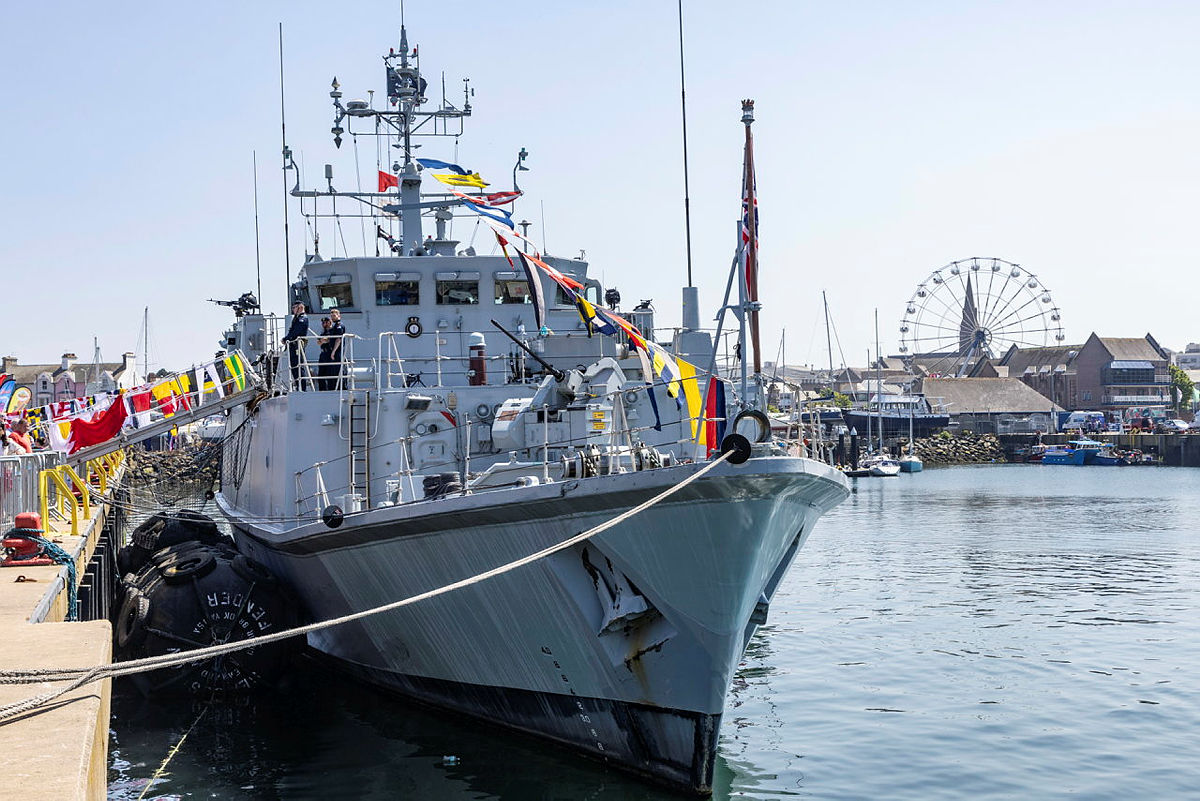
Royal Navy Minehunter HMS Bangor Returns to UK from Bahrain via Heavy Lift at Cost of £4.13 Million
The Royal Navy minehunter HMS Bangor has completed its long-term deployment in the Gulf, returning to the United Kingdom from Bahrain aboard a heavy lift transport vessel. The cost of this specific heavy lift contract was £4.13 million, according to information recently disclosed in the UK Parliament.
The precise date of the vessel’s arrival in the UK has been subject to slightly conflicting reports within the parliamentary exchange. An initial query referenced the ship’s return on “29 November last year,” while the official response from the Minister for Defence Readiness and Industry, Luke Pollard, stated that “HMS Bangor returned to the UK on 29 November 2025 via heavy lift.” This discrepancy in the year (between an implied 2023 and the stated 2025) suggests either a forward-looking statement, a clerical error in the parliamentary record, or a future planned return, though the context of “last year” points to a past event.
The information came to light following a question posed by Ben Obese-Jecty, the Conservative Member of Parliament for Huntingdon. Mr. Obese-Jecty specifically inquired about the date of the return and the cost of what he referred to as a “replacement heavy lift contract,” building on a previous parliamentary answer from September 8.
Minister Pollard’s response was direct: “HMS Bangor returned to the UK on 29 November 2025 via heavy lift. The cost of the heavy lift contract to bring her back to the UK was £4.13 million.” Notably, the Minister’s statement did not address the implication of a “replacement” contract or offer any explanation as to why an original heavy lift arrangement might have been superseded or fallen through.
The Practice of Heavy Lift Transport
The term “heavy lift” in this context refers to the practice of transporting a ship aboard a larger, semi-submersible transport vessel, rather than having the ship sail under its own power. This method is a standard operational procedure for the Royal Navy, particularly for its mine countermeasures vessels (MCMVs) when undertaking long-distance transits. These specialized ships are designed for specific tasks in potentially hazardous environments, emphasizing maneuverability and stealth over long-range independent sailing capabilities. Transporting them via heavy lift reduces wear and tear on the vessel’s engines and hull, saves fuel, and minimizes transit time, allowing the ship to arrive at its destination ready for immediate deployment or decommissioning.
HMS Bangor and the Sandown Class
HMS Bangor is a Sandown-class single-role minehunter, part of a fleet specifically designed for mine detection and clearance operations. A defining characteristic of the Sandown class is their glass-reinforced plastic (GRP) hulls, which are non-magnetic. This design feature is critical for reducing their magnetic signature, enabling them to operate safely and effectively within active minefields without inadvertently triggering magnetic mines. These vessels typically displace around 600 tonnes and carry a crew of approximately forty personnel.
Their primary mission involves hunting mines using advanced sonar systems, deploying remotely operated vehicles (ROVs) for close-range inspection and neutralization, and utilizing clearance divers for manual removal or disposal of explosive ordnance. For many years, several vessels of the Sandown class, including HMS Bangor, were forward-deployed to Bahrain. This deployment was a vital component of the Royal Navy’s mine countermeasures force in the Arabian Gulf, a region crucial for global energy supply and international maritime trade.
Transition to Uncrewed Systems
The return of HMS Bangor and other Sandown-class vessels signals a significant strategic shift within the Royal Navy’s mine warfare capabilities. The entire Sandown class is progressively being decommissioned as the Royal Navy transitions towards a new generation of mine countermeasures, which will predominantly rely on uncrewed systems (UxS) operated from larger motherships. This modernization effort aims to enhance safety by removing personnel from direct danger, increase efficiency through automation, and potentially reduce operational costs in the long term. The new approach reflects a broader trend across leading navies globally to leverage autonomous technologies for tasks deemed too dangerous, dull, or dirty for human crews.
The cost of transporting HMS Bangor, while a substantial figure, represents a final logistical expenditure for an asset that has served its operational purpose in the Gulf and is now part of an ongoing fleet transformation. The parliamentary disclosure underscores the public scrutiny and accountability associated with defence spending and strategic decisions affecting the Royal Navy’s future capabilities and global presence.
Why This Matters
The return of HMS Bangor and the associated parliamentary disclosure carry significance across several dimensions, from national defence strategy to fiscal responsibility and international relations:
- Naval Modernization and Strategic Shift:The decommissioning of the Sandown class, exemplified by HMS Bangor’s return, marks a pivotal moment in the Royal Navy’s modernization efforts. It underscores a strategic pivot towards uncrewed maritime systems for mine countermeasures. This transition is not merely an upgrade but a fundamental change in how the Royal Navy plans to address mine warfare threats, prioritizing automation and remote operations to enhance safety, efficiency, and potentially reduce human risk. The success of this transition will be critical for maintaining the UK’s naval capabilities in an evolving threat landscape.
- Defence Spending and Accountability:The £4.13 million cost for a single heavy lift contract highlights the substantial financial outlays involved in managing naval assets, even for their return and eventual decommissioning. Public disclosure of such costs through parliamentary questions is crucial for transparency and democratic accountability, allowing taxpayers and their representatives to scrutinize how defence budgets are allocated and spent. The unanswered question regarding a “replacement” contract further emphasizes the need for clarity in defence procurement and logistical planning.
- UK’s Global Presence and Commitments:HMS Bangor’s long-term deployment in Bahrain was integral to the UK’s commitment to maritime security in the Arabian Gulf, a region vital for global trade and energy supplies. While the physical presence of a traditional minehunter is being withdrawn, the underlying commitment to freedom of navigation and counter-mine operations remains. The effectiveness of the new uncrewed systems in maintaining this commitment will be closely watched by international partners and regional stakeholders, impacting the perception of the UK’s enduring influence and capability in critical maritime chokepoints.
- Future of Naval Warfare and Technology:This event reflects a broader global trend in naval forces embracing autonomous and uncrewed systems. The Royal Navy’s move away from traditional minehunters provides a case study in the challenges and opportunities associated with integrating new technologies into established military structures. It signals a shift in defence industry priorities and potentially influences the development and adoption of similar technologies by other navies around the world. The transition will require significant investment in research, development, and training for the personnel who will operate and maintain these advanced systems.
- Personnel and Expertise:The phasing out of a class of ships like the Sandown minehunters also has implications for the highly specialized crews who have operated them for decades. Their skills and experience in mine warfare will need to be retained and adapted for the new technological platforms, ensuring continuity of expertise as the Royal Navy navigates this significant change.