
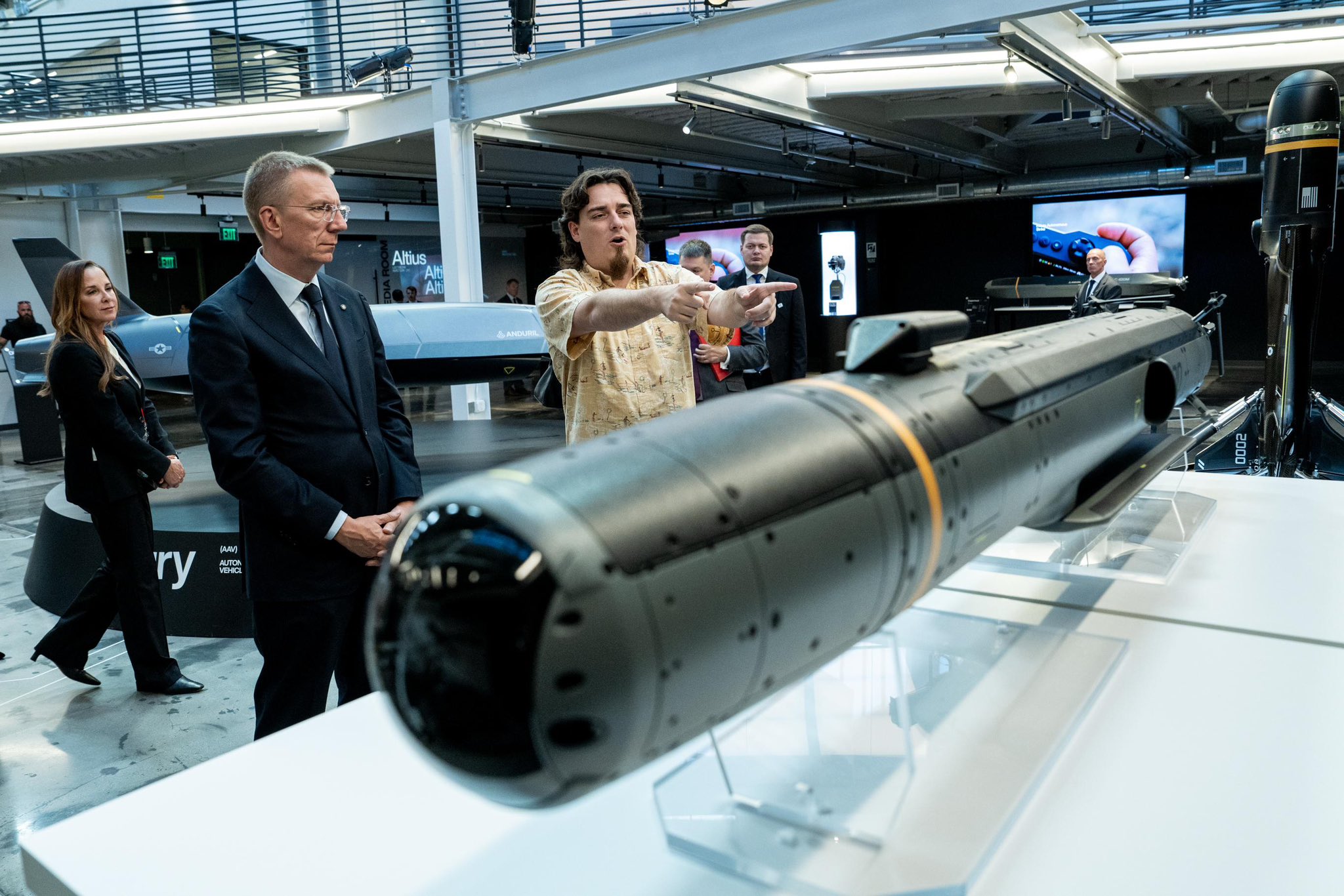
RIGA, Latvia– Latvia is advancing plans to acquire the Barracuda family of long-range cruise missiles from American defense technology company Anduril Industries, a move that would position it as the first Baltic state to field a strike weapon of such significant reach. This development follows a visit by Latvian President Edgars Rinkēvičs to Anduril’s facilities in California on September 25, 2023, as confirmed by the president in a post published after his visit.
In a message posted on X, formerly known as Twitter, President Rinkēvičs stated:“It was great to visit Anduril to meet with Palmer Luckey and to witness signing of memoranda of cooperation with MOD of Latvia and Origin Robotics. Looking forward to complete acquisition of Barracuda long-range missiles and Latvian-US defense industry cooperation.”The statement underscores a growing strategic partnership between Latvia and the United States in the defense sector.
As of this report, specific details regarding the intended Barracuda variant, the quantity of missiles Latvia seeks to procure, the estimated cost, or a projected delivery timeline have not been publicly disclosed by either Latvia or Anduril Industries. Such information is frequently withheld in the initial stages of major defense procurement agreements due to national security considerations, ongoing negotiations, and commercial sensitivities.
The Barracuda-500M, identified as the long-range member within the missile family, boasts an impressive operational range exceeding 500 nautical miles, equivalent to approximately 926 kilometers. This range represents a substantial increase – roughly three times the reach – compared to the ATACMS (Army Tactical Missile System) rounds that Latvia has previously ordered for its M142 High Mobility Artillery Rocket System (HIMARS) launchers. Given Latvia’s current military structure, which includes no fast jet combat aircraft and a limited helicopter fleet, a ground-launched configuration for the Barracuda missiles would be the most logical and operationally viable path for deployment.
Anduril Industries positions the Barracuda family as a strategic response to a perceived shortfall in the availability of affordable, rapidly producible, long-range precision weapons in the global defense market. The company asserts that its production methodology for the Barracuda requires half the conventional production time, utilizes 95 percent fewer specialized tools, and incorporates half the number of parts compared to similar weapon systems. These efficiencies are designed to enable faster scaling of production to meet urgent demand. Operationally, Barracuda variants are designed for autonomous function and collaborative engagement, capable of acting as decoys to confuse enemy defenses while simultaneously executing precision strikes. Their versatile design allows for deployment from a wide array of platforms, including fighter jets, helicopters, cargo aircraft, naval vessels, and ground-based launchers.
The acceleration of Barracuda production is already evident across both sides of the Atlantic. In May 2023, the U.S. Department of Defense (DoD) formalized a framework agreement for the procurement of at least 1,000 surface-launched Barracuda-500M missiles annually for the United States Army, with deliveries slated to commence in 2027. This significant commitment by the U.S. DoD serves as a strong validation of the Barracuda program and its perceived value. Furthermore, in July 2023, the Polish state-owned defense group PGZ entered into an agreement with Anduril to assemble and subsequently produce the Barracuda-500M variant at its Military Aviation Works No. 2 plant in Bydgoszcz. PGZ has indicated that this European production capability could potentially qualify the missile for purchase by other European Union member states under the bloc’s European Peace Facility (EPF) and other defense funding mechanisms, enhancing intra-European defense cooperation and supply chain resilience.
Beyond the long-range missile acquisition, President Rinkēvičs’ visit also saw the signing of a second memorandum of cooperation focused on counter-drone capabilities. Under this agreement, Origin Robotics, a Riga-based company, is tasked with integrating its BLAZE autonomous interceptor into Anduril’s Lattice command and control system. This integration aims to provide a sophisticated, multi-layered counter-uncrewed aircraft system (C-UAS) capability, enhancing the defensive posture of both Latvia and NATO’s eastern flank. BLAZE is described as a compact, briefcase-sized interceptor that utilizes both radar and camera guidance for target acquisition and engagement. Origin Robotics’ BEAK drone, another product of the Latvian company, is already reportedly in service with Ukrainian forces, demonstrating the firm’s practical experience in combat environments.
While Latvia’s Investment and Development Agency has indicated that a defense technology delegation currently in the United States is actively exploring opportunities for joint development, testing, manufacturing, system integration, and supply chain participation, it remains unconfirmed whether any Barracuda production, assembly, or other industrial work would be carried out within Latvia itself. Such industrial cooperation arrangements are often a significant component of major defense procurements, offering economic benefits through job creation, technology transfer, and contributing to a nation’s defense industrial base and self-sufficiency.
Why This Matters
The potential acquisition of Anduril’s Barracuda long-range cruise missiles by Latvia marks a significant shift in the defense capabilities of the Baltic states and has profound implications for regional security, NATO’s collective defense, and the broader landscape of modern warfare.
Enhanced Deterrence and Regional Security:For Latvia, a nation bordering Russia and Belarus, the Barracuda-500M represents a substantial upgrade in its ability to project power and deter potential aggression. With a range exceeding 900 kilometers, Latvia would gain the capacity to strike targets deep within adversary territory, significantly altering the strategic calculus for any potential aggressor. This long-range strike capability, especially from a ground-launched platform, fills a critical gap in the Baltic states’ defense arsenals, which have traditionally focused on territorial defense and air policing. It transforms Latvia from a purely defensive actor into one with a credible offensive deterrent, bolstering the overall security posture of NATO’s eastern flank.
Strengthening NATO’s Eastern Flank:As a frontline NATO member, Latvia’s enhanced capabilities contribute directly to the alliance’s collective defense. The Barracuda system would increase the depth and resilience of NATO’s defensive layers in a strategically vital region. It signals a proactive approach by member states to invest in advanced weaponry that aligns with NATO’s deterrence strategy, particularly in an era of heightened geopolitical tensions following Russia’s full-scale invasion of Ukraine. This investment can also encourage other NATO members, particularly those in Eastern Europe, to similarly upgrade their long-range strike capabilities.
Adoption of Cutting-Edge Defense Technology:Anduril Industries is known for its disruptive approach to defense manufacturing, leveraging commercial innovation, artificial intelligence, and software-first development. Latvia’s decision to procure Barracuda reflects a willingness to embrace these cutting-edge technologies, moving beyond traditional defense contractors. The missile’s autonomous and collaborative capabilities, including its use as a decoy and its ability to operate in networked swarms, represent a leap forward in military doctrine and underscore the evolving nature of warfare. This adoption positions Latvia at the forefront of military modernization.
Defense Industrial Base and Transatlantic Cooperation:The parallel U.S. DoD and Polish PGZ agreements highlight a broader trend towards scaling up production of critical munitions and fostering transatlantic defense industrial cooperation. For Latvia, participating in such a procurement strengthens its ties with the U.S. defense industry and could potentially open doors for future industrial collaboration, as hinted by the Investment and Development Agency. The European production aspect, particularly in Poland, offers benefits for supply chain security and reduces reliance on single-source suppliers, which is crucial for sustained readiness.
Response to Evolving Threats (Counter-UAS):The accompanying memorandum on counter-drone technology with Origin Robotics and Anduril’s Lattice C2 system underscores a pragmatic response to the lessons learned from recent conflicts, particularly in Ukraine, where uncrewed aircraft systems (UAS) have played a pivotal role. Developing a layered C-UAS capability is essential for protecting critical infrastructure, military assets, and personnel from the pervasive threat of drones. This demonstrates a comprehensive approach to modern defense, addressing both long-range strike and emergent tactical threats.
In essence, Latvia’s pursuit of the Barracuda missile system is not merely an arms purchase; it is a strategic investment that significantly alters its defense posture, contributes to regional stability, embraces future warfare technologies, and reinforces its commitment to strong transatlantic security alliances.