
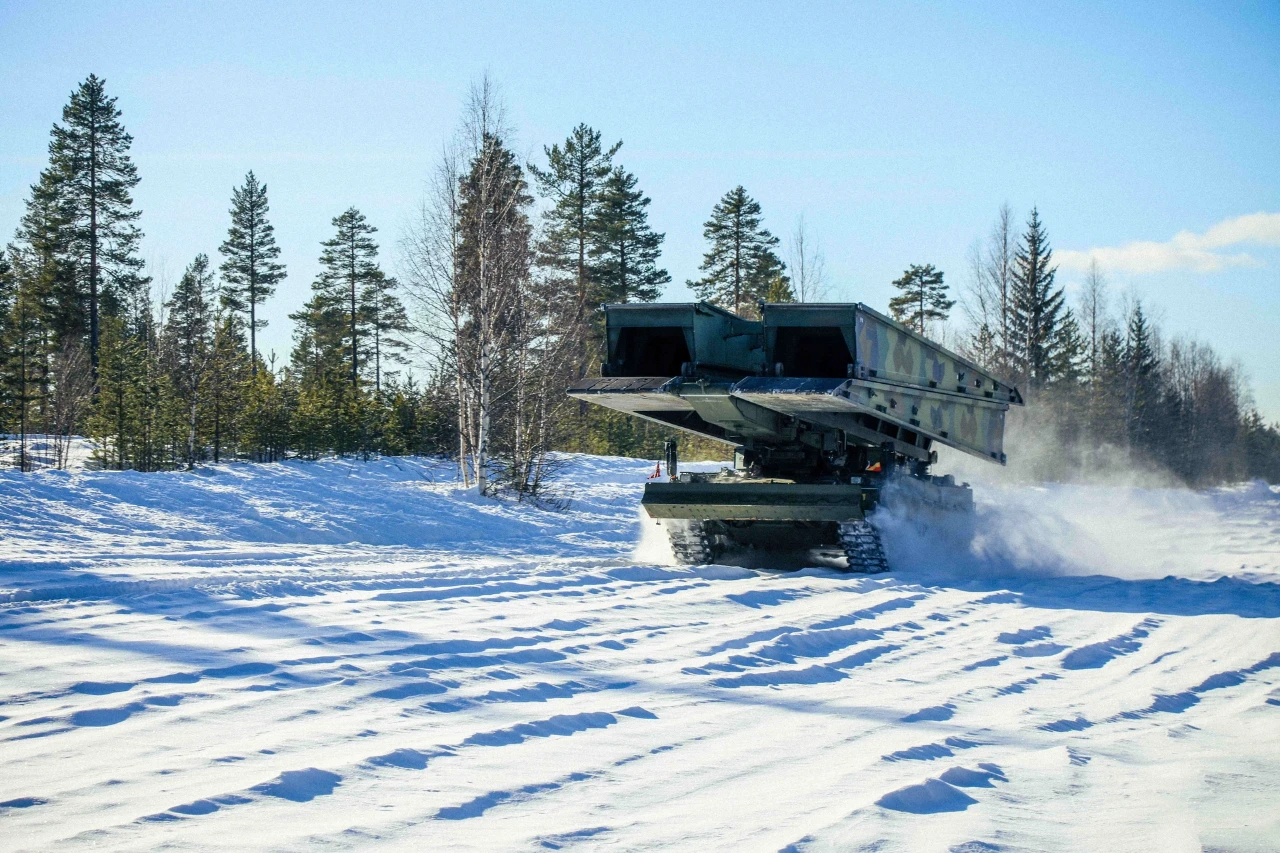
Under a deal valued at around EUR 210 million, Lithuania has tasked KNDS Deutschland with supplying a dozen LEGUAN bridge-laying systems, which are built upon the Leopard 2 chassis.
KNDS disclosed that this accord is set to equip the Lithuanian military with a robust armored bridge-laying capacity. This capability is engineered to aid operational maneuvers by swiftly allowing main battle tanks and armored personnel carriers to traverse impediments such as waterways, anti-tank trenches, and compromised structures.
The manufacturer stated that every one of the dozen units will come equipped with two LEGUAN spans measuring 14 meters and a single LEGUAN span of 26 meters. This provision offers the Lithuanian armed forces versatility, contingent upon the topography and operational demands.
KNDS further mentioned that the agreement encompasses a comprehensive Integrated Logistics Support (ILS) bundle, designed to uphold mission preparedness. This package will include instruction, proprietary equipment, and replacement components. The firm added that this bundle aims to guarantee the entire contingent can be efficiently maintained throughout its operational lifespan.
The LEGUAN Leopard 2 bridge-laying system is engineered to offer the agility and resilience akin to a Leopard 2 main battle tank, simultaneously ensuring significant logistical synergy with current Leopard 2 formations. KNDS asserted that the spans fulfill the criteria for an MLC 80 load rating, thus enabling them to facilitate the transit of contemporary heavy armored vehicles.
KNDS further noted that the bridge can be deployed and recovered autonomously from inside the fortified compartment, permitting personnel to conduct operations without exiting the unit, around the clock. This apparatus is designed to facilitate swift-paced missions, allowing armored contingents to sustain their impetus instead of being impeded by topographical barriers.
The firm additionally highlighted that the LEGUAN bridge-laying apparatus is currently operational with or on order for 22 militaries globally, having been incorporated onto diverse tracked and wheeled chassis.
KNDS characterized the Lithuanian procurement as aligning with a wider inclination among European militaries funneling resources into military engineering assets to enhance their agility and robustness. This trend is particularly notable given NATO’s reinvigorated emphasis on dissuasion and swift reinforcement along its eastern border.