
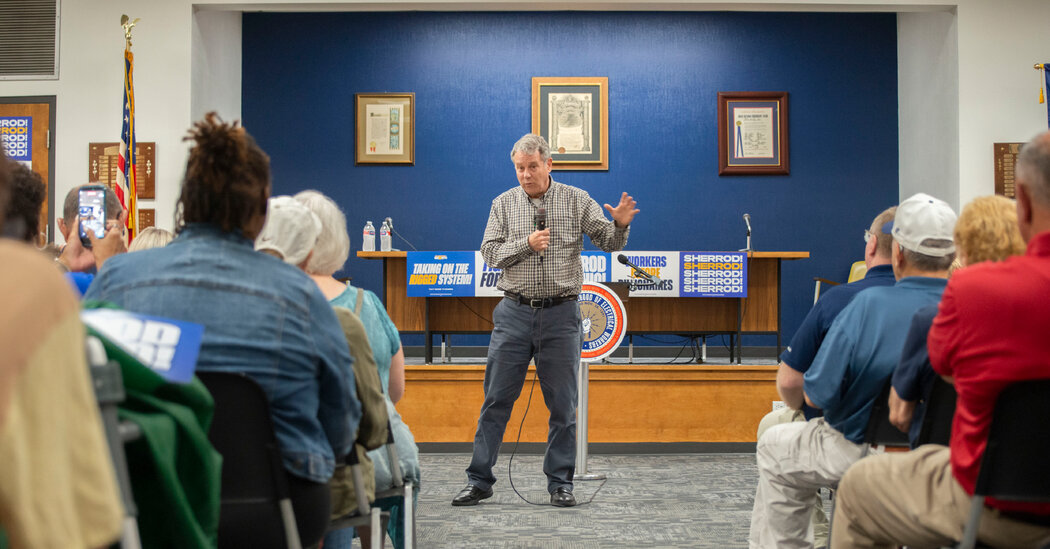
In New Philadelphia, Ohio, Senator Sherrod Brown recently addressed approximately 100 individuals gathered at a local coffee shop, the Daily Grind, to discuss his legislative activities. During the event, Senator Brown highlighted his involvement in co-authoring the bipartisan Social Security Fairness Act, asking the attendees, “How many of you benefit from the Social Security Fairness Act?”
Upon his question, several audience members raised their hands. Becky Bender, a retired teacher, voiced her appreciation, stating, “Thank you!” Senator Brown then responded, “Well, the best way to say thank you is to get all your friends to vote for me. It’s going to be a really important year.”
Senator Brown’s current campaign carries considerable weight for the Democratic Party. He is recognized as a key figure among Democrats seeking office in the upcoming election cycle.
Senator Brown is endeavoring to regain a seat in the U.S. Senate, a position he held for three terms before his defeat in 2024. His previous loss occurred amid evolving partisan preferences in Ohio and significant financial expenditures from the cryptocurrency industry, which targeted his re-election campaign.
For the current election cycle, Senator Brown’s campaign anticipates a more advantageous political climate. His defeat two years prior coincided with former President Trump’s presence on the ballot, which reportedly stimulated Republican voter turnout. In the present contest, with the former President’s public approval ratings being a factor, Senator Brown is campaigning against Senator Jon Husted. Senator Husted was appointed to the Senate to fill the vacancy created when JD Vance departed to assume the role of Vice President.
Democrats view securing this Ohio Senate seat as essential to their broader objective of acquiring control of the chamber.
Within the array of Democratic candidates, Senator Brown presents a distinctive profile. He embodies qualities that some Democratic voters express a desire to transcend, while simultaneously aligning with other strongly held preferences.
Analyses of focus groups, polls, and voting patterns suggest that a notable segment of the Democratic electorate seeks anti-establishment, anti-Washington figures, often younger and without extensive political careers. Senator Brown, currently 73 years old, was initially elected to public office in 1974 and has spent the majority of the past three and a half decades serving in Congress.
Conversely, as economic affordability issues increasingly animate progressive movements, Senator Brown’s long-standing message of economic populism resonates with a growing number of voters. Dennis Eckart, a former Ohio congressman and long-time associate, observed, “What he is, is what I think most people desire. He’s been the senator for the waitress. He’s been the senator for the laborer.”
Republicans, however, characterize Senator Brown as a veteran politician whose era has passed. They contend that his previous loss in 2024, and a potential future defeat, are attributable to his political positions being perceived as too far left for an Ohio electorate that has increasingly favored the Republican Party over the past decade.
Senator Husted stated in an interview, “It’s pathetic.” He further critiqued Senator Brown’s record, asserting, “It’s either his system, or he was a failure at changing the system. He can claim either one, but he was a failure one way or the other.” Senator Husted himself has a significant political background, having been elected to the State Legislature in 2000, and subsequently serving as Ohio’s Secretary of State and Lieutenant Governor prior to his Senate appointment.
At the New Philadelphia event, Senator Brown actively engaged with attendees. He projected an image of vitality and physical fitness. In a town and county that supported former President Trump, Senator Brown concluded his prepared remarks, addressed local reporters, posed for a photograph with a Vietnam veteran, and conversed with constituents for nearly an hour.
Tammy Dixon, a retired administrative assistant from the Akron area, commented in an interview, “We need new blood.” However, she distinguished Senator Brown, asking, “Who else could take on this fight?”
Senator Brown’s Political Philosophy and Career
Senator Sherrod Brown’s political philosophy is often understood through the names he chose for his dogs: Franklin and Walter. Franklin, a King Charles spaniel mix, is named after Franklin Delano Roosevelt. Walter, a Yorkie-poodle mix, is named after Walter Reuther.
“The greatest president,” Senator Brown stated in an interview before a campaign event in North Canton, referring to Roosevelt. He identified Reuther as “the greatest labor leader.” These choices underscore his alignment with New Deal liberalism and the principles of organized labor.
The son of a physician, Sherrod Brown was elected as a state representative in Ohio just four days before his 22nd birthday in 1974. At the time, The Mansfield News Journal, his hometown newspaper, described him as a “liberal” with “labor support,” noting his prior activism as a civil rights, environmental, and anti-war organizer in high school. He was quoted saying, “The system reeks.” He secured re-election in 1976, 1978, and 1980.
He was subsequently elected Ohio’s Secretary of State in 1982, serving until his defeat in 1990 after being re-elected in 1986.
In 1992, he was elected to the U.S. House of Representatives. He was re-elected in 1994, a year characterized by significant national losses for Democrats. He won re-election five additional times, a tenure partly attributed to his early and vocal opposition to the North American Free Trade Agreement (NAFTA).
In his 1999 book, “Congress From the Inside,” Senator Brown argued that NAFTA contributed to resentment and cynicism among labor union members. He wrote that they “saw their wages stagnate and their communities’ factories close and their president send their jobs to Mexico.”
His 2004 book, “Myths of Free Trade: Why American Trade Policy Has Failed,” further criticized America’s economic elite. He asserted, “If the leaders of our institutions would take the time to listen to people who work with their hands, they might learn something about the reason for workers’ anxiety, about the hopelessness with which many look to the future.”
Senator Brown demonstrated considerable political resilience throughout his career, successfully navigating diverse national political climates. He secured elections during the presidencies of Gerald Ford, Jimmy Carter, and Ronald Reagan. In 1992, the year Bill Clinton, a “New Democrat,” was elected president, Brown, a more steadfast proponent of the New Deal philosophy, won his House seat. His 2018 Senate victory occurred after former President Trump’s election.
Why This Matters
The campaign of Senator Sherrod Brown for re-election in Ohio holds significant implications for several reasons, affecting both state and national politics, as well as the broader discourse on political identity and economic policy.
Balance of Power in the U.S. Senate:This election represents a pivotal contest in the national struggle for control of the U.S. Senate. If Democrats are to achieve or maintain a majority, securing this Ohio seat is considered essential. A Democratic victory would bolster their legislative agenda, while a Republican win would strengthen the opposition and potentially enable them to obstruct key presidential appointments or legislation. The outcome will directly influence the legislative capacity of the next presidential administration.
Indicator of Ohio’s Political Leanings:Ohio has increasingly shifted towards the Republican Party over the last decade, particularly in presidential elections. Senator Brown’s ability to win in a state that has favored former President Trump previously, and where his opponent is a Republican appointee, will serve as a critical barometer of Ohio’s evolving political landscape and the potential for a Democrat with a specific profile to succeed there. His performance could indicate whether the state is firmly Republican or if a viable path still exists for moderate-to-progressive candidates.
The Future of Economic Populism within the Democratic Party:Senator Brown’s campaign tests the enduring appeal of his economic populist message. At a time when many Democratic voters express a desire for younger, anti-establishment figures, Brown’s long career and consistent focus on worker rights, trade protectionism, and social security fairness offer an alternative model. His success or failure could influence the Democratic Party’s strategic messaging and candidate selection in future elections, especially in industrial states facing economic anxieties.
Referendum on Incumbency and Political Experience:The campaign pits a long-serving politician with deep roots in traditional Democratic platforms against a newer Senator appointed to the role. It raises questions about the value voters place on extensive political experience versus newer faces. Senator Husted’s critiques highlight a narrative of Brown being ineffective at changing the system despite his longevity, which is a common line of attack against long-term incumbents. The election will gauge voter sentiment on whether experience is perceived as an asset or a liability in the current political climate.
Impact of National Political Figures on State Races:The election will also be a test of how national political figures, particularly former President Trump, influence state-level races. Brown’s campaign strategy is partly predicated on a less favorable environment for Trump compared to 2024. The results in Ohio could offer insights into the diminishing or sustained impact of national figures on down-ballot races, particularly in swing states.
Senator Sherrod Brown: A Consistent Voice for Labor in a Shifting Political Landscape
In Ohio, a state that has increasingly leaned Republican in recent national elections, Democratic Senator Sherrod Brown is navigating a challenging re-election campaign by steadfastly adhering to a political message he has championed for decades. His approach, centered on prioritizing workers over corporate interests, presents a unique case study in contemporary American politics, particularly as both major parties grapple with economic populism and the concerns of the working class.
Senator Brown’s political career spans over five decades, beginning with his first run for office in 1974. Throughout this extensive period, his core message has remained remarkably consistent. He posits that the fundamental challenge facing American politics and public policy over the last half-century has been the systematic empowerment of business at the expense of labor. This perspective views the current economic landscape as a continuous diminishment of the social safety nets and worker protections established by President Lyndon Johnson’s Great Society in the 1960s, which itself built upon President Franklin D. Roosevelt’s New Deal of the 1930s. His consistent advocacy for a rebalancing of power towards workers has been a defining characteristic of his public service.
The Senator’s message resonates particularly in Ohio, a state with a rich industrial history and a strong tradition of organized labor. Despite former President Donald Trump’s victories in Ohio in both 2016 and 2020, Brown has continued to win statewide elections, leading some Democrats to consider him a potential presidential candidate at various points. His ability to connect with voters across the political spectrum, particularly in working-class communities that have increasingly voted Republican, highlights the potency of his economic message.
Brown often frames the current political moment as a potential “hinge from one political epoch to another,” suggesting that for Democrats and for himself, “the new way” might, in fact, be “the old way” – a return to foundational principles of economic justice and worker empowerment. As he noted in an interview in North Canton, “History and politics are cyclical,” implying that the pendulum may be swinging back towards an era where labor’s voice is amplified.
On the campaign trail, Senator Brown’s events underscore his connection to the working class. In Steubenville, a former steel town located on the Ohio River, he received a warm reception at a local union hall of the International Brotherhood of Electrical Workers. Campaign signs prominently displayed slogans like “Workers before billionaires” and “Taking on the rigged system!” reflecting the core tenets of his platform. Kevan Brown, a union official and no relation to the Senator, introduced him, stating, “Sherrod Brown has always stood with us.”
During his address, Senator Brown demonstrated a personal touch, greeting individuals in the crowd by name and acknowledging retired mine workers in their distinctive camouflage shirts. He expressed solidarity with their concerns: “I know that you’re here for the same reason I’m doing this,” he said. “Because you fear for your country and you see what’s happening. You see the direction we’re going.”
Reflecting on his political journey, Senator Brown noted that the message he advocates today is strikingly similar to his platform from 1974. He continues to articulate a critique of the economic system, stating, “You see what happens when corporations are making more and more money. The executives are paid more and more, the profits are bigger, you’re working harder, you’re more productive — and there’s more money going out the door than coming in.” This perceived imbalance, he explains, is the driving force behind his continued political engagement: “That’s why we fight. That’s why I’m in this race.”
Senator Brown’s enduring appeal in Ohio is further highlighted by the landscape of Democratic politics in the state. While Ohio has emerging Democratic leaders such as Aftab Pureval, the 43-year-old mayor of Cincinnati, Justin Bibb, the 39-year-old mayor of Cleveland, and Dani Isaacsohn, the 37-year-old minority leader of the State House, none opted to run for the Senate seat this year. Mayor Pureval affirmed Brown’s unique position, stating, “As a young person, I wouldn’t want anyone running other than Sherrod. Affordability, cost of living — that has been Sherrod’s bread and butter and his focus the entire time he’s been in public service.” David Eckart, a former staffer for Brown, recalled the Senator’s speeches from the 1970s, noting, “He was reincarnating F.D.R. There’s not a whole lot new.”
However, Senator Brown’s long-standing message and political alignment draw criticism from opponents. Nick Puglia, a spokesman for Senate Republicans’ campaign arm, asserted that “After 32 years of bending the knee to the radical left in Washington, Sherrod Brown remains completely out of step with Ohio as he fights to hike taxes to give government benefits to illegals.” This critique highlights a common Republican strategy of portraying Democratic candidates as overly progressive and out of touch with the perceived values of the state.
Despite these attacks, Senator Brown has demonstrated strong financial backing, having raised more money than nearly any other Democratic Senate candidate, surpassed only by James Talarico of Texas and Jon Ossoff of Georgia. Independent election analysts’ ratings of the race vary, ranging from a “Republican lean” to a “tossup,” suggesting a highly competitive contest where Brown has a viable path to victory.
On the campaign trail, Brown has indicated a more aggressive strategy in confronting his opponent. At a coffee shop in New Philadelphia and later at a bar in North Canton, he stated, “I don’t talk a lot about my opponent, but I’m going to this year. I want to tell you some of the things he’s said.” He then proceeded to attribute statements to his opponent, including claims that “people who are struggling just don’t know how to navigate the real world,” and that “people just have to work harder and they have to work smarter and they should just go out and make more money.” He further characterized what he called “the worst thing, the thing that to me is the most insulting thing,” claiming his opponent suggested, “The work ethic in this country is ‘broken.’”
In response to these specific attributions from Brown, Mr. Husted, a prominent Republican figure, refuted the claims, stating, “A lie.” Mr. Husted then offered his own criticism of Senator Brown, remarking, “He’s never worked in a factory or done hard labor a day in his life.” This exchange underscores the contentious nature of the campaign, with both sides sharply contrasting their backgrounds and policy approaches.
Senator Brown, described as wearing Cole Haan loafers and L.L. Bean slacks, and possessing a characteristically scratchy voice and unfussy air, continues to engage directly with workers and retirees in union halls, embodying the grassroots approach that has defined his political career.
Why This Matters
Senator Sherrod Brown’s re-election campaign in Ohio holds significant implications for the national political landscape, the future of the Democratic Party, and the ongoing debate about economic policy in the United States.
Firstly, his campaign is a critical test of the viability of traditional economic populism in a state that has demonstrated a strong affinity for a different brand of populism under Donald Trump. Brown’s consistent focus on labor rights, fair wages, and corporate accountability offers a blueprint for how Democrats might connect with working-class voters in states that have increasingly moved away from the party. His ability to win in a state where Trump has been successful challenges the notion that the Democratic Party’s message cannot resonate in the industrial heartland.
Secondly, the outcome of this race could significantly impact the balance of power in the U.S. Senate. Ohio is a key swing state, and Brown’s seat is considered one of the most vulnerable for Democrats in the upcoming election cycle. Retaining this seat is crucial for Democrats hoping to maintain or expand their narrow majority in the Senate, which in turn influences legislative agendas, judicial appointments, and the overall direction of national policy. A loss would be a significant blow to Democratic aspirations and a strong indicator of Republican momentum.
Thirdly, the campaign highlights the enduring relevance of issues surrounding labor and corporate power. Brown’s message, rooted in the principles of the New Deal and Great Society, suggests that debates over income inequality, union strength, and the role of government in regulating the economy remain central to American politics. His emphasis on “workers before billionaires” is a direct challenge to prevailing economic orthodoxies and reflects a broader national conversation about who benefits from economic growth and how wealth is distributed.
Finally, Brown’s longevity and consistency offer insights into the nature of political identity and voter loyalty. In an era often characterized by rapid political shifts and the personalization of politics, Brown’s unwavering commitment to a core set of principles for over 50 years provides a unique example. His ability to maintain a strong base of support, even as the state around him shifts politically, suggests that authenticity and a clear, consistent message can be powerful assets in building and sustaining a political career. The narrative of whether “the new way is the old way” also speaks to a potential yearning among voters for a return to foundational economic principles amidst modern complexities.