
This piece’s audio content is presented courtesy of the Air & Space Forces Association, which venerates and aids our Airmen, Guardians, and their kin. Additional details are available at afa.org
American space and cyber units acted as the initial instigators in the recent weekend’s assaults on Iran, according to Pentagon officials, paving the way for the combined military contingent to hit over a thousand objectives within the operation’s inaugural day.
“The initial instigators were U.S. SPACECOM and U.S. CYBERCOM, implementing nonkinetic impacts, disrupting and impairing Iran’s capacity to perceive, communicate, and react,” Chairman of the Joint Chiefs of Staff Air Force Gen. Dan Caine informed journalists during a March 2 briefing at the Pentagon. Caine later affirmed that space and cyber impacts effectively disrupted Iran’s sensor and communications networks.
The Defense Department initiated its offensive campaign against the Iranian government, dubbed Operation Epic Fury, on Feb. 28. The assault targeted key administrative and military centers, encompassing command and control installations, ballistic missile sites, and, most notably, a complex where Ayatollah Ali Khamenei was convening with principal advisors. U.S. and Iran officials have since verified Khamenei’s demise.
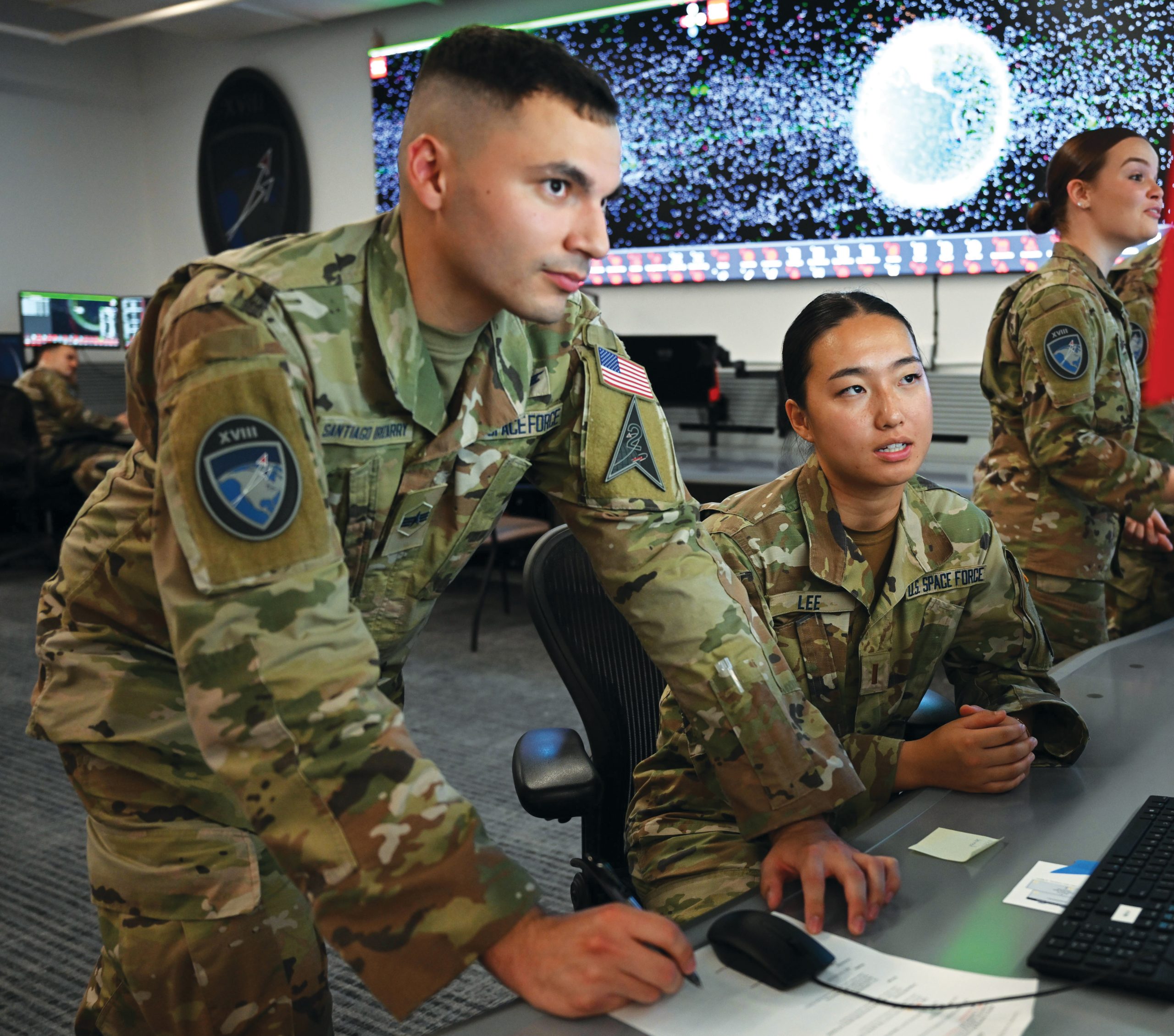
While many of the aircraft, vessels, and armaments deployed in significant military endeavors possess a certain degree of visibility, space operations and capabilities are frequently characterized as imperceptible—an unseen power disrupting or facilitating communication, guidance and navigation, and target identification and engagement.
In a recent discussion at AFA’s Warfare Symposium prior to the Iranian attacks, Lt. Gen. Gregory Gagnon, who leads the Space Force’s Combat Forces Command, stated that space effects are as vital to any contemporary military undertaking as flour is to baking.
“We’re integral to everything,” he remarked on Feb. 25 in Aurora, Colo. “If you appreciate cookies and brownies, we are, in essence, the flour. You may not perceive us, but you require us.”
The Pentagon has acknowledged that space capabilities have played a pivotal role in recent operations, including last year’s attacks on Iran’s nuclear weapon facilities and a January mission to apprehend Venezuelan President Nicolas Maduro. While officials have refrained from specifying the exact systems utilized, Gagnon pinpointed three sets of capabilities as crucial to recent operations:
- the global sensor network, comprising ground-based telescopes and radars, which is present on every continent except Antarctica
- intelligence units
- electronic warfare assets, some situated in the U.S., and others deployed worldwide
Space capabilities likely played a fundamental part in preparing the ground for the operation, according to Charles Galbreath, a senior resident fellow specializing in space studies at the Mitchell Institute for Aerospace Studies. U.S. Space Forces Central, the service’s component aligned with U.S. Central Command, probably contributed to planning efforts to ensure space effects were thoroughly integrated into the endeavor.
In the prelude to Epic Fury, space operators may have striven to guarantee that GPS and communication signals were robust enough to endure jamming attempts and, conversely, sought to impede or scramble Iran’s navigation and satellite communication systems.
“If Iran was utilizing satellite communications, which I anticipate they would, we aim to be able to deny those, to confound their command and control,” Galbreath conveyed to Air & Space Forces Magazine.
During Operation Midnight Hammer last June, when B-2 bombers unleashed bunker-busting ordnance on Iranian nuclear facilities, Space Force electromagnetic warfare units assisted in ensuring the bombers could safely engage their targets. Mission Delta 3, the operational entity tasked with EW capabilities, possesses several known systems, including the Remote Modular Terminal, a compact, deployable jammer devised by the Space Rapid Capabilities Office.
SPACECOM likely relied heavily on missile warning and defense assets to guard against Iran’s retaliatory assaults, Galbreath indicated, and any targeting information yielded by those sensors would typically be merged with vital intelligence data from the National Reconnaissance Office.
“What immediately springs to mind are missile warning capabilities that can direct either intercept aircraft or ground-based missile defense systems or ship-based missile defense systems to facilitate the shoot-down of those incoming attacks,” he articulated. “And then, if they also possess cyber capabilities, we must ensure that we can safeguard our networks against their incursions.”
Galbreath characterized Iran’s own counterspace capabilities as “emergent,” observing that the nation may possess some jamming and spoofing systems.
“It’s not exceedingly difficult to comprehend the frequencies at which we operate and to develop a noise generator at those frequencies to serve as a brute force jammer,” he stated. “Anything more intricate than that, I would have to question whether it’s an Iranian capability or something that has been furnished to them by another nation.”
Since the U.S. launched its initial offensives this weekend, there have been numerous reports of GPS and Automatic Identification System interference impacting vessels in the Strait of Hormuz, a crucial oil transit route in the Middle East.
This piece’s audio content is presented courtesy of the Air & Space Forces Association, which venerates and aids our Airmen, Guardians, and their kin. Additional details are available at afa.org