
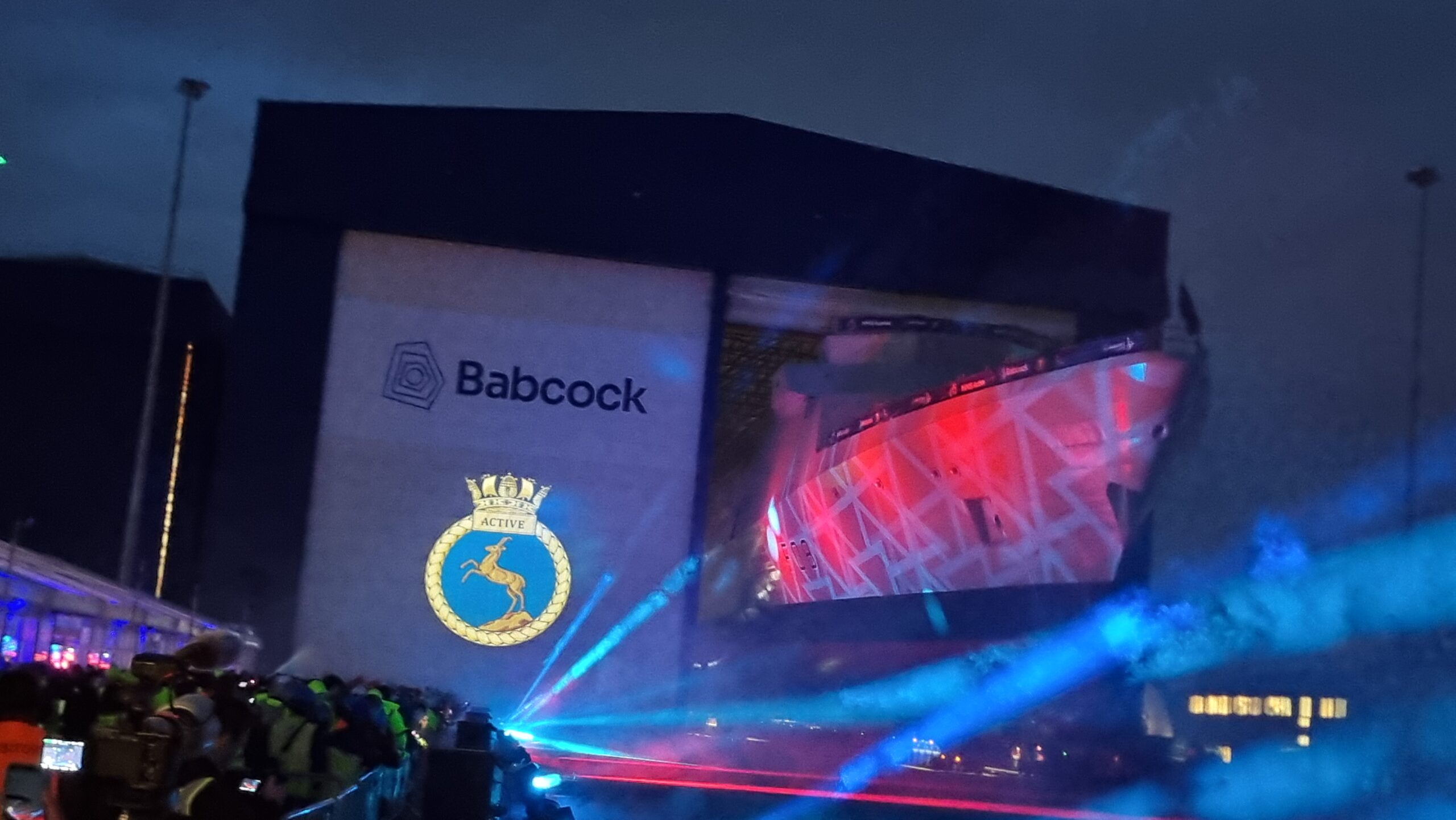
HMS Active emerged from the construction facility at Rosyth this week, and the significance of the event was palpable for those present.
The Royal Navy’s second Type 31 frigate gradually advanced from Babcock’s Venturer Building, the enormous fabrication facility where it has materialized over recent years. Upon clearing the entrance, its immense size truly impresses. With its steel plating and sharp angles, the considerable metal mass now unmistakably resembles a naval vessel.
Babcock orchestrated the occasion with fitting grandeur, recognizing it as a pivotal achievement in contemporary British naval construction. Illumination, musical accompaniment, and a precisely executed schedule were all part of the display. However, the most striking aspect was the personnel, as hundreds congregated to observe. Individuals beamed and captured images. The atmosphere resembled a celebration rather than a standard industrial operation. Their efforts had merited this recognition.
HMS Active has finished her primary structural construction. Subsequently, she will proceed to her ultimate fitting-out phase before being launched and made ready for maritime tests. Various systems will undergo integration, rigorous testing, and meticulous refinement. The extensive undertaking of transforming a vessel’s shell into a combat-ready warship persists.
Luke Pollard, the Defence Minister, stated: “These achievements demonstrate the pinnacle of Scottish naval construction. From commencing the build of HMS Bulldog to unveiling the formidable HMS Active, this initiative is providing top-tier naval vessels for the Royal Navy and tangible economic advantages for regions throughout Scotland and the broader United Kingdom.”
He further commented: “These frigates are destined to serve our country for many ensuing decades, and the expertise and facilities being established here will ensure the longevity of Scottish naval construction for future eras.”
General Sir Gwyn Jenkins, the First Sea Lord, affirmed: “The unveiling of HMS Active and the initial steel cutting for HMS Bulldog signify genuine progress in providing the vessels required by the Royal Navy. These adaptable frigates will serve as the fleet’s mainstays, able to engage in a broad range of naval activities.”
He proceeded to add: “The Type 31 Inspiration class signifies a substantial advancement in updating our naval forces. These are competent and flexible vessels, conceived to furnish the Royal Navy with the necessary versatility in a rapidly evolving geopolitical landscape.”
The unveiling occurred concurrently with the initial steel processing for HMS Bulldog, the class’s fourth vessel. This in itself speaks volumes regarding the speed of progression; further updates are anticipated.
The Type 31 initiative directly sustains approximately 1,250 employment positions, with a comparable figure throughout the United Kingdom’s supply network. Over 400 trainees have emerged from collaborations with regional educational institutions.
In Rosyth, this represented a tangible occasion when the access points parted and the vessel emerged. Crucially, however, the dedicated personnel who have committed years to this undertaking were afforded the opportunity to observe their accomplishments.