
Construction Progresses on Royal Navy’s Type 31 Frigates at Rosyth Dockyard
Work on the Royal Navy’s new fleet of five Type 31 general-purpose frigates is well underway at Babcock International’s Rosyth dockyard in Scotland, with recent imagery indicating significant progress across multiple vessels. The visible stages of construction range from early assembly within the dedicated Venturer Hall to advanced fitting-out in the drydocks, showcasing the scale and complexity of this ambitious shipbuilding program, which aims to modernize and expand the UK’s naval capabilities.
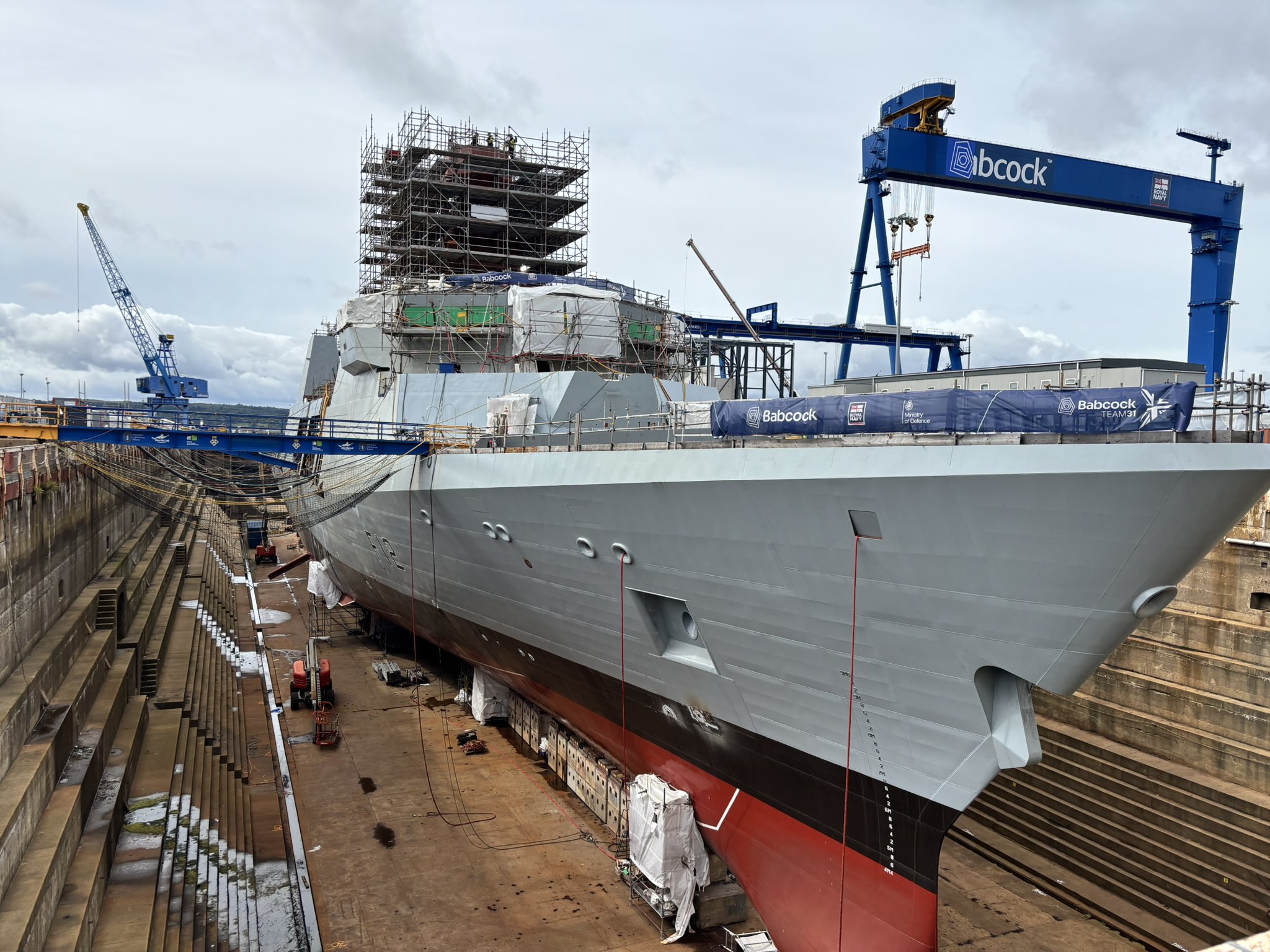
According to photographs shared by Vice Admiral Steve Moorhouse, the Fleet Commander of the Royal Navy, during a visit on Tuesday, August 18, two of the frigates are currently in the fitting-out phase within the drydocks. Simultaneously, two additional vessels are in earlier stages of construction inside the massive assembly hall, providing a clear visual representation of the staggered production schedule and the modular construction techniques employed.
Vice Admiral Moorhouse expressed optimism about the program’s progress, stating on social media,“A fantastic opportunity to see @Babcockplc T31 hulls inc @HMSVenturerRN taking shape. Brilliant to see the future of the @RoyalNavy coming to life, built for the challenges ahead and ready to deliver at the heart of our hybrid navy for decades to come.”His remarks underscore the strategic importance of these new frigates in enhancing the Royal Navy’s operational capabilities and adaptability for future global challenges, forming a core component of what he termed a “hybrid navy” – a fleet capable of diverse roles from high-intensity warfare to humanitarian aid, maritime security, and global presence missions.
Among the ships undergoing fitting out in the drydocks are HMS Venturer, designated as the first of the class, and HMS Active. HMS Venturer is notably advanced, bearing her pennant number F12 prominently on the bow. Externally, the vessel appears largely complete along its hull, reflecting significant structural integration. However, scaffolding remains in place around the mast and superstructure, indicating ongoing work on critical systems such as radar arrays, communications equipment, and other top-side installations. Various pieces of sensitive equipment on the upper decks are also observed under protective wraps, a common practice during this critical integration phase to safeguard components from the elements and construction activities while internal systems are installed and tested.
Inside the Venturer Hall, a purpose-built, covered assembly facility designed to accommodate two hulls simultaneously, significant progress is also evident. HMS Formidable, the third ship in the class, is in an advanced stage of block assembly, with a substantial bow block positioned adjacent to the main hull, awaiting its final integration. This modular construction approach allows for various sections of the ship to be fabricated simultaneously before being integrated, streamlining the build process. Further along in the hall, HMS Bulldog, the fourth vessel, is in its early stages of construction, indicating the sequential nature of the program’s production line. The fifth and final ship in the initial order, HMS Campbeltown, has not yet reached the keel-laying stage, marking the progression through the class as each vessel moves through design, fabrication, assembly, and fitting-out phases.
The Type 31 program stems from a £1.25 billion contract awarded to Babcock International in 2019. The design for these frigates, known as the Arrowhead 140, is a derivative of Denmark’s highly successful Iver Huitfeldt class, adapted to meet specific Royal Navy requirements. These vessels are conceived as general-purpose frigates, a strategic decision aimed at providing the Royal Navy with flexible, multi-role platforms that can perform a wide array of duties. This design philosophy is intended to free up the more specialized, anti-submarine warfare (ASW) focused Type 26 frigates, such as the City-class, for critical task group protection and continuous at-sea deterrent support roles, allowing them to concentrate on their high-end capabilities in complex maritime environments.
The armament suite for the Type 31s reflects their general-purpose role, featuring a BAE Systems Bofors 57mm Mk3 main gun and two BAE Systems Bofors 40mm Mk4 secondary guns for close-range defense and engagement of smaller surface threats. A significant enhancement to the original design, made after the initial contract signing, was the inclusion of Mk 41 Vertical Launch System (VLS) cells. The Mk 41 VLS is a highly adaptable, modular system capable of deploying a range of missiles, including anti-air, anti-ship, and potentially land-attack munitions, greatly enhancing the frigates’ defensive and offensive capabilities across multiple threat vectors. This addition signifies a commitment to ensuring these vessels possess robust combat power and adaptability for future operational requirements.
While construction is progressing, the program has encountered some delays relative to its initial schedule. The Ministry of Defence now anticipates the handover of the first Type 31 frigate by the end of the current decade, a revision from earlier projections. Babcock International has also acknowledged financial adjustments related to the program, setting aside approximately £140 million to cover costs associated with design changes and rework. Such adjustments are not uncommon in complex, large-scale defense projects, often stemming from evolving requirements, supply chain issues, material cost fluctuations, or unforeseen technical challenges during the development and construction phases.
The Rosyth yard has seen substantial investment to support the Type 31 program. Babcock has invested roughly £200 million in site infrastructure, with a significant portion dedicated to the construction of the Venturer Hall. This state-of-the-art facility provides a controlled environment for block assembly and integration, shielding work from adverse weather conditions and enabling more efficient, continuous construction. Its design, allowing for two hulls to be assembled side-by-side, optimizes production flow and maximizes throughput, highlighting a modern approach to shipbuilding that prioritizes efficiency and quality control.
Beyond its strategic military importance, the Type 31 program plays a vital role in the UK’s industrial base and economy. It is estimated to sustain around 2,500 skilled jobs across Scotland and the wider UK supply chain, encompassing a diverse range of engineering, manufacturing, and support roles. Furthermore, the program has been instrumental in establishing approximately 400 apprenticeships through partnerships with colleges in Fife and other regions across Scotland. This significant investment in human capital ensures a pipeline of skilled workers for the future of UK shipbuilding and engineering, contributing to regional economic development and national industrial capability.
The future of UK naval shipbuilding beyond the current batch of Type 31s remains a subject of ongoing discussion and strategic planning. Babcock International has successfully marketed the Arrowhead 140 design globally, with Poland and Indonesia having already selected variants of the design for their own naval modernization programs, underscoring its international competitiveness and versatility as an exportable platform. Domestically, Graeme Downie, the local Member of Parliament for Dunfermline and West Fife, has been actively advocating for the Ministry of Defence to confirm that the planned Common Combat Vessel (CCV) program will utilize the Type 31 hull design and be built at the Rosyth facility. Securing this future work would be crucial for maintaining the long-term viability of the yard and the skilled workforce it employs, ensuring continuous investment in a vital strategic industry.
The imagery providing these construction updates was originally published by Vice Admiral Steve Moorhouse, offering a rare and authoritative glimpse into the significant progress being made on these crucial additions to the Royal Navy fleet, which are poised to become a backbone of its operations for decades to come.
Why This Matters
The construction of the Royal Navy’s Type 31 frigates represents a critical juncture for the United Kingdom’s defense capabilities, industrial base, and geopolitical standing. These vessels are more than just new warships; they are a strategic investment in the future of the Royal Navy and the UK’s role on the global stage, with far-reaching implications.
Strengthening Naval Capabilities:The Type 31 frigates are designed to be versatile, general-purpose platforms, significantly enhancing the Royal Navy’s ability to conduct a broad spectrum of operations. This includes maritime security and anti-piracy missions, humanitarian aid and disaster relief, presence projection across international waters, and support for carrier strike groups. By taking on these varied roles, they allow the more specialized Type 26 frigates to focus on high-end anti-submarine warfare, providing a more balanced, flexible, and resilient fleet structure. This operational flexibility is paramount in an increasingly complex and contested global maritime environment, enabling the UK to respond effectively to emerging threats and uphold international maritime law and freedom of navigation.
Economic and Industrial Impact:The program provides a substantial boost to the UK’s shipbuilding industry, directly sustaining approximately 2,500 skilled jobs in Scotland and across the wider UK supply chain. These jobs span a diverse range of engineering, manufacturing, and support roles, contributing significantly to regional economies. The investment of £200 million in the Rosyth dockyard, particularly the creation of the state-of-the-art Venturer Hall, modernizes critical infrastructure and ensures the UK retains a robust capability for complex naval construction. Furthermore, the establishment of 400 apprenticeships is vital for developing the next generation of engineers and shipbuilders, safeguarding essential skills, and fostering long-term economic growth in high-value manufacturing sectors. This program is a testament to the government’s commitment to industrial strategy and leveling up economic opportunities across the nation.
Global Influence and Export Potential:The Arrowhead 140 design’s success in securing contracts with international partners like Poland and Indonesia demonstrates the UK’s prowess in naval design and engineering. This export success not only generates revenue and creates further jobs within the UK but also strengthens defense relationships and promotes interoperability with allied nations. It positions the UK as a leader in naval innovation and a reliable partner in defense procurement, potentially paving the way for future export opportunities and collaborative projects that extend British influence and expertise globally.
Future of UK Naval Shipbuilding:The ongoing discussions about future naval programs, such as the Common Combat Vessel, and the potential for Rosyth to secure further work using the Type 31 hull design are crucial for the long-term stability and growth of the UK’s shipbuilding industry. Sustaining a consistent pipeline of work is essential to maintain skilled workforces, retain industrial capabilities, and ensure the UK remains at the forefront of naval construction. The Type 31 program, therefore, acts as a foundational element for future strategic defense projects, demonstrating commitment to a continuous shipbuilding strategy vital for national security and economic prosperity.
In essence, the Type 31 frigates are more than individual ships; they represent a strategic reorientation of the Royal Navy’s capabilities, a substantial investment in the UK’s industrial future, and a tangible expression of the nation’s commitment to global security and economic prosperity. Their progress underscores the importance of a robust domestic defense industry and its critical role in supporting both national interests and international alliances in an evolving geopolitical landscape.