
The sound accompaniment for this piece is presented by the Air & Space Forces Association, commemorating and aiding our military aviators, space defenders, and their kin. Discover further details at afa.org
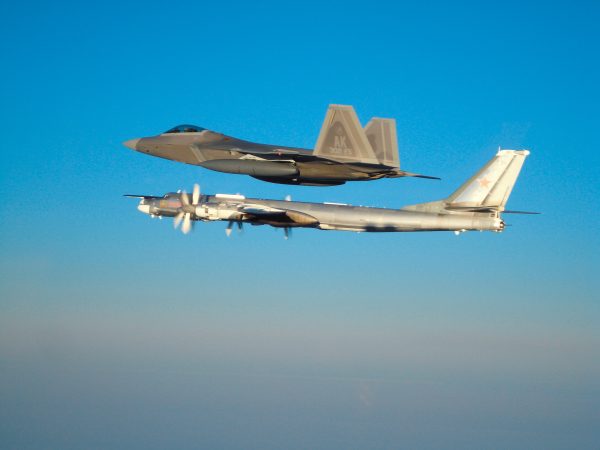
NORAD rapidly dispatched six U.S. and Canadian combat jets, accompanied by half a dozen auxiliary planes, to challenge a pair of Russian warplanes that encroached upon the Air Defense Identification Zone near the Alaskan and Canadian shorelines on the fourth of March.
This deployment, featuring state-of-the-art F-35s and F-22s, alongside Canadian CF-18s, ranks among the most substantial actions NORAD has undertaken over the last ten years, occurring concurrently with numerous American warplanes concentrated in the Middle Eastern region for military actions targeting Iran.
The Russian Tu-142 aircraft, employed for naval surveillance and underwater combat, accessed the Alaskan and Canadian ADIZ—the global air region immediately beyond American and Canadian national airspace—yet did not breach the airspace of either country, NORAD stated in an official announcement.
As a countermeasure, the command dispatched:
- 2 F-35As
- 2 F-22s
- 2 CF-18s
- 4 KC-135 tankers
- 1 CC-150 tanker
- 1 E-3 AWACS
Aircraft from Russia frequently traverse near the Alaskan shoreline without intruding into American airspace, and NORAD emphasized in its communiqué that this action was not perceived as a danger.
However, this particular incursion marked the initial instance since the United States commenced Operation Epic Fury targeting Iran, and the deployment of twelve aircraft in response to merely two Russian anti-submarine warfare planes implies NORAD aimed to convey a signal to Moscow. Conversely, on a previous occasion when Russia dispatched a pair of Tu-95 strategic bombers, two Su-35 combat jets, and an A-50 airborne early warning and command plane into the Alaskan Air Defense Identification Zone on the nineteenth of February, NORAD rapidly deployed only nine planes, comprising two F-16s, two F-35s, and five auxiliary aircraft.
This deployment represented NORAD’s most extensive intervention since July 2024, when Russian and Chinese long-range aircraft conducted a combined surveillance flight near the Alaskan shoreline, an unprecedented operation of its kind. U.S. F-16s and F-35s, along with Canadian CF-18s, intercepted those bombers on that occasion. Furthermore, it marked the initial instance in recent memory that F-35s and F-22s were launched simultaneously.
The Russian intrusion occurred amidst Arctic Edge 26, a vast yearly drill spanning from Alaska to Greenland, with participation from both the American and Canadian armed forces.
The sound accompaniment for this piece is presented by the Air & Space Forces Association, commemorating and aiding our military aviators, space defenders, and their kin. Discover further details at afa.org