
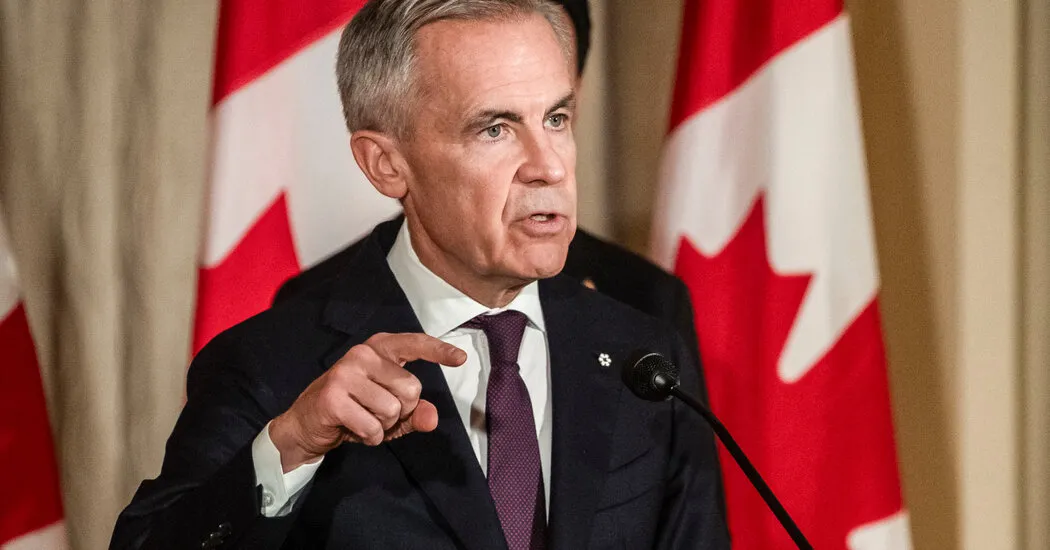
Prime Minister Mark Carney’s ambitious strategy to reorient Canada’s economic and political alliances, actively seeking to reduce its historical over-reliance on the United States, was prominently showcased last week through his extensive international travel schedule. This initiative represents a significant pivot in Canadian foreign policy, aiming to forge deeper ties with diverse global partners and enhance the nation’s resilience in a shifting geopolitical landscape.
A notable addition to Mr. Carney’s itinerary was an unscheduled stop in Dublin, where he participated in a critical meeting of European leaders. This engagement immediately preceded a previously planned, multi-country trip to Asia, underscoring a deliberate, dual-pronged approach to Canada’s global diversification efforts across two key continents.
Just last month, Prime Minister Carney formally announced Canada’s intention to seek “associate member” status with the European Union. This move would represent a groundbreaking new tier of engagement with the powerful economic bloc, signifying a strategic commitment to Europe. However, this focus comes amidst observations from economic analysts who suggest that the burgeoning markets and rapid growth of Asia present potentially larger long-term economic opportunities for Canadian businesses seeking to expand beyond North America.
“Prime Minister Carney certainly seems to have a strong focus on Europe, which gives an impression that he is not looking toward Asia,” observed Kazuto Suzuki, a professor at the University of Tokyo’s graduate school of public policy, reflecting on the perceived emphasis. “Nevertheless, if Canada is to avoid dependence on the U.S. market and form a coalition of middle powers, cooperation with Asia is essential. The sheer scale of economic growth, population, and emerging consumer base in Asia offers unparalleled prospects for trade, investment, and technological partnership, which Canada cannot afford to overlook in its comprehensive diversification efforts.”
While Mr. Carney was initially regarded with some curiosity at major Asian gatherings such as the Association of Southeast Asian Nations (ASEAN) and the Asia-Pacific Economic Cooperation (APEC) forum last year, his international profile has since significantly elevated. His widely reported speech in January at the World Economic Forum in Davos, Switzerland, coupled with the global economic disruptions and energy security concerns stemming from former U.S. President Trump’s aggressive trade policies, has transformed Canada and its energy-rich economy into a significant draw at these crucial international assemblies. In an increasingly unpredictable geopolitical landscape, Canada’s reputation as a stable, democratic, and resource-rich nation offers an attractive proposition to countries seeking reliable partners for trade and investment, particularly those facing energy supply uncertainties exacerbated by global tensions.
Ahead of the APEC meeting scheduled for this week in Shenzhen, China, Mr. Carney is set to engage in his second formal meeting this year with Chinese leader Xi Jinping. This repeated high-level dialogue signals an effort to stabilize and rebuild aspects of the complex Canada-China relationship. Demonstrating his commitment to fostering new trade pathways, Mr. Carney, a vocal proponent of free trade agreements in stark contrast to former President Trump’s protectionist stance, announced in Manila prior to the ASEAN meetings that Canada had successfully concluded broad negotiations for a comprehensive trade deal with the Philippines. Furthermore, discussions are actively progressing towards a wider trade arrangement encompassing all eleven member countries of ASEAN, indicating a broader regional engagement strategy aimed at opening diverse new markets for Canadian goods and services.
On Saturday, Mr. Carney reiterated his core message, stating that at both upcoming summits, he would vigorously champion his call for a “coalition of middle powers” to unite. He articulated Canada’s strategic positioning as a consistent and reliable alternative to the increasingly unpredictable United States, particularly as a supplier of crucial resources such as oil and natural gas. This positioning emphasizes Canada’s capacity to contribute to global energy security amidst geopolitical flux and economic nationalism, offering stable supply chains to international partners.
“It’s part of our strategy, absolutely, 100 percent,” Mr. Carney affirmed at a news conference following his meeting with President Ferdinand R. Marcos Jr. of the Philippines. “We’re very transparent about it. It’s a part of our strategy to develop this dense web of connections to make us resilient, to make us more independent, to make us sovereign so we can live our lives as we choose, so we’re not being told what to do by some hegemon or a hyperscaler. This comprehensive approach is about building a robust international network that not only insulates Canada from external pressures but also ensures its autonomy and strengthens its voice on the world stage.”
“It is to varying degrees part of the strategies of many, many countries,” he added, underscoring that Canada’s approach aligns with a broader trend among nations seeking greater self-determination and diversified partnerships in the current global climate. “And that’s one of the reasons why you’re seeing so much progress in forming new alliances and trade partnerships globally, as countries look for stability and reliability.”
Between the significant Asian summits, Mr. Carney undertook a brief but symbolically important stop in Cambodia, which was hosting a meeting of the International Organization of La Francophonie, an association dedicated to promoting the French language and culture globally. During the introduction of leaders at the event, Mr. Carney received a notably enthusiastic reception, garnering more applause than any other head of state, signaling Canada’s continued influence within this cultural and linguistic sphere.
However, the APEC meeting is expected to bring Mr. Carney face-to-face with the stark realities of superpower politics. The summit will feature a high-profile meeting hosted by Mr. Xi, bringing together President Vladimir V. Putin of Russia and former U.S. President Trump. Mr. Putin’s presence, marking his return to APEC after skipping last year’s meeting in South Korea, stands in sharp contrast to the recent European Political Community summit in Dublin. There, Mr. Carney and his European counterparts unequivocally reaffirmed their unwavering support for Ukraine, at a meeting also attended by Ukrainian President Volodymyr Zelensky, highlighting the profound and ongoing divisions in global geopolitical alignments.
Despite the challenging optics of appearing alongside Mr. Putin, Mr. Carney stated he would participate in a group photograph of the APEC leaders with the Russian president, explaining this decision as an act “out of respect for the host” nation. This pragmatic approach underscores the diplomatic tightrope Canada must sometimes walk in multilateral forums that include adversarial actors.
Yet, this appears to represent the extent of Canada’s direct engagement with Russia. Mr. Carney reiterated on Saturday that Canada would uphold its ban on Russian and Belarusian national teams from entering the country for the Men’s World Junior Hockey Championship scheduled for the end of the year. This firm stance on athletic participation reflects a broader condemnation of Russia’s actions in Ukraine.
“Canada stands firmly with Ukraine, firmly with democracy, territorial integrity, rule of law,” he declared, leaving no ambiguity about Canada’s principles. “All of those put us on the other side of Vladimir Putin’s Russia. Our unwavering commitment to these fundamental values and international norms dictates our position on the global stage.”
Canada’s relationship with China, which represents the largest potential alternative market to the United States for Canadian exports and investments, faced significant challenges even before Mr. Carney, a former governor of both the Bank of Canada and the Bank of England, entered the political arena last year. The bilateral relationship had deteriorated considerably in recent years.
It reached a critical low point following China’s arrest of two Canadian citizens, Michael Kovrig and Michael Spavor, in what was widely interpreted in Canada as retaliatory “hostage diplomacy” for Canada’s detention of Meng Wanzhou, a senior executive of Huawei, on an extradition request from the United States. Furthermore, an official inquiry in Canada concluded that China had actively attempted to interfere in Canadian democratic processes, exacerbating bilateral tensions and eroding trust.
Recent polls suggest a gradual improvement in Canadian public sentiment towards China since Mr. Carney embarked on efforts to re-establish diplomatic and economic ties. Concurrently, public perception of the United States under former President Trump, whose administration initiated a trade war with Canada and frequently floated the idea of Canada becoming the 51st American state, has shifted decidedly in a negative direction among Canadians. This divergence in public opinion provides both impetus and constraint for Canadian foreign policy, reflecting a desire for greater autonomy.
However, Mr. Carney’s ability to deepen ties with China remains subject to significant domestic limitations and public apprehension. A recent poll conducted by the non-profit Angus Reid Institute revealed that only 14 percent of Canadians favor closer trade relations with China. In stark contrast, a substantial 58 percent of respondents expressed a desire to increase trade ties with Europe, reflecting a clear public preference for European engagement over a significant deepening of economic links with China.
In January, following his initial meeting with Mr. Xi, Mr. Carney had expressed optimism, predicting that Chinese automakers would make substantial investments in Canada within three years, particularly in the burgeoning electric vehicle sector, aligning with global climate goals.
By Saturday, however, his remarks were notably more circumspect regarding specific Chinese investments. While emphasizing the government’s commitment to fostering “a competitive Canadian auto sector that produces good-paying jobs, good union jobs for Canadian workers,” he also stressed the importance of ensuring Canadians have access to affordable electric vehicles. This balance reflects a careful consideration of economic benefits against potential geopolitical and supply chain risks associated with over-reliance on a single foreign partner.
“There are multiple variables, and there’s multiple ways to achieve those objectives,” he stated, acknowledging the intricate nature of global trade and industrial policy. “It depends partially on — and importantly on — where the U.S. trading relationship settles out.” This statement underscores the enduring influence of Canada’s relationship with its largest neighbor, the United States, on its broader global economic diversification strategy, indicating that even as Canada seeks independence, it must carefully navigate the realities of North American economic integration and the potential impact of future U.S. policy decisions.
Why This Matters
Prime Minister Mark Carney’s intensified efforts to diversify Canada’s economic and political relationships away from its traditional reliance on the United States signal a significant recalibration of a G7 nation’s foreign policy. This strategic shift has profound implications for global trade, international alliances, and Canada’s future sovereignty, reflecting broader trends in global governance.
For **Canada**, this strategy is crucial for building economic resilience against external shocks, particularly from an unpredictable U.S. administration and volatile global markets. By forging new trade agreements with regions like ASEAN and pursuing “associate member” status with the European Union, Canada aims to secure new markets for its exports, attract diversified investments, and enhance its political independence. The goal is to create a “dense web of connections” that strengthens Canada’s position as a middle power, capable of charting its own course on the international stage without being dictated by larger powers. This pursuit of autonomy is a defining feature of Canada’s evolving identity.
Globally, this move highlights a broader trend among nations seeking to reduce single-market dependence and build more robust, diversified supply chains in an era of increasing geopolitical fragmentation and protectionism. Canada’s push for “middle powers” to unite could foster new blocs of influence, challenging the traditional dominance of superpowers and promoting a more multipolar international order. The success of Canada’s strategy could serve as a blueprint for other medium-sized economies grappling with similar challenges of balancing economic prosperity with national sovereignty.
The emphasis on Canada as a reliable supplier of critical resources, particularly energy, also has significant implications for **global energy security**. In a world grappling with supply chain vulnerabilities, climate change pressures, and geopolitical instability, an energy-rich, democratic nation like Canada positioning itself as a stable alternative to more volatile sources can contribute to market stability and offer allies greater security. This also shapes the future of trade, as Canada seeks to leverage its resources and technological capabilities to build new economic partnerships and support the global energy transition.
Finally, the delicate balancing act involved in engaging with major powers like China (for economic opportunity) while maintaining a firm stance against Russia (on principles of international law), and navigating complex relations with the United States (its closest ally and largest trading partner), reflects the intricate challenges facing multilateral diplomacy today. Canada’s strategy underscores the increasing importance of values-based foreign policy, even when tempered by economic pragmatism, and the enduring influence of domestic public opinion on a nation’s international engagements. The outcome of Canada’s diversification efforts will be closely watched as a test case for navigating 21st-century geopolitical and economic complexities.