
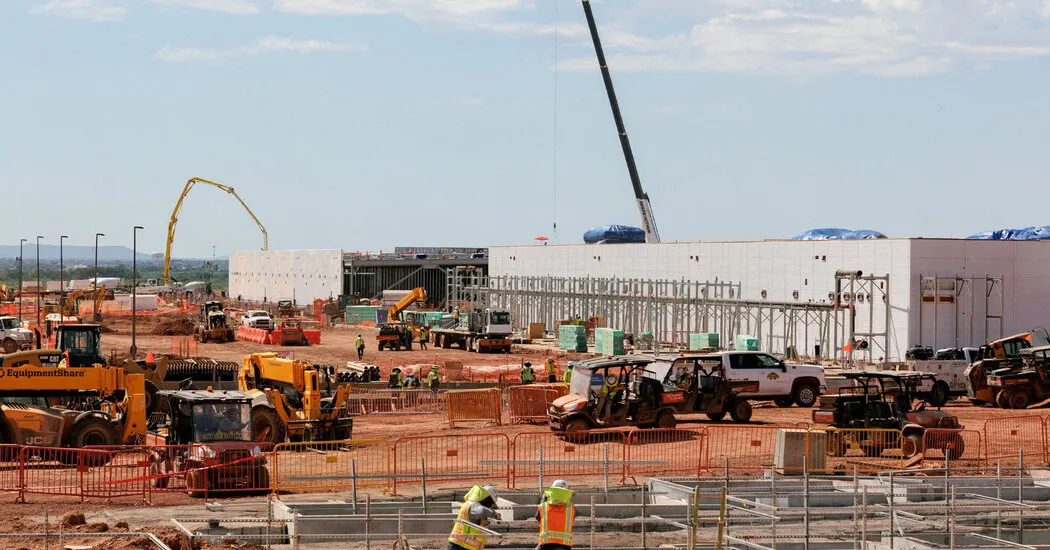
Washington D.C.– The United States Congress is currently engaged in a complex debate over a comprehensive federal permitting bill that could significantly reshape the landscape for energy infrastructure development, particularly impacting the rapidly expanding data center industry. This legislative push comes in the wake of mounting public frustration and local electoral actions against the proliferation of data centers, primarily driven by the escalating energy demands of artificial intelligence (AI) technologies.
The proposed legislation presents a paradoxical situation for tech companies. On one hand, it aims to streamline and accelerate federal environmental reviews for a broad spectrum of energy projects, including critical transmission lines and gas pipelines. This expedited process would ostensibly make it easier and faster for developers to secure the necessary power infrastructure to support new data centers, addressing a key challenge for an industry that prioritizes speed and scale.
However, this potential benefit is coupled with a substantial financial imposition. A significant provision within the bill proposes to compel data centers to pay considerably more for their electricity by charging these facilities extra for access to the national electric grid. This measure represents a radical departure from decades of established federal power rules, which have historically distributed the costs of grid upgrades and maintenance across all ratepayers. Supporters of this provision argue it could save billions of dollars for households and other consumers over the next decade.
The political maneuvering around this bill underscores the growing tension and multifaceted challenges posed by the AI revolution in Washington and across the nation. Data centers, which are massive, energy-intensive facilities essential for training and running cutting-edge AI models, are spreading rapidly. Their construction and operation have placed considerable strain on existing electrical networks, triggering widespread community anger. This public discontent manifested significantly in recent local elections, where voters approved at least 40 ballot initiatives aimed at restricting or controlling data center development.
The bill’s dual nature has elicited varied reactions from different interest groups. Environmental organizations, many of whom generally oppose the broader permitting reform aspects of the bill, view it with suspicion. They contend that by paring back federal environmental laws to expedite construction for a wide array of projects—including gas pipelines, wind and solar farms, high-voltage transmission lines, roads, public transit, and housing—the legislation could inadvertently accelerate the development of data centers powered by natural gas, thereby contributing to increased carbon emissions.
Conversely, proponents of the bill frame the cost-imposition provisions as a crucial opportunity to hold AI firms accountable. Senator Sheldon Whitehouse, a Democrat from Rhode Island and a co-author of the bill, articulated this stance forcefully. “The day of data center freeloading ends when this bill passes,” Whitehouse stated. “Data centers now have to pay for the extra costs that they bring to the grid when they come online. They do not get to have all that extra cost dumped out onto the utility’s rate base and picked up by all of the other ratepayers.” This statement highlights a central aim of the legislation: to ensure that the significant demands placed on the grid by data centers are borne directly by the companies that benefit from them, rather than being socialized among all electricity consumers.
The data center industry, which includes tech giants such as Amazon, Google, Meta, and Microsoft, has maintained a relatively cautious public posture regarding the bill. While numerous business groups, labor unions, and some individual Silicon Valley companies have endorsed aspects of the legislation, the Data Center Coalition, a leading trade group representing the industry, has not yet officially backed the bill. Jon Hukill, a spokesperson for the coalition, stated that the organization is “continuing to evaluate its implications with our members, who are doing their part to address affordability and economic growth by investing hundreds of billions of dollars in the U.S. annually.” This measured response suggests a careful weighing of the trade-offs between expedited development and increased operational costs.
The intense debate over who should bear the financial burden of grid upgrades stems from the immense power consumption of modern data centers. Many facilities being developed to train and run cutting-edge AI models can consume as much electricity as a small city. Historically, utilities have spread the costs associated with electrical grid upgrades and expansion among all their customers. However, as public outcry over data centers has grown, figures such as former President Trump and various state governors have publicly urged tech giants to directly cover these costs rather than passing them on to households. While most AI companies have made pledges to protect ratepayers, enforcing these voluntary commitments has proven difficult in practice.
To address this enforcement challenge, the 494-page permitting bill includes several key provisions designed to formalize these ratepayer protections. One critical measure would mandate the Federal Energy Regulatory Commission (FERC) to issue new rules within 90 days. These rules would specifically direct that data centers be charged for both the costs of any grid upgrades required to serve their operations and the costs associated with using the existing electrical network. This effectively means data centers could face charges for grid capacity twice, a significant departure from long-standing regulatory principles dating back to 1994, which explicitly forbid such double charging.
Robin Millican, director of research programs and strategic partnerships at Columbia University’s Center on Global Energy Policy, underscored the profound nature of this shift. “It’s a large shift away from how we’ve governed the grid to date, where the benefits of the grid are broadly shared and we socialize the costs,” Millican observed. Other provisions in the bill would grant state regulators greater flexibility to charge data centers additional fees for the power plants they necessitate, with the collected funds potentially being used to credit household electricity bills. Additionally, for the first time, the federal government would be required to track and report data center energy consumption, providing crucial data for future policy decisions.
The sheer scale of the AI boom is a primary reason politicians have singled out data centers. Tech giants consistently prioritize speed in deployment and are often willing to pay a premium to secure power connections more quickly. A report by Grid Strategies, a consulting firm, estimated that the federal grid rules alone could force data centers to pay an additional $35 billion over the next decade. This substantial sum could help offset transmission costs for other customers or finance thousands of miles of new high-voltage power lines. If states were to fully leverage the bill’s other provisions, the report projected an additional $136 billion could be raised.
Despite these potential financial benefits, questions remain about the practical implementation and efficacy of the new rules. For instance, Texas, a major hub for data centers, operates its main grid (ERCOT) largely outside the authority of FERC, raising uncertainty about the extent to which federal measures would apply there. State utility commissions would also need to develop detailed mechanisms for assigning and collecting transmission costs, which could vary significantly across jurisdictions.
A significant unknown is whether imposing higher electricity costs might inadvertently encourage tech companies to bypass the grid altogether and build their own, potentially more polluting, off-grid power plants. Developers are already planning dozens of such facilities, often utilizing less efficient gas turbines or even repurposed jet engines. While these projects can produce higher levels of air pollution compared to traditional power plants, companies pursue them because it can be significantly faster than enduring years-long waits for grid connections. An analysis of the permitting bill by the Rhodium Group has flagged this potential consequence, suggesting that while the bill aims to address grid strain and cost distribution, it might inadvertently incentivize a fragmented and environmentally detrimental energy supply for data centers.
Why This Matters
This congressional debate is not merely about bureaucratic permitting rules or electricity bills; it represents a critical juncture in the nation’s energy policy, technological development, and environmental stewardship. The rapid expansion of AI-driven data centers is fundamentally reshaping energy demand, challenging existing infrastructure, and sparking widespread public concern over environmental impact and economic fairness.
The proposed legislation seeks to address these multifaceted challenges by simultaneously streamlining infrastructure development crucial for economic growth and imposing significant costs on the booming tech sector. Should the bill pass, it would mark a historic shift in how large industrial consumers, particularly data centers, are integrated into and charged for the national electricity grid. This could lead to substantial cost savings for ordinary households and help finance crucial upgrades to aging infrastructure. However, the legislation also carries the risk of unintended consequences, such as incentivizing the development of less efficient and potentially more polluting off-grid power solutions, thereby undermining environmental goals.
The outcome of this debate will have far-reaching implications for the future trajectory of AI development, the resilience and cost-effectiveness of the national energy grid, and the delicate balance between technological progress, economic equity, and environmental protection. It will set a precedent for how societies manage the energy demands of future technological revolutions and determine who ultimately bears the costs of the digital age.
A proposed permitting reform bill in the United States is drawing significant attention for its potential wide-ranging impacts on infrastructure development, environmental protection, and the rapidly expanding data center industry. These digital infrastructure hubs, essential for modern connectivity, are voracious consumers of energy, making their development and power sources a critical factor in national greenhouse gas emissions targets. The legislation, currently under intense scrutiny, aims to streamline the approval process for large-scale projects, but critics and proponents offer contrasting views on its ultimate effects on energy grids, climate change, and the future use of vast federal lands. This debate highlights the complex balance between fostering technological growth and adhering to environmental stewardship.
Emissions and Energy Infrastructure Implications
One of the most significant aspects of the proposed bill, according to analyses, centers on its potential influence over the energy supply for data centers. The Rhodium Group, a prominent consulting firm specializing in energy and climate, has conducted an analysis estimating a substantial increase in planet-warming emissions should future data center growth primarily rely on off-grid natural gas power. Specifically, their projections indicate that powering these facilities with off-grid gas could lead to 31 to 90 percent more greenhouse gas emissions compared to a scenario where all new data centers connect to the existing electrical grid. This disparity stems from the fact that the national grid typically incorporates a more diverse and often more efficient mix of power sources, including advanced natural gas turbines, nuclear energy, and an increasing share of renewable power like solar and wind. Off-grid gas solutions, by contrast, often involve less efficient, localized generators that lack the economies of scale and environmental controls present in larger grid-connected power plants.
Despite these potential concerns, Ben King, a principal at the Rhodium Group, noted the inherent “uncertainty” regarding whether the permitting bill would fundamentally shift the geographical placement or energy sourcing choices for data centers. He expressed skepticism that a significant number of companies would opt for off-grid solutions, citing the considerable logistical, regulatory, and financial “hassle” involved in establishing and maintaining independent power generation infrastructure. This includes navigating complex fuel supply chains, managing environmental compliance for standalone facilities, and incurring higher operational costs compared to drawing power from an established, interconnected grid. Paradoxically, the bill also contains provisions that could accelerate the upgrade and expansion of transmission lines, potentially making it faster and easier for data centers to connect to the main electrical grid. While these grid-enhancing provisions might take several years to fully materialize and have an effect, the Rhodium Group’s overall assessment suggests that if passed, the bill could actually lead to a modestreductionin U.S. greenhouse gas emissions between now and 2040, primarily due to the anticipated improvements in grid connectivity and efficiency across the broader energy sector.
Concerns Over Public Lands Development
Environmental organizations, however, have voiced strong opposition to the bill, raising a distinct set of concerns, particularly regarding the potential for increased data center construction on federal public lands. The western United States, in particular, is home to vast tracts of government-owned land, much of which remains undeveloped and ecologically sensitive. Historically, no major data centers have been constructed on federal land in this region. This situation, however, appears to be at a potential turning point. The previous Trump administration actively encouraged developers to propose projects on federal land, viewing it as an opportunity for economic development and diversification in rural areas.
Building on this momentum, the Interior Department is currently reviewing at least 17 applications for data center projects on federal lands, according to information compiled by the Center for Western Priorities, a nonprofit conservation advocacy group that actively opposes the permitting bill. Aaron Weiss, the group’s deputy director, articulated a significant worry, stating, “We’re very concerned that this bill could lock in a data center binge on public lands.” This concern is rooted in the belief that opening up these lands to such intensive industrial development could have irreversible environmental consequences, including habitat destruction for endangered species, increased demand for often-scarce water resources in arid regions, and challenges to scenic, recreational, and cultural values that federal lands provide to the public.
Regulatory Streamlining and Legal Safeguards
A key mechanism by which the proposed permitting bill could facilitate such developments, and thus fuel environmental groups’ opposition, is through its provisions to scale back certain foundational environmental and historic preservation laws. Specifically, the legislation seeks to streamline or limit the application of statutes such as the National Environmental Policy Act (NEPA) and the National Historic Preservation Act (NHPA). NEPA, enacted in 1970, requires federal agencies to assess the environmental impacts of their proposed actions before making decisions, often involving detailed environmental impact statements and opportunities for public comment. The NHPA, meanwhile, mandates federal agencies to consider the effects of their undertakings on historic properties, including archeological sites, tribal cultural resources, and historic structures, before proceeding with projects.
By curtailing the scope or rigor of these laws, for example by shortening review timelines, limiting the types of projects subject to full review, or reducing opportunities for public and stakeholder input, the bill could significantly diminish the avenues available for environmental groups and concerned citizens to challenge and potentially block projects, including data centers, through legal action. Furthermore, critics argue that the bill could limit the power of future presidential administrations to reverse course, for instance, by rescinding federal permits already issued for data centers or imposing a moratorium on new developments on public lands. It is important to note, however, that the proposed federal bill would not override many of the state and local permits that data centers require, nor would it prevent individual communities from imposing their own specific restrictions or regulations on such projects within their jurisdictions. This means local communities would still retain some level of autonomy in shaping development through zoning laws, impact fees, and other local ordinances.
Balancing Perspectives and Uncertainties
The debate surrounding this permitting bill underscores a fundamental tension between accelerating economic and technological progress and safeguarding environmental integrity. While proponents argue that streamlining the permitting process is essential for modernizing infrastructure and maintaining economic competitiveness in the digital age, critics contend that such measures could come at an unacceptable cost to natural resources and climate goals. The Rhodium Group’s analysis, with its nuanced conclusion of a modest overall emissions reduction alongside specific concerns about off-grid power, reflects the complexity and multiple interacting factors at play. The ultimate impact of the bill remains subject to a “fair bit of uncertainty,” as noted by Ben King, with its effects contingent on how developers respond to new incentives, the pace of grid infrastructure improvements, and the ongoing legal and political landscape. The diverging viewpoints highlight the need for careful consideration of both the immediate and long-term consequences of such legislative changes, as they will shape the future of digital infrastructure and environmental policy for decades to come.
Why This Matters
The debate surrounding the proposed permitting bill and its implications for data center development is significant for several overarching reasons, touching upon critical national and global priorities:
- Climate Change Goals and Energy Transition:Data centers are one of the fastest-growing consumers of electricity globally. Their energy source directly impacts greenhouse gas emissions. If new data centers predominantly rely on less efficient, off-grid fossil fuel generation, it could significantly undermine national efforts to combat climate change and meet emissions reduction targets. Conversely, if the bill genuinely accelerates grid modernization and integration of renewables, it could support a cleaner energy transition. The choice between off-grid gas and grid-connected power is not merely an economic decision but a crucial climate one, impacting whether the nation moves closer to or further away from its environmental commitments.
- Public Land Stewardship and Conservation:The prospect of a “data center binge” on public lands represents a fundamental shift in how these shared national resources are utilized. Federal lands, particularly in the West, are cherished for their ecological value, biodiversity, recreational opportunities, and historical significance. Industrial-scale development on these lands could lead to irreversible habitat loss, increased pressure on scarce water resources in already arid regions, and a degradation of natural landscapes. This issue raises profound questions about the long-term stewardship of public assets and the delicate balance between facilitating economic development and fulfilling conservation mandates.
- Regulatory Framework and Environmental Protections:The proposed scaling back of foundational environmental laws like the National Environmental Policy Act (NEPA) and the National Historic Preservation Act (NHPA) has implications far beyond data centers. These laws provide critical mechanisms for public input, environmental review, and accountability in federal decision-making for a wide array of projects, from pipelines to residential developments. Weakening them could set a precedent that diminishes environmental safeguards for future infrastructure, energy, and industrial projects across the country, potentially leading to less transparent processes, reduced environmental oversight, and an erosion of public trust in federal project approvals.
- Economic Competitiveness and Digital Infrastructure:Data centers are the backbone of the digital economy, enabling everything from cloud computing to artificial intelligence, and their efficient operation is vital for national economic competitiveness. Streamlining their development is often framed as essential for maintaining this edge and fostering technological innovation. However, this must be balanced against the environmental costs. The challenge lies in finding pathways for digital growth that are both economically viable and ecologically sustainable, avoiding a scenario where short-term gains lead to long-term environmental liabilities that could ultimately hinder sustainable economic progress.
- Local Community Impact and Sovereignty:While the federal bill may not override local regulations, the proliferation of data centers, whether on public or private land, profoundly affects local communities. Concerns about noise pollution, increased traffic, strain on local infrastructure (like roads and sewage systems), and significant water consumption are common. The debate highlights the ongoing tension between federal policy directives aimed at national economic goals and local autonomy in managing development that directly impacts residents’ quality of life and the sustainability of local resources.
- Precedent Setting:The decisions made regarding this permitting bill and data center development in the U.S. could establish important precedents internationally. As countries grapple with rising digital demand and its substantial energy footprint, how a major economy like the United States addresses these challenges will be closely watched and potentially emulated, influencing global approaches to sustainable digital infrastructure and environmental governance.
This legislation, therefore, is not merely a technical adjustment to bureaucratic processes; it is a critical pivot point that could reshape America’s environmental landscape, energy future, and approach to public resource management for decades to come, with far-reaching consequences for both its citizens and the global environment.