
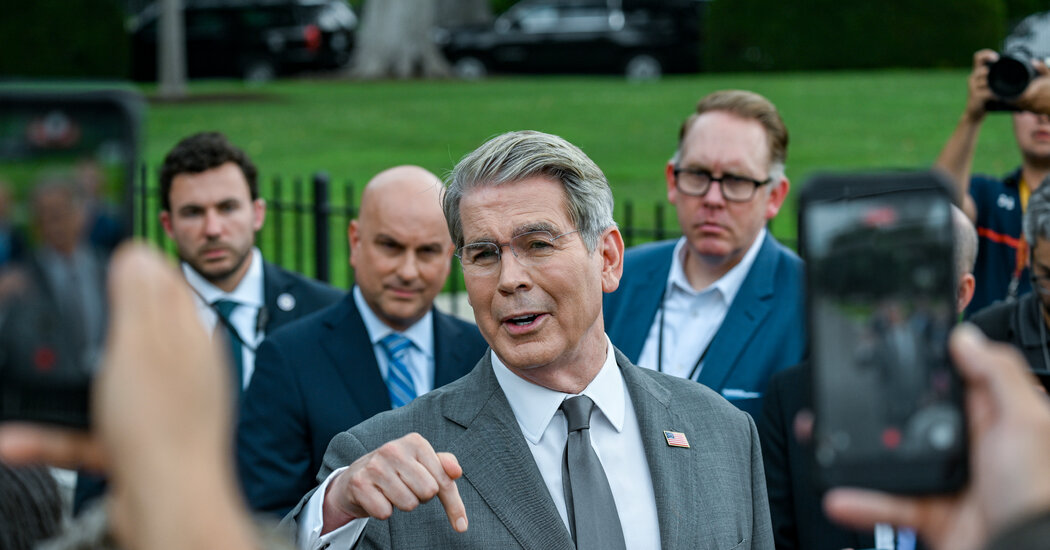
The U.S. Treasury Department, under the Trump administration, has recently increased its direct involvement in financial markets with the stated aim of influencing global economic conditions to benefit the United States, particularly by seeking to lower the cost of living. These efforts, however, are encountering significant market resistance.
This heightened assertiveness coincides with the U.S. gross national debt surpassing $40 trillion on Wednesday, August 20, 2026. This financial milestone is largely attributed to escalating interest payments on government debt held by investors. The combination of high interest rates and elevated consumer prices has reportedly contributed to a decline in public approval regarding President Trump’s economic management.
Earlier this week, Treasury Secretary Scott Bessent initiated a notable measure intended to stabilize the government bond market. He announced that the Treasury Department would double the volume of government debt it is authorized to repurchase from investors. This increase in buybacks was designed to mitigate the upward trajectory of long-term government bond yields, thereby aiming to curb overall borrowing costs for the government and potentially for consumers.
“Part of this is signaling and to show that we believe that yields don’t reflect the underlying fundamentals,” Mr. Bessent stated in an interview with CNBC on Thursday, clarifying the department’s rationale.
Secretary Bessent further articulated his willingness to expand the buyback program, asserting that current market valuations by investors do not accurately reflect economic realities. “We are trying to keep the market in equilibrium,” he added, indicating a desire to restore perceived balance.
Government bond yields, which represent the return investors demand for purchasing bonds and move inversely to bond prices, had recently surged to their highest levels since 2007. Following Mr. Bessent’s announcement on Wednesday, yields initially saw a temporary decline. However, by Thursday, yields began to rise again, highlighting the inherent complexities and challenges associated with such interventions when confronted with fundamental market dynamics that are causing investor apprehension.
This is not the Treasury Secretary’s sole strategy for moderating borrowing costs. The Treasury Department has also been increasing its issuance of short-term bills, which mature in less than one year, as a method to help maintain lower interest rates. This approach mirrors a tactic previously employed by Mr. Bessent’s predecessor, Janet L. Yellen. Notably, in 2024, Mr. Bessent had criticized Ms. Yellen for utilizing this very strategy, suggesting it was an attempt to ease financial conditions in the economy ahead of the presidential election.
Mr. Bessent has also engaged in other market interventions. Earlier this month, he executed a rare intervention in currency markets to bolster the weakening Japanese yen. The objective of purchasing the Japanese currency was to prevent Japan from potentially selling its substantial holdings of U.S. Treasuries to support the yen’s value. Such a sale by Japan could have injected a large volume of Treasuries into the market, potentially driving up yields as supply outstripped demand.
“I think it’s both economic and political,” commented Nellie Liang, who served as Under Secretary for Domestic Finance at the Treasury Department during the Biden administration. “They think these higher rates are a problem.”
Ms. Liang also pointed out that the bond buyback program was initially introduced by the Biden administration. She expressed surprise that Mr. Bessent’s recent announcement occurred without following the Treasury’s customary formal process. The Treasury Department has historically adhered to a strategy of making “regular and predictable” announcements for significant policy changes, typically during its quarterly refunding operations where debt issuance plans are detailed. The early August refunding, however, made no mention of expanded bond buybacks.
In the aftermath of Wednesday’s announcement, investors are left contemplating future market movements as yields continue their upward trend. Part of the challenge for Mr. Bessent, according to Sophia Drossos, an economist at the hedge fund Point72, is that “not all of the drivers of the rise in long-end yields are under direct control of the Treasury.”
The increase in Treasury yields stems from a confluence of factors. The U.S. fiscal outlook appears to be deteriorating, rather than improving. Lingering inflation concerns, partly fueled by the ongoing conflict with Iran, persist, alongside skepticism about whether Federal Reserve Chairman Kevin M. Warsh will proceed with further interest rate increases if inflation does not continue to ease. Additionally, a surge of new debt issued by technology companies to fund artificial intelligence development has added to the supply in the broader bond market.
In announcing Wednesday’s measure, the Treasury Department indicated a willingness to scale up its interventions as deemed necessary, suggesting that buybacks could become a more regularly employed tool if market conditions become disorderly. Potentially, sufficiently large buyback operations could have a sustained impact by fundamentally altering the available supply of bonds for buyers.
Thomas Simons, chief U.S. economist at Jefferies, estimates that buybacks in the range of $6 billion to $8 billion would be required to achieve such a lasting effect, representing a significant escalation in the Treasury’s market involvement. “At that point, the market would actually start to look at the fact that duration would actually be somewhat more scarce over time,” he stated, referring to longer-dated bonds.
Mr. Simons explained that the “term premium,” which is the additional compensation investors demand for holding longer-term securities compared to shorter-term ones due to increased uncertainty, would likely decrease. This reduction would translate into sustainably lower inflation-adjusted yields.
The Federal Reserve’s future policy decisions will also be a critical factor in determining whether long-term yields experience another upward surge, potentially necessitating further Treasury interventions.
Fed officials are currently in active deliberation regarding the necessity of raising interest rates at their upcoming meeting in mid-September. This decision largely hinges on the trajectory of inflation, following two recent reports that indicated a modest improvement in price pressures since June. While another month of moderate inflation data could alleviate some immediate pressure for a rate hike, it would not entirely eliminate the possibility of such action later in the year.
A number of officials have already expressed support for a rate increase, citing impatience with inflation having consistently exceeded the Fed’s 2 percent target for approximately five years. Any indication that progress towards this goal is faltering could persuade other officials to join this group.
Furthermore, Chairman Warsh is expected to pursue policies aimed at reducing the Fed’s substantial $6.8 trillion portfolio of government bonds and mortgage-backed securities, having advocated for a “leaner, meaner balance sheet” during a congressional hearing last month.
A reduction in the Fed’s balance sheet, depending on its implementation, could create a situation where the Fed is “at cross-purposes” with the Treasury, according to Blake Gwinn, head of U.S. rates strategy at RBC Capital Markets. “You’ve got Bessent, who obviously would prefer not to have long-end yields going up, and then you’ve got Warsh now suggesting that he’s going to tighten policy by pushing long-end yields up through balance sheet action,” Gwinn noted.
However, Mr. Warsh has also called for greater coordination between the Treasury and the Fed, suggesting that the central bank chairman may not act unilaterally. One potential area for alignment could emerge if the Fed modifies the composition of its balance sheet to hold more short-term securities rather than longer-term ones over time. This would align with Mr. Bessent’s preference for issuing Treasury bills, which mature in one year or less. Following Mr. Bessent’s buyback announcement, investors are already anticipating the possibility that he may reduce the issuance of longer-term debt in the future.
The Treasury Department explained its expansion of the buyback operation as a move to “provide greater liquidity support in longer-dated nominal sectors where there is consistent strong sponsorship from market participants.”
Upon assuming office last year, Mr. Bessent had acknowledged that elevated yields, particularly for the benchmark 10-year bond, were among his primary concerns. In an interview with Tucker Carlson, he described himself as “the United States’ leading bond salesman,” emphasizing the close correlation between the 10-year bond rate and mortgage rates. He further highlighted the immense volume of government debt that needs to be refinanced.
Why This Matters
The U.S. Treasury Department’s increasingly active role in direct market interventions signals a significant shift in economic policy under the Trump administration, departing from traditional hands-off approaches to managing government debt and market stability. This aggressive strategy has broad implications for the U.S. and global economies, financial markets, and the future of fiscal and monetary policy coordination.
For the **U.S. economy and everyday Americans**, these interventions are directly aimed at lowering borrowing costs. If successful, reduced long-term bond yields could translate into lower interest rates for mortgages, auto loans, and business investments, potentially stimulating economic activity and making housing more affordable. However, the current inability to sustainably suppress yields suggests that these benefits may not materialize easily, leaving consumers and businesses facing persistent high borrowing costs. The ongoing battle against inflation, coupled with the rising national debt, directly impacts the purchasing power of citizens and the overall economic outlook.
**Global financial markets** are closely watching these developments. U.S. Treasury bonds are considered a bedrock of the global financial system, and any perceived instability or unconventional intervention can trigger broader market jitters. The Treasury’s rare intervention to prop up the Japanese yen, for instance, underscores the interconnectedness of international currencies and the potential for U.S. actions to ripple across global markets. Investor confidence in the stability and predictability of U.S. economic policy is crucial, and unexpected announcements or frequent interventions could erode this trust, potentially leading to capital flight or increased risk premiums for U.S. assets.
The dynamic between the **U.S. Treasury and the Federal Reserve** is also a critical aspect. With Secretary Bessent actively working to lower long-term yields and Federal Reserve Chairman Warsh potentially seeking to raise rates and reduce the Fed’s balance sheet, there is a risk of conflicting policies. This potential for “cross-purposes” could undermine the effectiveness of both institutions and create confusion in the markets. Effective coordination is paramount to ensure consistent economic signals and avoid counterproductive policy outcomes, especially as the nation grapples with high debt, inflation, and the need for sustained economic growth.
Finally, the long-term **sustainability of the U.S. national debt** is a central concern. Surpassing $40 trillion, the debt is increasingly costly to service due to rising interest rates. While Treasury interventions aim to manage these costs, they do not address the underlying fiscal situation. The effectiveness of these measures will ultimately determine whether the U.S. can sustainably finance its operations without further exacerbating its debt burden or fueling inflation. This complex interplay of debt, inflation, and policy responses will shape the economic landscape for years to come, influencing both domestic prosperity and America’s standing in the global financial system.