
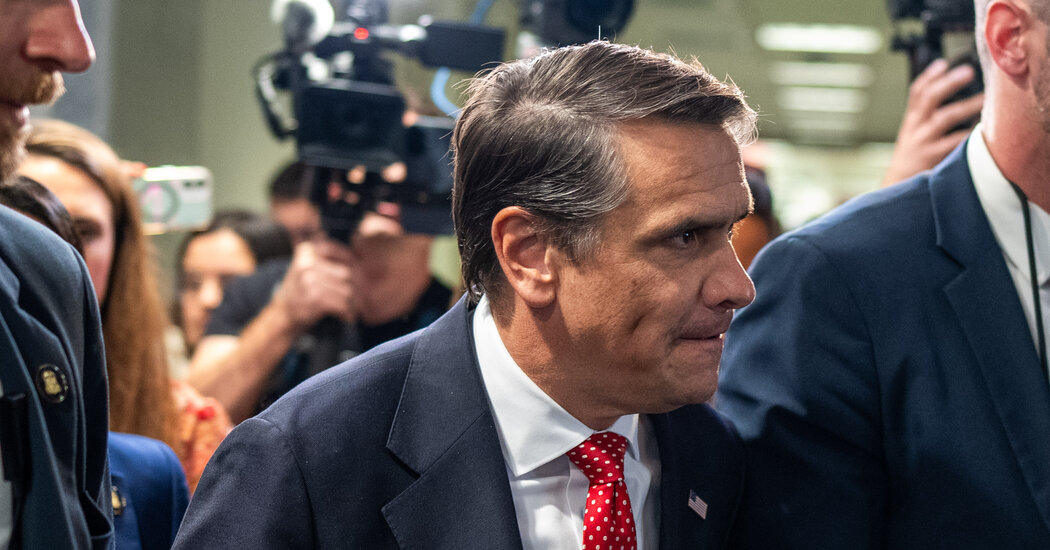
The United States Senate Judiciary Committee on Wednesday night postponed a scheduled vote on the nomination of Todd Blanche to serve as Attorney General. The postponement followed threats from two Republican senators, John Cornyn of Texas and Thom Tillis of North Carolina, to oppose the nomination over concerns related to a settlement agreement Blanche had negotiated in a lawsuit filed by former President Donald Trump against the Internal Revenue Service (IRS).
Senators Cornyn and Tillis, neither of whom is seeking re-election to Congress next year, indicated that they would not support Mr. Blanche’s nomination unless they received written assurances regarding modifications to specific provisions within the settlement deal. Their primary contention centered on Mr. Blanche’s alleged refusal to formalize commitments he had made verbally concerning the agreement.
The settlement in question stems from a lawsuit initiated by President Trump against the IRS. In June, Mr. Blanche had publicly stated his intention to remove one key aspect of the proposed settlement: a provision that would have established a $1.8 billion fund. This fund was intended to compensate individuals described as “purported victims of Biden-era actions by the Justice Department.” However, another controversial element of the settlement, a provision designed to shield Mr. Trump and his family from future tax investigations and audits, was stated to remain in place.
This tax audit shield emerged as the principal obstacle to Mr. Blanche’s confirmation on the eve of the Judiciary Committee’s scheduled vote. Senator Cornyn, a former state judge, who previously lost a primary election to a Trump-backed challenger, Ken Paxton, stated that he had not received adequate written assurances from Mr. Blanche. Specifically, Senator Cornyn sought guarantees that the audit shield would not extend to future tax liabilities incurred by Mr. Trump or his family, nor be broadened to include a wider circle of individuals beyond the immediate family.
Following a day of extensive discussions and negotiations, Senator Charles E. Grassley, the Republican chairman of the Judiciary Committee from Iowa, announced late Wednesday evening that the vote had been postponed. According to his spokeswoman, the delay was intended to allow negotiations to continue and “to secure sufficient support” for Mr. Blanche’s nomination, which was facing an uncertain path forward.
The situation highlights the complexities surrounding high-level executive appointments, particularly when issues involving a president’s personal financial matters intersect with governmental functions. Concerns have been raised by some lawmakers about the perceived implications of a tax deal that could offer a president what they view as significant financial advantages, potentially blurring the lines between personal and public interest in governance.
Senator Grassley, a long-serving Republican, did not provide a detailed explanation for why Mr. Blanche had, at that point, declined to provide the written assurances sought by some Republican colleagues. Many within the Republican party consider the request for formal removal of provisions seen as potentially creating conflicts of interest or preferential treatment to be a reasonable demand.
His office clarified that Senator Grassley was acting as an intermediary in the negotiations, stating that he “works to set President Trump’s nominees up for success in committee, not failure,” as conveyed by his spokeswoman. This underscores the leadership’s effort to navigate internal party disagreements and advance presidential nominations.
Throughout Wednesday, Senator Cornyn repeatedly conveyed his surprise and frustration that the administration had not readily complied with what he characterized as a straightforward request to delineate and limit the scope of the settlement deal. He emphasized the importance of clarity and formal documentation.
Senator Cornyn, publicly stating that he was “not prepared to vote yes” on Mr. Blanche’s nomination without further assurances, set a deadline of 4 p.m. for the Department of Justice to produce clear written guarantees concerning both the proposed $1.8 billion fund and the controversial tax deal. In a sign of the escalating tension, he also canceled a previously scheduled meeting with Mr. Blanche for Wednesday morning.
This ultimatum initiated a day of intense communication and negotiation between the senators’ offices and the Justice Department. Despite the urgency, there was no immediate indication that Mr. Blanche was either willing or authorized to make the requested concession in order to secure his confirmation as the Senate-approved head of the Justice Department. As acting Attorney General, Mr. Blanche can continue in his current role indefinitely, but a full confirmation requires Senate approval.
When questioned by reporters at the Oval Office, President Trump offered his perspective on Senator Cornyn’s resistance. He suggested that the senator’s stance might be a result of “pique” over his defeat in the primary by a candidate endorsed by the President. “I don’t know, maybe John Cornyn is upset with me because I didn’t endorse him,” President Trump said. “I don’t know what it is, but I haven’t heard that there’s a problem.”
Senator Cornyn dismissed President Trump’s characterization of his motives, telling reporters who followed him from meetings, “That’s a convenient excuse and it happens to be untrue.” This exchange highlighted the political friction surrounding the nomination.
For Mr. Blanche to be confirmed as Attorney General, a position he is widely reported to desire, he would need to secure the support of nearly all Republican senators, given the likely opposition from Democratic members. With Senators Cornyn and Tillis publicly withholding their support, he currently appears to be short of the necessary votes.
Senator Tillis, while expressing solidarity with Senator Cornyn’s concerns, appeared to be more optimistic about the possibility of an eventual resolution. He conveyed a belief that the differing sides would ultimately reach an agreement, thereby clearing the path for a full Senate floor vote on Mr. Blanche’s confirmation.
“We’re trying to work just to get the language,” Senator Tillis informed reporters. He added, “I really do believe it’s just a drafting exercise. I don’t believe that we’re apart in terms of the objective.” His statement suggested that the core disagreement might lie more in the precise wording of the agreement than in fundamental policy differences.
Senator Tillis further indicated his belief that the central unresolved issue remained “the remaining language on the audit” deal with the IRS. He also suggested that Senator Cornyn had already expressed comfort with the “language related to rendering the 1776 fund inoperative,” implying progress on one aspect of the dispute.
This is not the first instance of Senator Cornyn publicly scrutinizing Mr. Blanche’s prospective role. During Mr. Blanche’s confirmation hearing earlier this month, Senator Cornyn, joining some Democrats, questioned Mr. Blanche’s independence from potential influence by the White House. He refrained from committing to support the nomination at that time.
During the hearing, Senator Cornyn acknowledged Mr. Blanche’s public service but articulated the challenges of his potential transition. He remarked that it was a “very difficult position ‘to be the president’s personal lawyer, and then to end up being a member of the cabinet.'” This statement reflects a broader concern about potential conflicts of interest when an individual moves from advising a president personally to leading a major federal agency like the Department of Justice, which is tasked with upholding the law independently.
Justice Department officials had engaged in communications with Senator Cornyn’s staff over the preceding week in an effort to address his concerns and secure his support. An administration official, who possessed knowledge of these exchanges, indicated that there was an impression that Mr. Blanche had addressed many of Senator Cornyn’s apprehensions regarding the tax exemption. This exemption, if fully implemented, could potentially result in a financial benefit estimated at $100 million for Mr. Trump and his family.
Despite these efforts, Senator Cornyn’s dissatisfaction appeared to intensify as the day progressed. He issued another pointed remark, saying, “Why don’t you call over the Department of Justice and tell them they have one hour and 50 minutes to get me what I asked for?” He further explained the specificity of his request: “We actually sent them a red-line strikeout of what we need, and they just need to make a decision.” This indicated a detailed and actionable demand from the senator.
Senator Cornyn stated that he was unaware of the precise reasons for the delay in providing the requested written assurances. However, he did not discount the possibility that President Trump himself might be resolute in maintaining the tax provision as it currently stands.
“I can see why he wants it, because it provides immunity from audits no other taxpayer would get,” Senator Cornyn concluded, articulating his concern that the provision could grant a unique and potentially unfair advantage.
Why This Matters
The postponement of Todd Blanche’s confirmation vote for Attorney General highlights several critical aspects of American governance and the rule of law. Firstly, it underscores the Senate’s vital role in the system of checks and balances. The Senate’s power to advise and consent on presidential nominations is a cornerstone of democratic accountability, ensuring that high-ranking executive officials are thoroughly vetted and possess the independence and integrity required for their roles. This situation demonstrates the legislative branch’s willingness to use this power, even against a nominee from its own party, when significant concerns arise.
Secondly, the core issue at stake — a provision potentially shielding a former president and his family from future tax audits — raises fundamental questions about the principle of equal application of law. The Department of Justice, led by the Attorney General, is responsible for ensuring that all individuals are treated equally under the law, without preferential treatment or immunity. Concerns that a settlement could grant unique tax advantages to a former president could erode public trust in the impartiality of government institutions, particularly the IRS and the Justice Department itself. An Attorney General, as the nation’s chief law enforcement officer, must be perceived as fiercely independent and uncompromised by personal or political interests.
Thirdly, the dispute reflects the ongoing tension between presidential authority in appointments and the expectations of congressional oversight. The President has the prerogative to nominate his chosen officials, but the Senate acts as a crucial safeguard. The reluctance of the administration to provide written assurances, despite verbal commitments, suggests a potential power dynamic at play, where the executive branch seeks to maintain flexibility while the legislative branch demands concrete transparency. This friction can complicate the functioning of government, particularly for agencies like the Department of Justice, whose effectiveness relies heavily on public confidence in its neutrality.
Finally, this episode reveals internal divisions within the Republican Party, especially regarding accountability and the influence of a former president. The public opposition from Senators Cornyn and Tillis, both seasoned lawmakers not seeking re-election, indicates a willingness to challenge the party line on matters they deem fundamental. This highlights the complexities of party unity and the varying priorities among elected officials, particularly as the political landscape evolves. The outcome of these negotiations will not only determine the leadership of the Justice Department but also set a precedent for future interactions between the executive and legislative branches concerning sensitive financial arrangements and high-stakes nominations. It underscores the continuous effort required to balance political appointments with the imperative of maintaining the integrity and independence of federal institutions.