
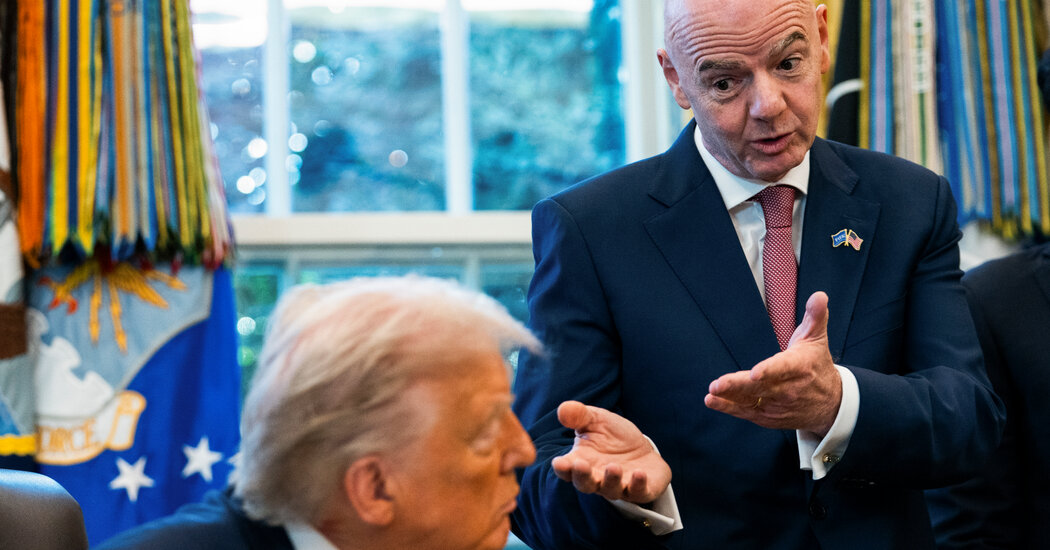
A telephone call between FIFA President Gianni Infantino and then-President Donald Trump, following the United States’ victory over Bosnia that secured the team’s path to the quarterfinals, has ignited a significant crisis within global football, casting doubt on FIFA’s claims of being a neutral arbiter of the world’s most popular sport.
According to Mr. Infantino, his communications with Mr. Trump regarding the World Cup are frequent and regular. However, this particular phone call has reportedly triggered one of the most substantial controversies in the World Cup’s 96-year history, further eroding confidence in FIFA’s governance.
Mr. Trump, by his own account, was observing the game on television when he learned that the U.S. team’s star striker, Folarin Balogun, would be ineligible for the upcoming quarterfinal match against Belgium. This exclusion stemmed from a red card Balogun received after an on-field review by the Brazilian referee. Perceiving this decision as unjust, Mr. Trump sought to intervene.
“All I did was ask for a review because I didn’t think it was a foul,” Mr. Trump stated, characterizing his action as an entirely ordinary request. This intervention, however, has led to widespread suspicions regarding the impartiality of sporting decisions at the highest levels.
The regulations governing red cards in soccer are generally understood and accepted: a player who receives a red card is automatically suspended for at least the subsequent match. Yet, when FIFA announced a reprieve for Mr. Balogun on Sunday, allowing him to play, many observers quickly drew parallels to a presidential pardon, given the extraordinary nature of the decision.
FIFA, an organization frequently embroiled in disputes, has sought to defend its actions through legalistic explanations concerning its processes and committees. The organization insists that Mr. Trump and Mr. Infantino were merely interested parties in a decision ultimately rendered by an independent committee, over which even FIFA’s top leader holds no direct sway.
“During our conversation, I explained that there was an ongoing legal process involving FIFA’s independent judicial bodies and that the case would be decided in due course by the competent bodies,” Mr. Infantino affirmed in a statement. “That is how FIFA’s system works, and it is a principle that I will always uphold.”
Despite these assurances, FIFA’s disciplinary system has long faced criticism for its lack of transparency. With support from the White House, U.S. Soccer successfully mounted a case that resulted in Mr. Balogun’s exemption from a suspension that other players receiving red cards in this World Cup have been unable to avoid. The committee responsible for this decision, chaired by Mohammad Al Kamali, a lawyer from the United Arab Emirates, comprises 18 members representing diverse nations such including Colombia, Tonga, Paraguay, and Vietnam.
On Monday, FIFA released a statement signed by “the chairperson of the FIFA disciplinary committee,” without explicitly naming Mr. Al Kamali. The statement listed 13 points but did not provide a clear rationale for why Mr. Balogun’s red card, while upheld, warranted a suspended one-game ban rather than an immediate one. It did, however, note that the committee “has the discretion to suspend any disciplinary measure.”
The deliberations of this committee are conducted behind closed doors. Nonetheless, sensitive cases are typically flagged to senior FIFA leadership, including Mr. Infantino, before final decisions are officially released. Committee officials also receive stipends and various benefits, such as luxury travel, as part of their engagement with FIFA.
Miguel Maduro, who served as FIFA’s inaugural head of governance appointed by Mr. Infantino, has voiced strong skepticism regarding the autonomy of these committees. He argues that they cannot be truly independent “under the current FIFA rules where they are ultimately selected by and dependent upon those whom they ought to control and be independent from.”
Mr. Maduro further elaborated on his assessment of FIFA’s internal mechanisms: “This is the reality at FIFA. They use the word independence, like they use the word peace, human rights or accountability. They use all the right words but have in place no governance instruments to give actual meaning to those words. It’s performative. Window dressing.”
Mr. Infantino has consistently sought to present himself as largely detached from the specifics of the disciplinary process. “I read the decisions of the FIFA Disciplinary Committee when they are issued,” he stated. “Sometimes I agree with them, and sometimes I disagree.”
Mr. Trump similarly attempted to counter accusations of undue influence. He maintained, “I don’t believe he made the decision,” referring to Mr. Infantino. “I think it was a committee that made the decision, and they made the right decision because, number one, it wasn’t a foul.”
The decision in Mr. Balogun’s case marks an unprecedented event in modern World Cup history, a fact that has provoked widespread indignation not only from the Belgian team but also from numerous soccer officials, coaches, and political figures globally. Compounding the controversy, a separate FIFA appeals committee subsequently ruled Belgium’s request to revisit the decision inadmissible.
This incident has intensified scrutiny on Mr. Infantino’s relationship with Mr. Trump and could potentially impact the FIFA president’s campaign for a new four-year term next year.
A wave of condemnation has emanated from across Europe. UEFA, European soccer’s governing body, released a strong statement, asserting, “When the certainty of rules is no longer guaranteed by its guardians, the integrity of the game is at stake and the credibility of a competition is undermined.” The statement continued, “We express our disbelief at such an unprecedented, incomprehensible and unjustifiable decision.”
Mr. Infantino’s association with President Trump has previously drawn criticism. Lise Klaveness, who chairs Norway’s soccer federation, had previously accused Mr. Infantino of violating FIFA’s regulations on political neutrality when he presented a newly created FIFA peace prize to Mr. Trump in December. Ms. Klaveness reiterated her concerns on Monday.
“Such a suspension is not subject to appeal,” Ms. Klaveness stated. “When FIFA nevertheless clears the player to participate in the next match without providing any explanation, there is reason for concern regarding the integrity of the competition, political interference in sporting matters, and the credibility of football.”
The German Football Association echoed these sentiments. Its statement read: “The impression that there has been active political interference in sport must be dispelled swiftly and conclusively. The integrity of the competition and the credibility of FIFA are at stake.”
Despite the growing anger and widespread criticism, Mr. Infantino has consistently maintained that no impropriety occurred. He continues to assert that “independent institutions and the rule of law is what protects the integrity of our competitions and the credibility of FIFA at all times.”
Why This Matters
The controversy surrounding Folarin Balogun’s red card reprieve transcends a single player’s eligibility; it strikes at the fundamental integrity and credibility of global football’s governing body, FIFA. At its core, the incident raises critical questions about whether the rules of the game are applied uniformly and impartially, or if they can be influenced by political power and personal connections.
Firstly, the principle of sporting fairness is paramount. For many, the unwritten contract of sport dictates that rules are clear, consistent, and universally applied. When a decision lacks precedent and deviates from established norms without clear, compelling justification, it undermines the very notion of fair play. This perception of unequal treatment can breed cynicism among fans, players, and national federations, eroding the trust that underpins competitive sports.
Secondly, the episode highlights persistent concerns about FIFA’s governance and transparency. Despite past reforms aimed at combating corruption and improving accountability, the opaque nature of the disciplinary committee’s decision-making process—and the organization’s legalistic but vague explanations—reignites fears of internal manipulation. Critics argue that a body claiming independence cannot genuinely be so if its committees are perceived as beholden to or influenced by the very leadership they are meant to scrutinize. This lack of clear, public reasoning for an exceptional decision fuels accusations of “window dressing” rather than genuine reform.
Thirdly, the alleged political interference sets a troubling precedent. The involvement of a head of state in a disciplinary matter, regardless of intent, blurs the lines between political power and sporting administration. Such actions can open the door for future attempts by powerful figures to exert influence over sporting outcomes, potentially transforming the beautiful game into a tool for political leverage rather than a pure athletic contest. This also challenges FIFA’s stated commitment to political neutrality, a principle vital for an organization overseeing a truly global sport.
Finally, the controversy has direct implications for FIFA President Gianni Infantino’s leadership and his upcoming re-election campaign. His close relationship with Mr. Trump and the widespread condemnation from influential European football bodies like UEFA and the German FA suggest that this incident will weigh heavily on his reputation. The credibility of FIFA, and by extension its leader, is intrinsically linked to the public perception of its impartiality. A perceived failure to uphold this impartiality could weaken Mr. Infantino’s standing and potentially lead to further calls for structural reforms within FIFA, reshaping the future direction of international football governance.