
Key Takeaways
- Unifying Databases for AI:Munich-based CedarDB is challenging the traditional split between analytical (OLAP) and operational (OLTP) databases, offering a single engine designed to handle both, a capability becoming critical with the rise of agentic AI.
- Performance-Driven & PostgreSQL Compatible:Spun out of the Technical University of Munich’s Umbra research, CedarDB prioritizes extreme efficiency on modern hardware, promising faster performance with fewer resources, and ensures low switching costs through deep compatibility with the popular PostgreSQL system.
- Strategic Cloud Expansion:After initially launching on-premise, CedarDB announced limited availability of its fully managed cloud offering at TechCrunch Disrupt, positioning itself to expand beyond large enterprises and compete directly with major players like Databricks in the evolving “agentic era.”
CedarDB Unifies Data Paradigms, Paving the Way for the Agentic AI Era
For decades, the world of databases has been neatly compartmentalized. Businesses relied on analytical databases (OLAP) to sift through vast datasets, spot trends, and extract insights, while operational databases (OLTP) diligently recorded the relentless stream of daily transactions – orders, payments, user interactions. This architectural divide, born of differing performance requirements, has long been a bedrock of enterprise data infrastructure. However, a seismic shift is underway, driven by the emergence of agentic AI, and Munich-based CedarDB is at the forefront, proposing a radical unification of these two previously distinct worlds.
Cofounder and CEO Moritz Sichert emphasized to TechCrunch that CedarDB’s ability to support both analytical and operational workloads from a single engine is not just an efficiency play; it’s a necessity for the future of AI-driven applications. The company, which has been honing its technology for the better part of a decade, is now finding significant momentum among enterprise companies whose existing, often cumbersome, data stacks are ill-equipped to handle the demands of modern AI – particularly the ability to query complex historical data in natural language with speed and precision.
Beyond the Divide: Efficiency as a Guiding Principle
CedarDB’s innovative approach to transcending the OLAP/OLTP divide isn’t a mere feature addition; it’s a byproduct of a foundational focus on extreme efficiency. The company originated as a spinout from the Technical University of Munich, built upon the formidable Umbra research project. Umbra was conceived from the ground up with a singular mission: to outpace legacy database engines by intelligently leveraging the full potential of modern hardware architectures. This meant rethinking fundamental data processing paradigms to minimize latency, optimize memory usage, and maximize CPU utilization.
The five Umbra researchers who cofounded CedarDB carried this ethos forward. Their promise is compelling: significantly faster performance without demanding an increase in CPUs, processing power, or memory. This gain in efficiency also translates into a remarkably low barrier to entry for customers, requiring minimal changes to their existing applications and data pipelines. A critical strategic decision underpinning this was ensuring CedarDB’s robust compatibility with PostgreSQL, the ubiquitous open-source database system.
PostgreSQL Compatibility: A Strategic Advantage for the AI Age
Sichert highlighted the profound impact of PostgreSQL compatibility. From a practical standpoint, it drastically reduces switching costs, as developers don’t need to undertake the arduous task of rebuilding their applications from scratch. This familiar interface and ecosystem allow for seamless integration into existing IT environments. However, the advantages extend beyond mere convenience. In a fortunate turn of events, this compatibility also means CedarDB operates on logic and data structures highly familiar to large language models (LLMs), given their extensive training on vast corpora of code and data, much of which is rooted in SQL and relational database schemas.
While some decisions proved serendipitous in retrospect, Sichert acknowledged that not all choices were made on a whim. Cofounder Christian Winter detailed in a blog post the deliberate priorities set by the team post-academia. These included fundamental enterprise requirements such as “reliability, fault tolerance and compatibility with popular tools” – elements crucial for any database aspiring to handle mission-critical data. The path forward was not always clear-cut; for instance, the team engaged in vigorous debate over whether to launch a cloud offering immediately.
From On-Prem to Cloud: Expanding Reach
Ultimately, a phased approach was chosen. In May of last year, coinciding with the announcement of a substantial €5.3 million (approximately $6 million) seed funding round, CedarDB officially launched CedarDB Enterprise as an on-premise solution, alongside its free, feature-rich CedarDB Community Edition. This allowed the company to establish its core technology and cater to large organizations with specific data residency or security requirements.
The cloud offering, however, was merely delayed, not abandoned. After a period of intensive beta testing with a dedicated waitlist of early adopters, CedarDB made a significant announcement on Wednesday. On stage at TechCrunch Disrupt, where the company is currently competing with 20 other promising startups in the prestigious Startup Battlefield competition, CedarDB unveiled the limited availability of CedarDB Cloud. This fully managed, cloud-hosted version is a strategic move, poised to significantly expand CedarDB’s user base beyond its initial large enterprise focus and democratize access to its powerful unified database engine.
Validation from the Giants: The Agentic Era Arrives
The timing of CedarDB Cloud’s launch is particularly prescient, aligning with a broader industry shift. Major data players, such as Databricks, appear to have arrived at a strikingly similar conclusion regarding the future of data architecture. At its Data + AI Summit in June, the American data giant explicitly cited “the agentic era” as the driving force behind its own launch of LTAP (Lakehouse Transactional Analytic Platform) – a new data architecture designed to “[unify] transactions, analytics, streaming, and operational data on a single copy of storage in the lake.”
While it is too early to definitively gauge the full disruptive impact of these parallel developments, Sichert interprets Databricks’ move as a powerful validation of CedarDB’s core premise: there is a clear, escalating demand for unified data processing capabilities. CedarDB plans to support its initial cloud users with its current lean team of 14 people. However, as traction grows and the user base expands, Sichert anticipates the need for a significantly larger team, signaling the opportune moment for their next funding round.
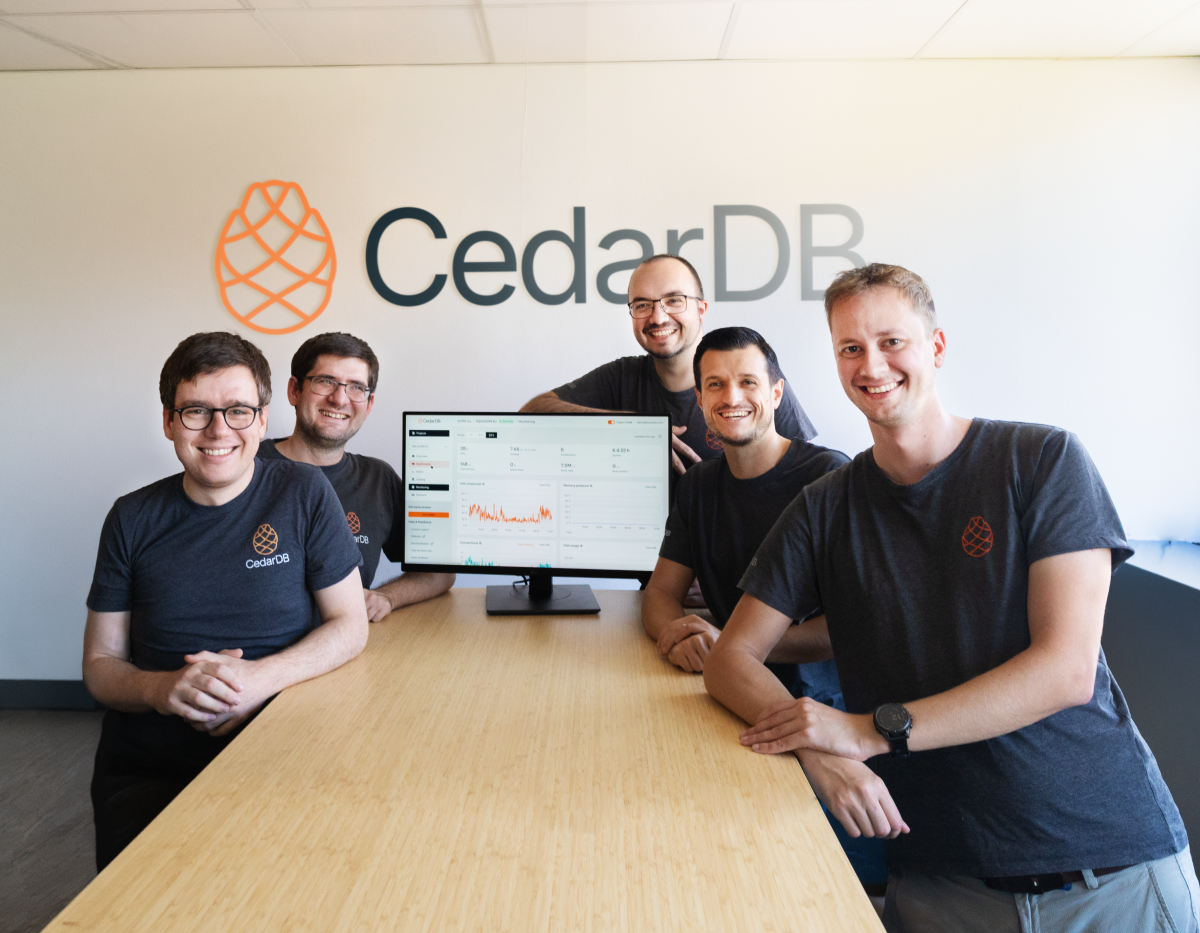
Pictured from left to right: CedarDB founders Moritz Sichert, Lukas Vogel, Philipp Fent, Dominik Durner and Christian Winter.
Bottom Line
CedarDB represents more than just another database; it embodies a forward-thinking re-architecture of data management tailored for the demands of the AI-driven future. By efficiently unifying operational and analytical workloads within a PostgreSQL-compatible engine, CedarDB is not only solving immediate enterprise pain points but also proactively building the foundational data layer necessary for agentic AI systems to thrive. As major industry players validate this unified approach, CedarDB’s strategic move into the cloud positions it as a nimble, yet powerful, contender ready to redefine how businesses interact with their most critical asset: data.
When you purchase through links in our articles, we may earn a small commission. This doesn’t affect our editorial independence.
{content}
Source:{feed_title}