
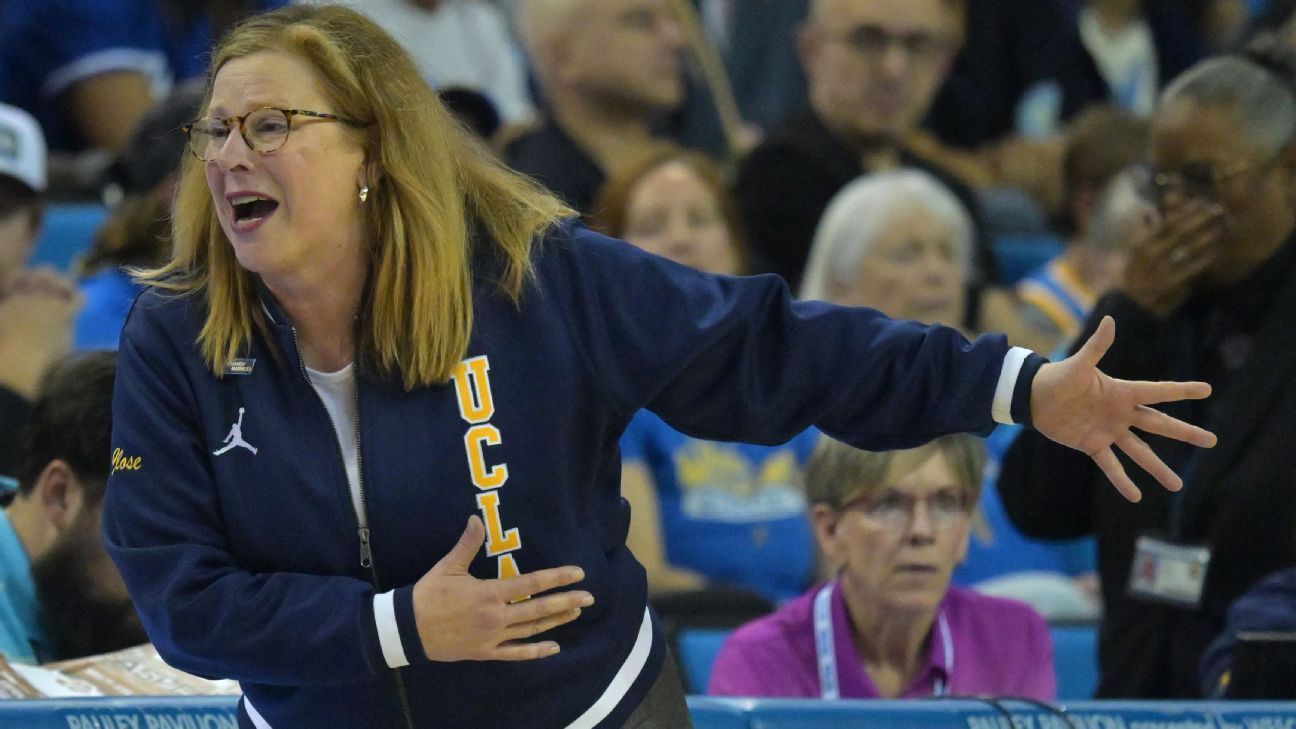
A considerable response has followed UCLA coach Cori Close’s declaration that she is uncertain about her ability to persist within the evolving NCAA landscape.
Close expressed, “I have never felt such weariness as in the past two years, which has prompted me to ponder my capacity to continue in this role.” Close, who is set to guide top-ranked UCLA against fourth-seed Minnesota on Friday in the Sacramento Region 2 semifinal, added, “I am simply being candid with you concerning this. Numerous aspects have become more challenging, and we are continually seeing remarkable individuals depart from both the men’s and women’s programs.”
Upon being informed of Close’s remarks, Louisville coach Jeff Walz, a 54-year-old in his nineteenth season with the Cardinals, showed no indications of nearing retirement.
“Cori and I are friends,” Walz stated. “My preferred adage, which I would convey to her, is: if your current occupation is unsatisfactory, then seek alternative employment. I mean, this morning at 4:20, I was hearing the laborers working outside my hotel window in the street. You opt for your occupation. If it doesn’t suit you, then pursue a different career path.”
Walz had been addressing reporters before 8 a.m. Texas time on Friday morning, ahead of the Cardinals’ Sweet 16 match against Michigan in the Fort Worth Regional 3.
“Certainly, it is an arduous undertaking, yet we deliberately chose this path and are remunerated for our efforts,” Walz remarked. “I doubt anyone will express much pity for us merely because we might be fatigued. I am also weary, but is anyone truly exempt?”
Close has dedicated 33 years to coaching, 15 of them at UCLA; however, Name, Image, and Likeness (NIL) policies and the transfer portal have profoundly transformed the sport’s competitive landscape.
Several veteran mentors have departed their positions over recent seasons due to a multitude of factors, including medical concerns. Others, meanwhile, have contemplated stepping aside from their careers.
According to Wolverines coach Kim Barnes Arico, the exhaustion experienced in coaching is predominantly about evolving, rather than being primarily a matter of age.
Barnes Arico recalled, “When these changes began to emerge a few years ago, I recognized as a mentor – and communicated with our athletes and our personnel – that the era was shifting.” She emphasized, “We must adapt, we must progress, and we must rise to the demands, because failure to do so means the sport, its environment, and everything else will simply overtake us.”
In contrast to Close, who was candid about the transforming environment, Duke coach Kara Lawson avoided commenting on the current condition of the sport.
“I am not aiming to become the primary spokesperson for collegiate athletics, or anything of that nature. That is not a personal objective,” she stated. “I believe numerous other individuals excel at fulfilling that role.” Lawson continued, “As for me, I’ve been involved with college basketball for what I believe is my sixth year. When I arrived, the entire dynamic began to transform. Consequently, I lack a perspective on past methods because I did not experience coaching under former systems. For me, evolution has simply been the norm.”
Content from The Associated Press was incorporated into this account.