
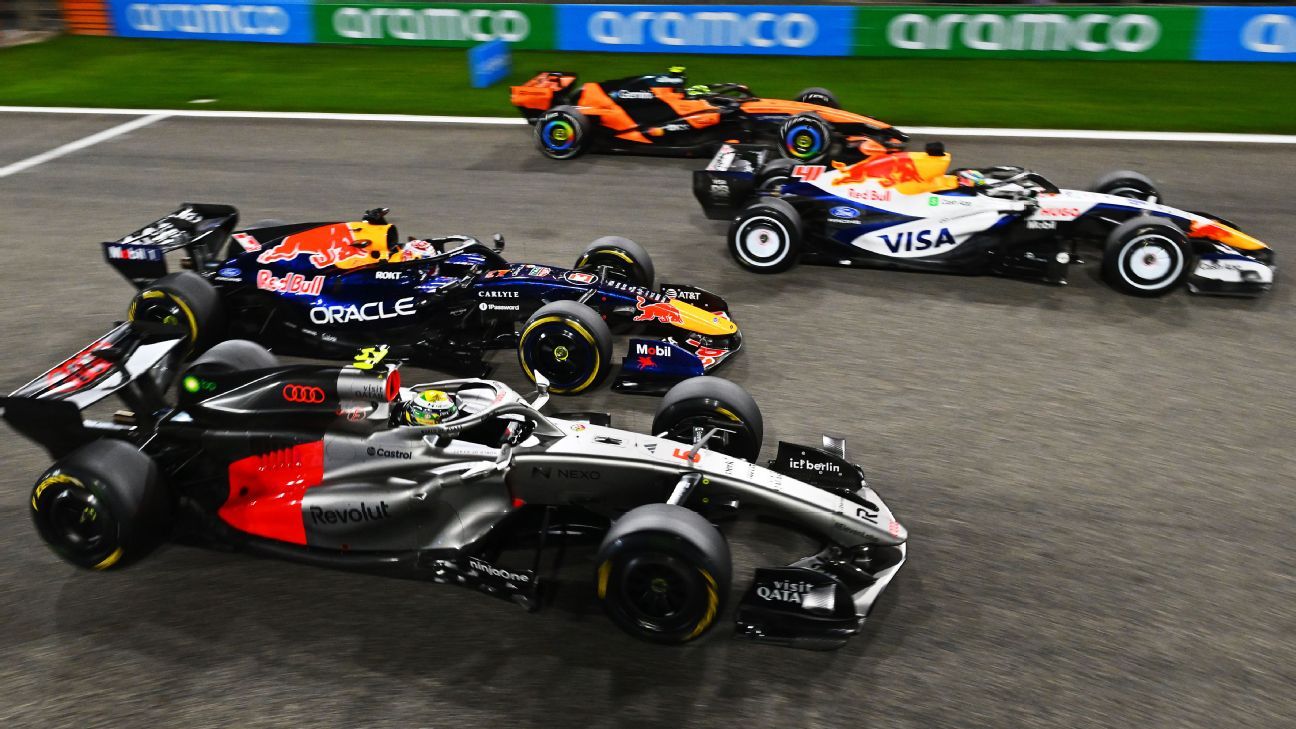
The commencement of Grand Prix races has consistently harbored the prospect of pandemonium, however, this season, considerable excitement is virtually certain as the starting signals disappear in Australia this Sunday. An unforeseen outcome stemming from modifications to Formula 1’s propulsion system rules has rendered it markedly more challenging to achieve a flawless departure from the starting line, thereby generating the likelihood of widespread alterations in ranking prior to the initial turn.
Initial practice launches during trials proved so problematic that Andrea Stella, McLaren’s team principal, voiced apprehensions regarding potential impacts, given that some vehicles struggled to depart their starting positions while others executed flawless commencements. This situation has already prompted adjustments to F1’s launch protocol, affording all competitors additional preparation time on the starting grid.
Prominent figures such as Max Verstappen have subsequently minimized safety worries, stating that drivers are at liberty to commence from the pit lane if apprehension arises; nevertheless, the potential for a substantial rearrangement of positions persists once the starting lights are extinguished.
– Bold predictions for F1 in 2026: Ferrari will end its title drought
– Australian Grand Prix 2026: Race start time, how to watch, full schedule
– Does winning first race of F1’s new era guarantee title?
What’s the issue?
The primary difficulty is an occurrence termed turbo-lag, which presents itself as a postponed surge in speed when the pilot engages the accelerator. Turbo-lag arises as turbocharged powerplants must generate adequate exhaust gas force to rotate the turbocharger before it can supply the amplified air benefit to the engine. In essence, it represents a rather boisterous conundrum of cause and effect.
Within the preceding configuration of turbo-hybrid regulations, the intricate Motor Generator Unit-Heat (MGU-H) provided the solution. The MGU-H constituted an extraordinary component of the hybrid framework, not only producing electrical current from the rotating turbo but also capable of functioning as an electric motor to propel the turbocharger in the absence of exhaust gas pressure.
In accordance with F1’s revised stipulations for 2026, the complex and costly MGU-H technology has been eliminated from the propulsion systems to facilitate the entry of new competitors like Audi and Red Bull into the sport. While beneficial, this implies that F1’s comparatively sizable turbochargers must now depend solely on exhaust emissions from a 1.6-liter engine to achieve the ideal boost pressure for rapid acceleration.
‘Yet, concerning the MGU-K?’ we can imagine engineering scholars inquiring. Despite remaining a fundamental element of the 2026 power unit and possessing unprecedented potency, the Motor Generator Unit-Kinetic is prohibited from activating and supplying electrical power to the rear wheels until the vehicle attains a speed of 50 km/h. Consequently, it cannot assist with the sluggish reaction caused by turbo-lag during the initial launch phase and only becomes operational after the most severe effects of turbo-lag have dissipated.
A basic remedy involves revving the engine before the commencement to accumulate boost pressure, and precisely this sound was audible from the vehicles periodically throughout preseason trials. However, for a majority of drivers, this operation required over 10 seconds to yield acceptable outcomes, and even then, they were obliged to decrease engine revolutions and disengage the clutch at the precise instant to execute an impeccable launch.
“Goodness, it’s intricate,” remarked Audi competitor Gabriel Bortoleto during the inaugural week of preseason trials in Bahrain. “The 10-second process, then after five seconds I’d already lost track, and subsequently the engine is accelerating, gears engaging and disengaging, and one must release the clutch. It’s quite chaotic. It was considerably simpler last year.”
What’s changed?
To afford all 22 competitors a fair prospect of executing an unblemished commencement, an additional five-second pause has been incorporated into the start protocol preceding the signal to launch. An apprehension existed that vehicles positioned at the rear of the grid would lack sufficient time to generate boost pressure under the standard start procedure, resulting in sluggish departures for the latter half of the field or hurried endeavors that activated the car’s anti-stall mechanism, leaving the driver as a helpless obstruction on the circuit.
The revised launch sequence tested during trials is detailed below:
– Following the formation lap, the final vehicle returns to its grid position, and a flag official brandishes a green flag at the rear of the pack.
– The flag official indicates the commencement of the protocol, but instead of the initial light of five illuminating, a five-second postponement is begun. During trials, azure lights were exhibited on panels alongside the grid to communicate this segment of the process to the drivers.
– Upon the conclusion of the five seconds, the first crimson light activates, succeeded by four additional ones at single-second intervals.
– After all red lights are visible, the designated race initiator determines when to deactivate them and commence the competition.
Who’s making the best starts?
The discrepancy in launch performance during testing rapidly became a prominent topic of discussion. Ferrari seemed to exhibit the most reliable departures, and during a trial launch on the grid in Bahrain, Lewis Hamilton advanced from the 11th spot to overtake George Russell’s Mercedes, which began from pole position, by the initial bend. Even though Russell might have eased off slightly after his initial launch, the Ferrari’s rapid acceleration was unmistakable.
“To secure victory in a race, one must also make a rather strong departure from the starting line,” stated Russell. “And I believe the two starts I executed this week were inferior to my poorest ever launch in Formula 1. And Lewis, from the 11th position, reached the first. Thus, at this juncture, I doubt your qualifying pace is particularly significant. I believe what will hinder you will invariably be that most formidable obstacle. And that is what we are currently attempting to comprehend, and we are encountering difficulties at present.”
The potent launches demonstrated by Ferrari were likewise reflected by the Haas and Cadillac teams, which employ Ferrari’s propulsion system. The prevailing hypothesis suggests that Ferrari’s engine is equipped with a more compact turbocharger than those of its adversaries, thereby simplifying the driver’s task of attaining the ideal boost pressure prior to the starting signal. However, while certain benefits will probably be inherent in the design, it is also true that launch performances will enhance as drivers gain more experience.
“I believe it’s quite unpredictable at present, and I think we are all somewhat discovering what constitutes an effective launch and what constitutes a poor one,” stated McLaren driver Oscar Piastri. “There are some rather significant traps one can encounter if difficulties arise. Yet, merely managing the power output and the protocol is one aspect, but additionally, the manner in which we execute launches is considerably more challenging than last year. It’s more complicated from every perspective. And I believe what we are observing currently is some individuals executing things correctly while others are performing them quite poorly. Therefore, I certainly anticipate that in the initial few races, we might witness some launches somewhat resembling what we observed this week. However, I believe we will hopefully begin to align rather swiftly if one finds oneself on the less favorable end of that spectrum.”
Nonetheless, Sunday’s crucial “starting signal” moment in Australia will be essential viewing.