
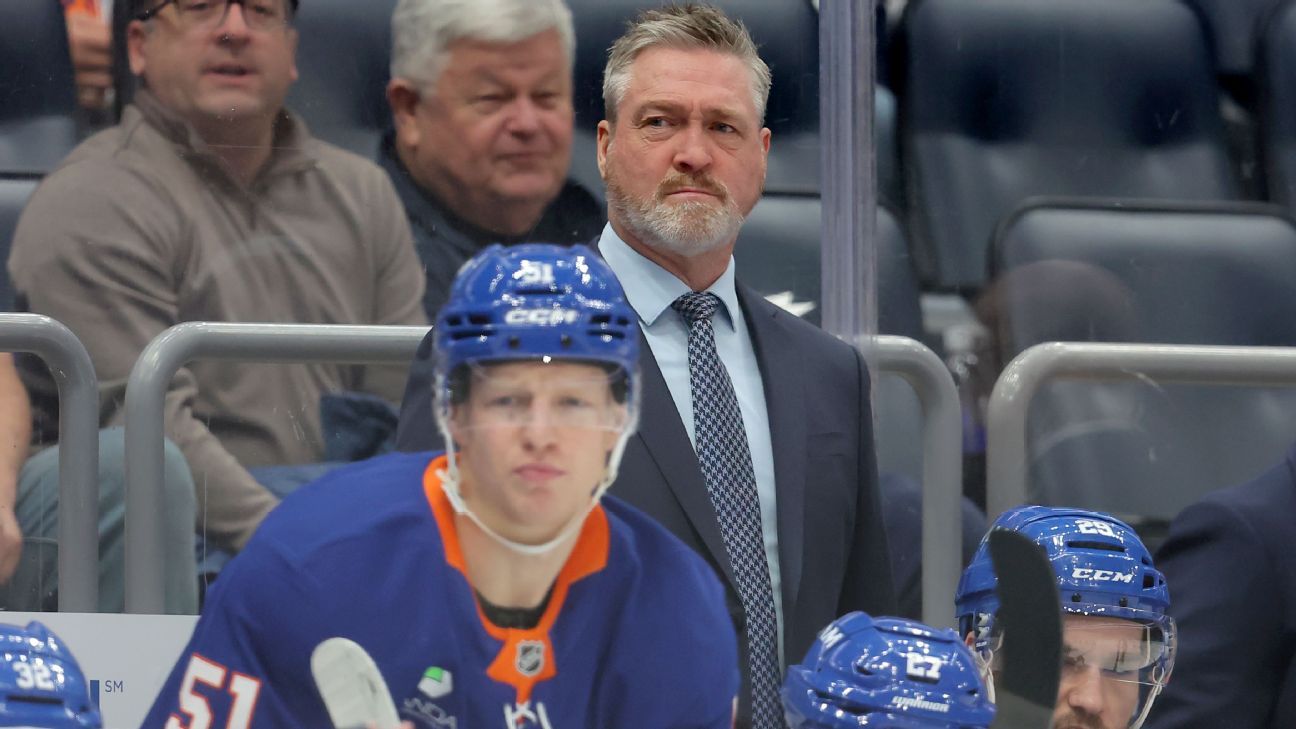
NEW YORK — The axe has fallen on Long Island, and it’s a seismic tremor rattling the very foundations of the New York Islanders’ playoff hopes. In a stunning, yet perhaps inevitable, move that reverberates across the NHL landscape, Hall of Fame goaltender turned coach Patrick Roy has been unceremoniously relieved of his duties, another high-profile casualty in an NHL season defined by its relentless competitive grind and sudden leadership changes.
First-year General Manager Mathieu Darche, barely settled into his new role, wasted no time making his presence felt, pulling the trigger on arguably the most impactful decision of his young GM career. With just four critical games left in the regular season, Darche announced the abrupt parting of ways with Roy, immediately naming Peter DeBoer as his full-time replacement. The timing is brutal, but the necessity undeniable. Just weeks ago, the Islanders seemed poised for a comfortable postseason berth, riding a wave of mid-season momentum that belied their earlier struggles. But the spring air has brought not bloom, but blight to UBS Arena. A crippling four-game losing streak, coupled with a dismal 3-7-0 record over their last ten outings, has seen the once-promising playoff picture dissolve into a murky, desperate scramble. From a position of relative security, the Islanders now gaze up at the playoff bar, needing not just wins, but significant help, a stark testament to a team that lost its way precisely when it mattered most.
Roy’s departure marks the second NHL coaching change in as many weeks, following the Vegas Golden Knights’ decision to fire Bruce Cassidy and install John Tortorella on an interim basis. This rapid turnover underscores the immense pressure and razor-thin margins defining the league’s competitive balance.
Stepping into the void is Peter DeBoer, a seasoned bench boss whose resume gleams with two Stanley Cup Final appearances and a recent run of three consecutive Western Conference Finals with the Dallas Stars before his departure last year. Fresh off serving as an assistant on Canada’s staff at the Milan Cortina Olympics, the 57-year-old DeBoer isn’t a long-term project; he’s a proven winner, a strategic mind brought in to galvanize a team teetering on the brink. This isn’t a rebuild; it’s a desperate plea for immediate course correction, a high-stakes gamble on a coach known for his ability to squeeze every ounce of potential from his rosters and make an immediate impact.
Roy’s tenure, initially hailed as a jolt of energy, now feels like a fleeting spark that quickly faded. Hired by former GM Lou Lamoriello in January 2024 as a midseason replacement for fired coach Lane Lambert, Roy’s arrival coincided with a late-season surge that propelled the Islanders into the playoffs, where they ultimately fell in the first round to Carolina. The question lingering in the air is whether that initial success was a true reflection of coaching brilliance or merely a “new coach bump” masking deeper structural issues. The subsequent regression, marked by inconsistent play, defensive lapses, and a baffling inability to close out games, suggests the latter, with a team that often looked discombobulated, lacking consistent identity and tactical cohesion when the chips were down.
The timing of this dramatic shake-up couldn’t be more pivotal for the organization. The Islanders boast a generational talent in Matthew Schaefer, a rookie-of-the-year front-runner whose 18-year-old brilliance has been a lone beacon of consistent excitement. Add to that a pipeline brimming with promising prospects, and the organization stands at a critical juncture. The next coach isn’t just guiding a struggling team; they’re shaping the developmental trajectory of a potentially dominant core. Darche’s swift move signals an urgent desire to maximize this window, to ensure the burgeoning talent isn’t squandered by an environment lacking direction or accountability.
Game Highlights: The Downward Spiral
The Islanders’ recent struggles have been particularly painful, marked by a series of agonizing losses that illustrate the team’s unraveling under Roy:
- March 28 vs. Pittsburgh Penguins (L 5-2):In a crucial divisional showdown, the Islanders delivered a lifeless performance, surrendering three power-play goals in a disjointed second period. Despite a spirited, albeit too late, push in the third, the defensive breakdowns and lack of offensive finish were glaring. Goaltending, usually a strength, looked vulnerable, reflecting a team crumbling in front of it. The lack of discipline and inability to contain key opponents’ offensive threats were stark.
- April 2 vs. Philadelphia Flyers (L 4-3 OT):A gut-wrenching overtime loss to the rival Philadelphia Flyers epitomized the Islanders’ late-season fragility. Leading 3-2 with less than five minutes left in regulation, the Islanders surrendered a soft tying goal, then collapsed in overtime on a defensive miscue, handing the Flyers a crucial extra point. The inability to close out games, the tentative play with a lead, and the recurring special teams woes (another crucial penalty kill failure) were all on full, agonizing display. This was a game they simply *had* to win.
- April 5 vs. Washington Capitals (L 2-1):In what many saw as a playoff elimination game against a direct rival, the Islanders mustered just 22 shots on goal, looking anemic and creatively bankrupt in the offensive zone. Their lone goal came from a deflection, a testament to their inability to generate sustained pressure. Despite a heroic effort from their goaltender, the team simply couldn’t find the necessary spark or tactical ingenuity to break down a disciplined Capitals defense, sealing their fate as a team unable to rise to the moment.
The writing, it seems, was on the wall. While Roy’s initial impact was undeniable, the tactical nuances, the consistent message, and the demanded accountability appeared to wane. Players looked increasingly disengaged and confused, particularly in critical situations. Defensive schemes, once tight, began to unravel, and an offense that struggled for consistency never truly found a reliable identity under Roy. Darche’s swift action suggests a loss of confidence not just in the results, but in the process, and perhaps, crucially, in the locker room’s belief in the coach’s vision. The urgency of the playoff race, coupled with the long-term vision for Schaefer and the impressive prospect pipeline, made this decision a brutal necessity rather than a luxury.
Prediction: Immediate Impact, Long-Term Vision
With Peter DeBoer now at the helm, the immediate future is a high-wire act. Can he instill enough discipline and tactical clarity in four games to salvage a playoff spot? It’s an uphill battle, and while DeBoer’s pedigree suggests he’ll demand accountability and simplify the gameplan, focusing on fundamentals, the statistical odds are stacked against them. However, don’t be surprised if the Islanders play with renewed vigor and structure under their new coach, potentially spoiling someone else’s playoff party in the final stretch. Looking further ahead, this move signals a new era of aggressive management on Long Island, one determined to build a sustainable winner around their burgeoning young talent. The Islanders may miss the playoffs this year, but with DeBoer charting the course, expect a more disciplined, analytically driven, and ultimately more competitive team to emerge from the ashes of this tumultuous season. The Patrick Roy era is over; the Peter DeBoer era begins with a clear, albeit challenging, mandate: win now, and build for the future with a renewed sense of purpose.