

The roar of the crowd faded into a haunting silence, replaced by the crushing weight of a dream denied. Lionel Messi, the maestro who had once again carried a nation’s hopes on his slender shoulders, stood amidst the confetti of Spain’s triumph, tears streaming down a face etched with unimaginable pain. La Roja had done it – dethroned the reigning champions, Argentina, in a tempestuous World Cup final that left the footballing world breathless, and its greatest icon in agony.
Ferran Torres’ extra-time strike, a dagger plunged into the heart of Argentine aspirations, settled an encounter that was less a game and more a gladiatorial contest. For Messi, at 39, this may well have been the final, heartbreaking chapter of his storied international career. He wept openly on the pitch, a raw, unvarnished display of emotion that spoke volumes, before disappearing into the locker room, skipping the obligatory post-match interviews alongside his shell-shocked teammates. The weight of the moment was simply too much.
“Thank you from the bottom of my heart for every greeting and message,” Messi later penned on Instagram, his words a testament to the profound connection he shares with his homeland. “The pain is immense and this wound will take time to heal. Once again, we managed to unite as a country and stand together, sharing the immense pride of being Argentine.” His message, a blend of gratitude and raw sorrow, underscored the collective experience of a nation that lived and breathed every kick. “It is hard to fully appreciate our achievement right now, but this group reached two consecutive World Cup finals.” A remarkable feat, indeed, but one currently overshadowed by the bitter taste of silver.
Lionel Messi: A Tournament for the Ages, A Legacy Cemented (Almost)
Even in defeat, Messi’s tournament was nothing short of sensational. At 39, an age where most outfield players are long retired, he contributed an astounding eight goals and four assists in eight matches. This wasn’t just a swan song; it was a masterful performance that cemented his status, if it wasn’t already, as the greatest of all time. He led his country to glory in 2022, and at this edition, he was only outscored by the indomitable Kylian Mbappé, whose 10 goals continue to push the boundaries of modern football. Mbappé remains the only player to have eclipsed Messi’s all-time total of 21 goals at the finals, a staggering statistic that highlights the Argentine’s longevity and consistent brilliance on the biggest stage.
“I also hold onto all the good things,” reflected Messi, whose 125 goals and 207 caps are unsurpassed for Argentina, records that may stand for generations. “The matches we turned around by giving it our all – moments that will remain in our memories forever – and the support of an entire country which, combined with this group’s hard work and effort, brought us back among the world’s elite once again.” His words acknowledge the profound impact this squad had, transforming a nation’s footballing identity from one of perpetual heartbreak to one of consistent contention. They had, indeed, returned to the ‘world’s elite,’ a testament to the alchemy between a generational talent and a dedicated, fighting squad. He concluded, gracious even in the depths of despair: “I also want to congratulate Spain on winning the title.”
The Uncertain Future: Scaloni’s Crossroads
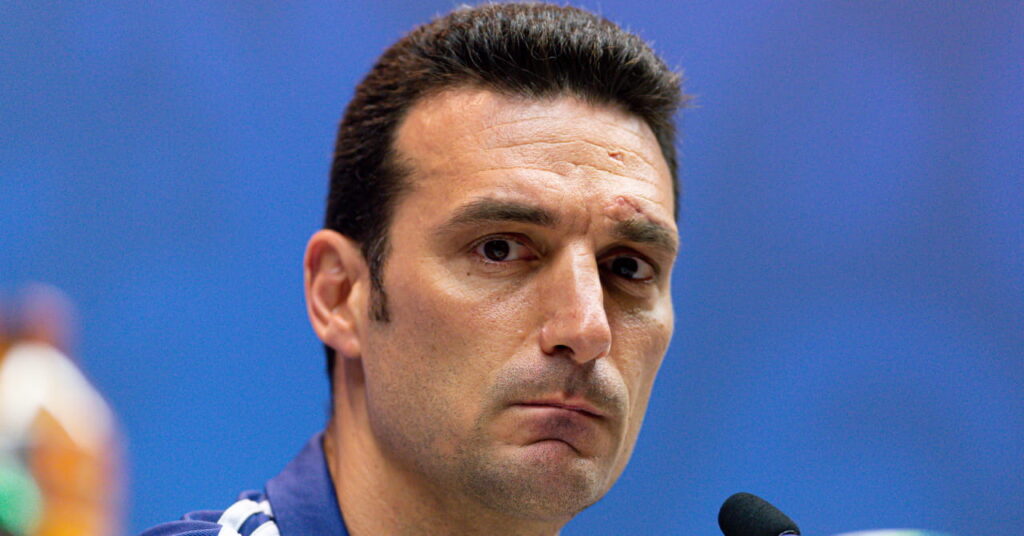
The somber mood wasn’t confined to the players. Argentina head coach Lionel Scaloni, the architect of their recent triumphs, joined Messi in being unable to hide his despair after the final whistle. His post-match comments hinted at a deeper crisis, a potential changing of the guard at the helm. “I haven’t spoken with Leo,” Scaloni told Ole, his voice heavy with emotion, suggesting a rift or at least a period of necessary reflection. “As for me, I’ll talk to the president: I’ll fulfill my contract and then I’ll see. I feel the need to think. I don’t know if I’ll be able to do something as big as this [again].”
These are not the words of a coach basking in the glory of leading his team to a second consecutive final, but rather those of a man contemplating the immense pressure and the emotional toll of the job. “Maybe we’ll have to see. I thank the president for the opportunity, for giving me this position. This place is a dream for everyone.” His sincerity is palpable. “We tried until the very last moment to give our all as a coaching staff and players. It’s only fair that I can take this time and think about it.” The implication is clear: the energy required to maintain such an elite level, to rally a group of superstars and integrate fresh talent, is exhausting. “This place is wonderful – a dream place, one that my coaching staff and I never imagined we’d be in. To continue, a lot of things are needed: to reset, to form a group like this, which is unlikely to be formed again. It hurts me deeply. I’m sorry.” Scaloni’s potential departure would open a massive void, raising questions about Argentina’s ability to sustain their recent success without the man who masterminded it.
History Rewritten, Records Broken, Glory Elusive
The statistical narrative of the final also painted a picture of Messi’s enduring presence on football’s grandest stage. He became only the second player in World Cup history to appear in three finals (2014, 2022 and 2026), joining Brazil’s legendary Cafu (1994, 1998, 2002). At 39 years and 25 days of age, he etched his name into the record books as the oldest outfield player to have appeared in a World Cup final, a testament to his unparalleled dedication and physical conditioning. Argentina, meanwhile, as reigning champions, became the sixth nation to reach the decider, a strong indicator of their sustained dominance.
Yet, the dream of an undefeated campaign was shattered. Having won all seven of their preceding matches at the 2026 edition, Argentina failed to become the first team since Brazil’s flawless run in 2002 (who also won seven out of seven) to have a 100% winning record at a single World Cup. This near-perfect journey, ending in such dramatic fashion, only amplified the heartbreak. Spain, on the other hand, displayed tactical brilliance and an unyielding will, culminating in their well-deserved victory.
Game Highlights: The Battle for Immortality
- **15′ Early Jitters:** The match began with a frantic pace. Argentina’s Lautaro Martinez had the first real chance, a powerful shot from outside the box narrowly sailing over the bar, setting the tone for a high-stakes affair.
- **32′ Spanish Dominance:** Spain gradually asserted control, with Gavi and Pedri orchestrating play in midfield. A brilliant through ball from Pedri found Nico Williams on the left wing, whose curling effort forced a spectacular diving save from Emiliano Martínez.
- **45+2′ Messi Magic Denied:** Just before halftime, Messi nearly broke the deadlock. A trademark run saw him skip past two defenders, but his delicate chip towards the far post was cleared off the line by a desperate Spanish defender. The crowd collectively gasped.
- **68′ Yellow Card Frenzy:** The second half saw increased physicality. A midfield tussle between Rodrigo De Paul and Rodri resulted in a heated exchange and double yellow cards, highlighting the simmering tension.
- **85′ Missed Opportunity:** Enzo Fernández had a golden chance for Argentina, finding himself unmarked inside the box, but his header from a corner kick flew agonizingly wide, leaving the Argentine bench in despair.
- **90+3′ Extra Time Looms:** As the final whistle of regulation time blew, neither side could find the decisive goal, pushing the epic encounter into extra time, with both teams visibly exhausted but unwilling to yield.
- **104′ Ferran Torres’s Decisive Strike:** The moment of truth arrived in the first half of extra time. A quick counter-attack by Spain saw Dani Olmo drive down the left, cutting back a perfectly weighted pass for Ferran Torres. The forward took a touch, then unleashed a powerful, low shot that arrowed into the bottom corner, leaving Martínez with no chance. The Spanish bench erupted, while Argentine hearts sank.
- **118′ Last Ditch Efforts:** Argentina threw everything forward in the dying minutes, including Emiliano Martínez joining the attack for a corner. However, Spain’s defense held firm, repelling every desperate surge.
The Return to Club Duties: Messi’s Miami Marathon
While many members of Argentina’s squad have flown together to Buenos Aires for a hero’s welcome despite the loss, Messi, ever the private man, has travelled to Rosario with his family. The emotional and physical toll of this tournament demands a break, but the relentless schedule of club football waits for no one. His preparations could now begin for his highly anticipated return with MLS side Inter Miami, who face a packed schedule that will test his legendary stamina.
Assuming Messi takes a well-deserved break for at least a week, here’s how the Herons’ fixture list looks for August, a potential marathon of matches that will demand his immediate focus and leadership. Asterisk denotes match starting on previous day in specified territory.
| Date | Opponents | BST kick-off time | ET | PT |
|---|---|---|---|---|
| Sun, Aug 2 | Columbus (H) | 00:30 | 19:30* | 16:30* |
| Wed, Aug 6 | San Luis (H) | 00:30 | 19:30* | 16:30* |
| Sat, Aug 9 | Monterrey (H) | 01:00 | 20:00* | 17:00* |
| Wed, Aug 13 | Leon (H) | 00:30 | 19:30* | 16:30* |
| Sat, Aug 16 | Nashville (A) | 01:30 | 20:30* | 17:30* |
| Wed, Aug 20 | Philadelphia (A) | 00:30 | 19:30* | 16:30* |
| Sat, Aug 23 | Toronto (H) | 00:30 | 19:30* | 16:30* |
| Sat, Aug 30 | Montreal (H) | 00:30 | 19:30* | 16:30* |
Prediction: The End of an Era, The Dawn of Another?
The image of Messi in tears after the final whistle is one that will linger in the collective memory of football fans for years to come. While he has not explicitly announced his international retirement, the raw emotion, his age, and the sheer mental and physical toll of leading Argentina to two consecutive World Cup finals strongly suggest that this was indeed his last dance on the global stage. It’s a bittersweet farewell for the greatest player of his generation, ending not with another triumph, but with the quiet dignity of a warrior who gave absolutely everything. Argentina, under new leadership if Scaloni departs, will undoubtedly enter a transitional phase, needing to unearth new stars to carry the torch. While they possess an abundance of talent, the void left by Messi’s potential absence will be immense, and it will take a monumental effort for them to reach a third consecutive World Cup final without him. For Inter Miami, however, the arrival of a still-motivated, albeit heartbroken, Messi promises a thrilling second half of the MLS season. Expect him to channel his World Cup disappointment into a blistering club performance, driving the Herons towards a playoff push with renewed fire.