
INDIANAPOLIS — The NCAA declared on Thursday that Division I football’s rule-setting body has put forth an experimental regulation for a single season. This new guideline would permit a player, ejected for illegal contact for the initial instance, to participate in his squad’s subsequent match, irrespective of the game half during which the infraction occurred.
At present, athletes removed for targeting violations are compelled to miss the remainder of the contest. Furthermore, should the infraction take place in the second half, they must also be absent from the initial period of the subsequent match.
According to the suggestion from the Division I Football Rules Subcommittee, an athlete ejected for a targeting offense for the second occasion within the same competitive year would forfeit the initial half of the subsequent match. A subsequent (third) removal for illegal contact in the identical competitive period would result in the violating athlete being suspended for the entirety of the following match.
Forceful impact with a rival’s cranial or cervical region defines targeting, typically occurring when the violating athlete frequently employs the apex of their headgear for impact or propels their physique into an adversary beyond the shoulder line.
Supervisory panels for both the Bowl Subdivision and Championship Subdivision are required to endorse suggestions prior to their formal adoption. These panels are scheduled to convene in the upcoming month.
“This advances the progression of our targeting regulation and harmonizes the critical safety implications with a suitable disciplinary framework,” stated A.J. Edds, who chairs the rules subcommittee and serves as vice president of football administration for the Big Ten. “We will meticulously observe this single-season modification, and the panel deems it crucial to bolster the graduated sanction to guarantee adequate instruction and athlete enlightenment.”
Attire requirements:
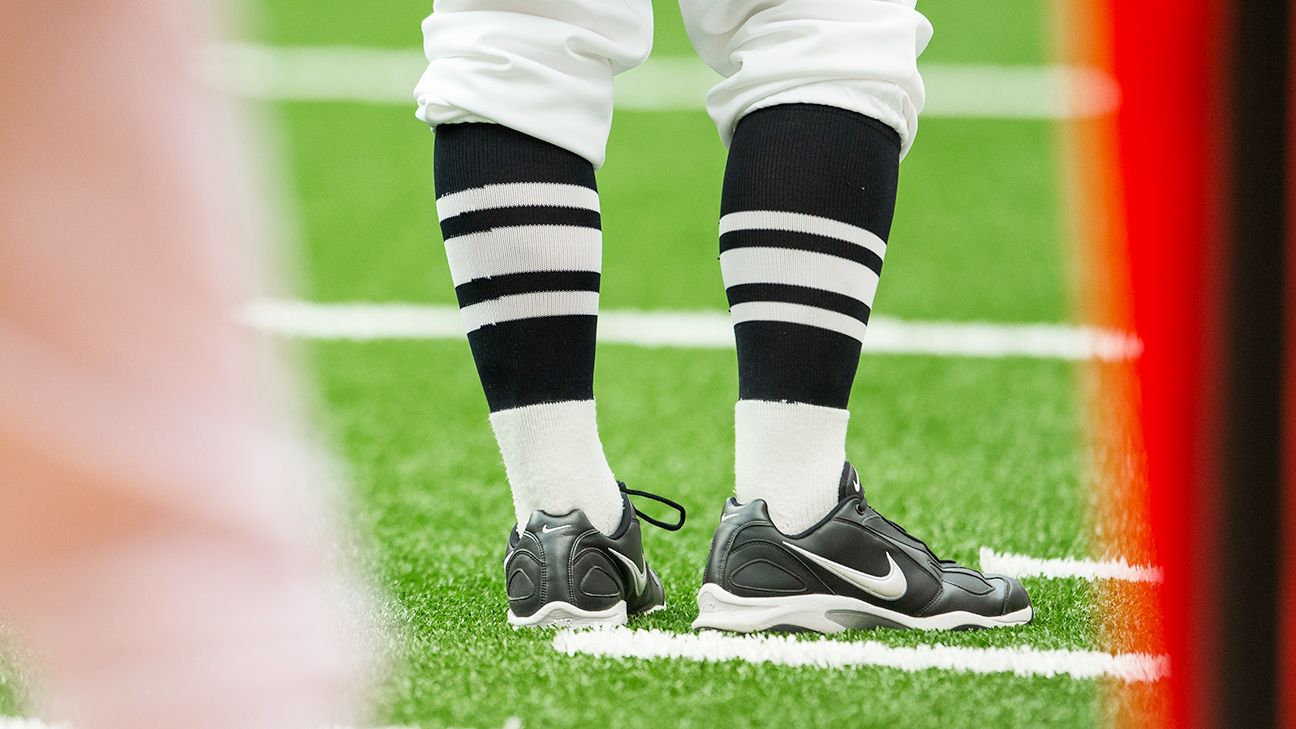
The rules subcommittee suggested athletes don lower limb attire extending from the upper edge of their footwear to the lower hem of their trousers. Athletes would be required to wear identical style and hues of attire for the specific match.
Athletes not adhering to the regulation would be required to exit the contest for a minimum of one play and rectify the matter. For the initial transgression, a squad would be issued a caution.
Should a team commit a subsequent infraction per this suggestion, the violating squad would incur a 5-yard penalty. Any further breaches of the regulation would lead to a 15-yard penalty.
“The present appearance of the uniform is evidently falling short of the anticipations of the collegiate gridiron fraternity,” Edds commented. “This will necessitate a concerted endeavor by executives, instructors, and arbiters to convey requirements to athletes and gear supervisors. This suggestion, we believe, is unambiguous and provides an opportunity for uniform application throughout Division I football.”
Steve Sarkisian, the head coach for Texas, found humor in the proposition, remarking, “I’m just endeavoring to comprehend how we’re going to monitor the adherence of hosiery to trousers.”
“The NFL possesses that regulation, and they financially penalize athletes who fail to satisfy their attire stipulations,” he commented. “Are we employing attire enforcers, as the NFL does, who come to evaluate each athlete, reduce their earnings, and impose monetary penalties when they’re dressed appropriately? I would assume, rather than fretting over the hosiery-trousers connection, we should consider if we’re going to secure our tops? We’ve got undershirts dangling to our lower limbs now. There are numerous matters, but for that to emerge as a concern appears somewhat peculiar.”
Uncontested reception free kicks:
According to a proposition, a squad would have the option to endeavor an uncontested reception free kick following a successful or granted uncontested reception. This kick could be a field goal attempt using a holder for placement or a drop kick from the precise location where the receiver secured the sphere. The opposing side would be a minimum of 10 yards from the point of the free kick.
Should the subsequent boot clear the goalposts, it would be valued at three scores.
Members of the subcommittee are of the opinion that incorporating this regulation would harmonize Division I regulations with the stipulations of the NFL and prep-level gridiron. This infrequently employed maneuver occurred in 2024 in the NFL when Cameron Dicker of the Los Angeles Chargers successfully executed it from 57 yards distant against the Denver Broncos.
The Associated Press provided input for this dispatch.