
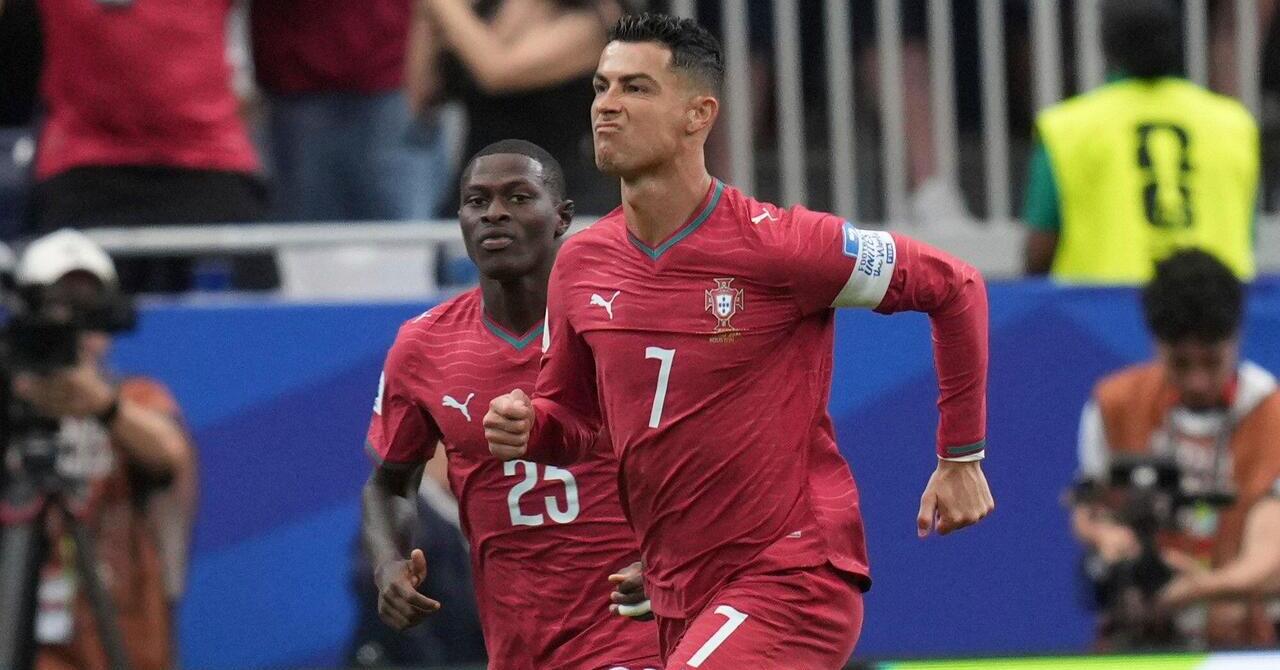
The tremors from Cristiano Ronaldo’s seismic departure from the Portugal camp continue to reverberate, leaving a gaping void and an iconic jersey suddenly adrift. The legendary number seven, synonymous with goals, records, and the very brand ‘CR7’, now hangs heavy with expectation, ready to be bestowed upon a new wearer as Portugal faces Denmark in a crucial Nations League clash. This isn’t just about a shirt; it’s about a statement, a changing of the guard, and a nation holding its breath.
Ronaldo’s dramatic exit, fueled by an escalating row with coach Jorge Jesús, has forced a scramble within the squad, not just tactically but symbolically. For over two decades, the number seven has been his, an extension of his unparalleled will to win, his dazzling skill, and his very identity. To see it on another player will undoubtedly be disorienting for fans worldwide, a stark visual representation of a new era dawning, perhaps prematurely, for the Seleção.

Leão Steps Into the Breach: The Weight of a Legacy
And the chosen one? Galatasaray’s electrifying winger, Rafael Leão. Previously donning the number 17, Leão now inherits a mantle laden with history and immense pressure. Is this a temporary measure, a pragmatic solution in Ronaldo’s absence, or a definitive signal that the Portuguese Football Federation is ready to move on? The answer, for now, remains shrouded in speculation, but the message is clear: Leão is being asked to carry a significant torch.
Leão’s ascent is not without merit. His blistering pace, audacious dribbling, and eye for goal have long earmarked him as one of Europe’s most exciting talents. Yet, filling Ronaldo’s boots is a challenge of an entirely different magnitude. The CR7 brand isn’t just about statistics; it’s about charisma, leadership, and an almost mythical presence that can turn games on its head. Leão, for all his talent, is still forging his own identity. This match against the Danes at Parken isn’t just a game for him; it’s an audition, a baptism of fire under the intense glare of a post-Ronaldo spotlight. Fabio Silva, meanwhile, takes on the 17 jersey, a testament to the ripple effect of this unprecedented squad reshuffle.

Ronaldo’s departure wasn’t a quiet affair. Summoning his private jet from Copenhagen, he flew into Madrid, leaving behind a trail of disruption and controversy. His exact whereabouts remain a topic of intense discussion, but the focus quickly shifts to his demanding schedule with Al-Nassr in Saudi Arabia – nine games in 28 days. A stark contrast to the national team drama, where his very presence, even in absence, continues to dominate headlines.
The fallout from the Ronaldo-Jesús spat has been colossal, escalating to such an extent that Portuguese Prime Minister Luís Montenegro was reportedly compelled to intervene, attempting to mediate a peace that ultimately proved elusive. This wasn’t merely a disagreement between player and coach; it was a national crisis, underscoring the monumental influence Ronaldo wields. For Portugal, moving forward without their talisman requires not just a tactical adjustment, but a profound psychological shift, a rediscovery of collective identity beyond the shadow of one monumental individual.
Game Highlights: Denmark vs. Portugal – A New Dawn?
The atmosphere at Parken was electric, a cacophony of red and white, as Denmark sought to exploit any lingering Portuguese disarray. Portugal, however, came out with a point to prove. The opening exchanges were cagey, both sides feeling their way into a game burdened by narrative. But it was in the 28th minute that the new number seven, Rafael Leão, truly announced his arrival. Picking up the ball wide on the left, he embarked on a dazzling run, skipping past two Danish defenders with a blur of step-overs and feints before unleashing a powerful, low drive that nestled in the far corner. A goal that wasn’t just technically brilliant, but symbolically potent – a new era’s first significant strike.
Denmark, spurred on by their fervent home support, pressed for an equalizer, creating several nervy moments for the Portuguese defence. Goalkeeper Diogo Costa was forced into a spectacular diving save from a point-blank header by Rasmus Højlund just before halftime, ensuring Portugal went into the break with a slender lead. The second half saw Portugal grow in confidence, with Bernardo Silva orchestrating play from midfield, his intricate passing patterns weaving opportunities. In the 65th minute, a sublime through-ball from Silva found Bruno Fernandes galloping into the box, who coolly slotted past the Danish keeper, doubling Portugal’s lead and providing a much-needed cushion.
Leão continued to be a livewire, linking up effectively with Gonçalo Ramos, who had a header cleared off the line in the 78th minute. While Denmark managed to pull one back in the 89th minute through a penalty expertly converted by Christian Eriksen, it was too little, too late. The final whistle blew with Portugal securing a vital 2-1 victory. It wasn’t just three points; it was a defiant statement, a testament to the team’s resilience and their ability to adapt and thrive, even in the absence of their greatest ever player.
Analysis and Prediction: The Road Ahead
This victory against a formidable Danish side is more than just a win; it’s a therapeutic triumph for Portugal. It proves, unequivocally, that there is life beyond Ronaldo. Rafael Leão’s performance, capped by that crucial goal, was a masterful demonstration of his burgeoning talent and his capacity to rise to the occasion. He didn’t try to *be* Ronaldo; he was distinctly Leão, playing with flair, freedom, and an infectious dynamism that invigorated the entire team. His ability to create chances and take on defenders offers a different, perhaps more fluid, attacking dimension for Portugal.
The collective effort was also striking. Bernardo Silva and Bruno Fernandes stepped up with leadership and creativity, while the defence, despite the late penalty, held firm under pressure. Jorge Jesús’s tactical choices were vindicated, suggesting that his vision for a post-Ronaldo Portugal, one built on collective strength and tactical flexibility, is beginning to take shape. The team looked more cohesive, less reliant on individual brilliance and more on intricate team play.
**Prediction:** The immediate future for Portugal, while still navigating the emotional and political aftermath of Ronaldo’s exit, looks surprisingly bright. This win will inject immense confidence into the squad and provide a clear direction for Jorge Jesús. Leão, now firmly established as the new number seven, will continue to grow into the role, becoming a focal point of their attack. Portugal will not only qualify for the next stage of the Nations League but will also emerge as a more balanced and unpredictable force on the international stage. As for Ronaldo, his international career with Portugal is, in my view, effectively over. The team has shown it can succeed without him, and the political will to reintegrate him after such a public rupture seems to have evaporated. This new, more unified Portugal, under a refreshed leadership, is poised for a strong showing in upcoming major tournaments, potentially even surprising many by reaching the semi-finals of the next major international competition.