
`
The 2026 men’s NCAA tournament proceeds as a packed Sweet 16 commences in Houston and San Jose on Thursday.
ESPN’s Jeff Borzello and Myron Medcalf offer their forecasts for Texas-Purdue, Iowa-Nebraska, Arkansas-Arizona and Illinois-Houston, in addition to analyzing the crucial elements for each squad to progress.
7:10 p.m., CBS
Borzello’s forecast:Purdue, 80-70
Medcalf’s forecast:Purdue, 85-72
How Texas can reach the Elite Eight:Texas has emerged as one of the most in-form teams in March, securing three victories in five days to advance from the First Four to the Sweet 16. Sean Miller has positioned Matas Vokietaitis as a key offensive player, and the Lithuanian responded by achieving averages of 20.0 points and 12.5 rebounds across his last two NCAA tournament games. Furthermore, over his recent 12 contests, Vokietaitis has averaged 17.6 points and 8.1 rebounds. Purdue possesses sufficient size to contend with the 7-foot-1 center, yet the Boilermakers permitted opponents to shoot over 56% within the arc during Big Ten play.
The Longhorns also must sustain their defensive revival, which appeared unexpectedly after they were ranked No. 159 in adjusted defensive efficiency during their final six games preceding the NCAA tournament. They are currently conceding merely 1.03 points per possession over three tournament matchups. The pivotal question is whether this level of defense will suffice against Purdue, a team holding the No. 1 ranking in adjusted offensive efficiency. Texas needs to ensure that Braden Smith does not control the entire game.
How Purdue can reach the Elite Eight:The return to peak form late in the season by Trey Kaufman-Renn and Fletcher Loyer has propelled Purdue to an elevated status – likely constituting the Boilermakers’ most significant factor. Kaufman-Renn accumulated 20 points in the Big Ten tournament championship game, 25 in the initial NCAA tournament round versus Queens, and then tallied 19 points and nine rebounds in the second-round triumph over Miami. Loyer demonstrated flawless 3-point shooting (4-for-4) against the Hurricanes and has now converted 19 of 35 attempts from beyond the arc in his last five appearances.
While Texas’ defense has recently become more stringent, it still occupied the lower half of the SEC rankings, whereas Purdue enters the Sweet 16 boasting the nation’s premier offense. Moreover, the Boilermakers are among the top 10 nationally in 3-point percentage, while the Longhorns are in the bottom third for 3-point defense. If C.J. Cox, who sustained a knee injury and is listed as doubtful, can participate and contribute shots alongside Loyer and Kaufman-Renn, Purdue ought to be capable of scoring prolifically.— Borzello
7:30 p.m., TBS/truTV
Borzello’s forecast:Nebraska, 66-63
Medcalf’s forecast:Iowa, 65-60
How Iowa can reach the Elite Eight:We possess clear indicators regarding how Iowa can overcome Nebraska (and vice versa). When the Hawkeyes triumphed over the Cornhuskers on Feb. 17, Bennett Stirtz, despite being somewhat unproductive, still managed 25 points, propelling Iowa to a victory. Conversely, when the Hawkeyes suffered defeat against the Cornhuskers in the regular-season closer, he recorded 11 points from 10 shots. In the NCAA tournament, Stirtz has received substantial assistance from his supporting cast, with Alvaro Folgueiras averaging 14.0 points in two wins and Tavion Banks netting 20 against Florida.
On defense, the Hawkeyes must refrain from committing fouls. They held the lowest rank in the Big Ten for defensive free throw rate, and a notable disparity in free throw attempts was observed in their two contests against Nebraska. In Iowa’s winning game, they were plus-6 at the free throw line. In Nebraska’s winning game, Iowa was minus-10.
How Nebraska can reach the Elite Eight:Nebraska secured its inaugural NCAA tournament victory in program history last Thursday, then augmented its total in a thrilling manner Saturday when Vanderbilt’s half-court attempt missed. What actions will the Cornhuskers need to undertake to achieve a third win – against an opponent with whom they split the regular-season series during Big Ten play? Their season-long achievements have primarily hinged on two components: 3-point shooting accuracy and defensive prowess.
They are positioned among the top 15 nationwide in 3-pointers converted per game, 3-point attempt frequency, and the proportion of points derived from 3-pointers. This season, they feature four players who have made 50 or more 3s, and they will likely need to sink double-digit 3s to secure a win next week. When they defeated Iowa on Feb. 17, they sank 10 3s. When they were defeated, they made 5-of-24. Nebraska topped the Big Ten in adjusted defensive efficiency, restricting opponents to under 30% from 3-point range and instigating turnovers on almost 20% of possessions. The Cornhuskers enjoyed considerably greater success against Iowa when they compelled Stirtz into a difficult performance.— Borzello
9:45 p.m., CBS
Borzello’s forecast:Arizona, 89-82
Medcalf’s forecast:Arizona, 93-87
How Arkansas can reach the Elite Eight:With his team contending with High Point late in the second round, Darius Acuff Jr. remained composed. The projected NBA draft lottery selection tallied 36 points with an effective 11-for-22 shooting from the field, propelling Arkansas to its fifth Sweet 16 in six years. The Razorbacks can advance if he can drive towards the basket, draw fouls, and generate opportunities for his teammates. This strategy was evident in their triumph against the Panthers on Saturday. With Acuff attracting multiple defenders, his teammates were able to perform: Malique Ewin (14 points, 12 rebounds) and Billy Richmond III (15 points, 10 rebounds) both achieved double-doubles, while Meleek Thomas (19 points) also posted a double-figure score.
Acuff must persuade Arizona coach Tommy Lloyd that the Wildcats stand no chance against Arkansas if he is covered by only one defender. Nevertheless, on the defensive end, Arkansas faces the deepest squad in the NCAA tournament bracket. Every Razorbacks player must prevail in individual contests; Richmond and Trevon Brazile, in particular, will need to match the physicality of an elite Wildcats frontcourt without accumulating excessive fouls.
How Arizona can reach the Elite Eight:Arizona can progress through a physically demanding approach that has tested adversaries throughout the season. Utah State reduced Arizona’s advantage to four points with five minutes remaining in Sunday’s second-round encounter – despite the Wildcats having held a lead of up to 18 points – and mounted a serious comeback attempt in the concluding minutes. However, Jaden Bradley drove to the hoop and scored, Brayden Burries sank crucial shots, and Arizona earned 22 free throw attempts in the second half. This is the arduous method that causes most opponents to yield.
Arizona is unyielding. To defeat Arkansas, however, their primary objective must be to neutralize the top player in this college basketball postseason: Acuff. If Lloyd can formulate a defensive strategy against Acuff without deploying extensive help, then his guards can avoid early foul trouble, which could significantly influence the game. Yet, that is simpler to suggest than to execute. Acuff possesses the ability to make anyone anxious, particularly during critical moments in the closing stages. Arizona cannot afford such panic if it intends to secure victory.— Myron Medcalf
10:05 p.m., TBS/truTV
Borzello’s forecast:Houston, 74-72
Medcalf’s forecast:Illinois, 77-74
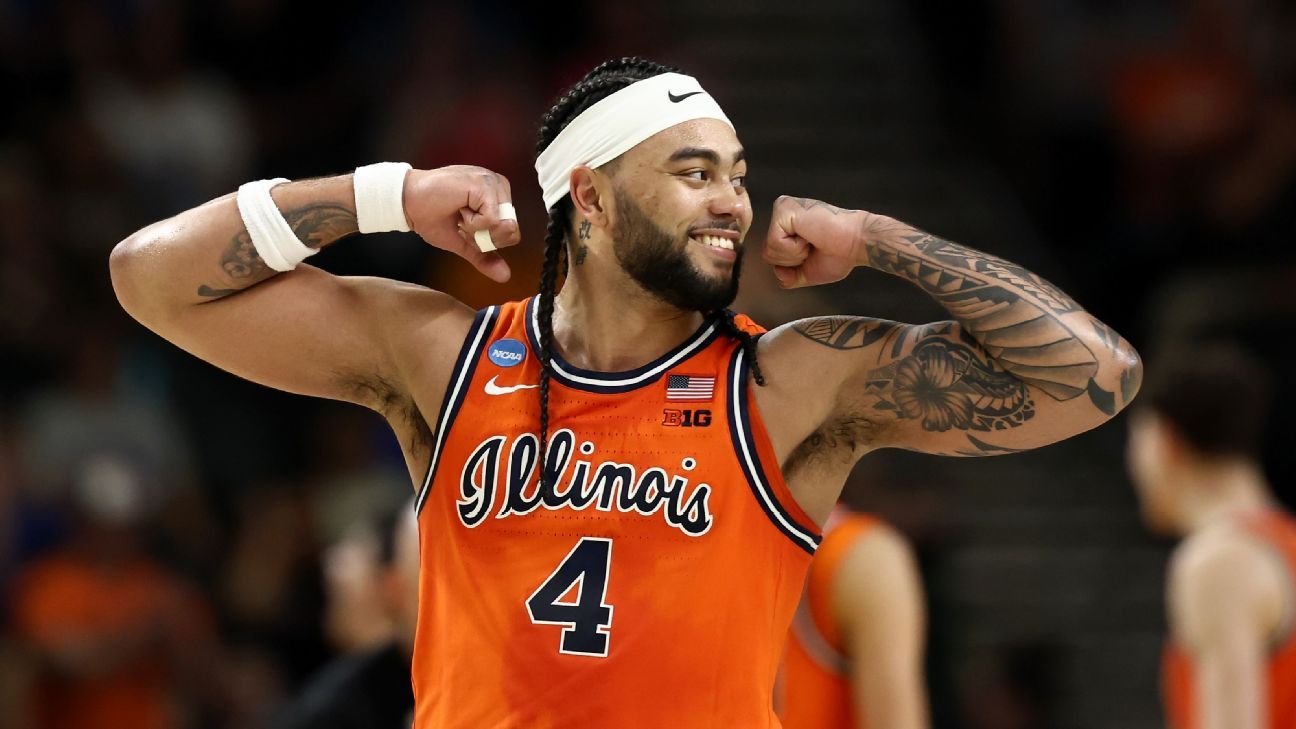
How Illinois can reach the Elite Eight:When Illinois established a 14-5 lead against VCU in the second round, it appeared as though the Illini would enter halftime with a considerable advantage – but then the Rams decelerated the pace and intensified their defensive pressure, resulting in them trailing by only seven points at the break. Ten minutes into the second half, however, they found themselves behind by 22 points. This illustrates how rapidly the game can shift against Illinois, which boasts the finest offense in the United States. This represents the Illini’s edge against a Houston team susceptible to prolonged offensive dry spells.
They have already secured victories over Tennessee and Nebraska, both among the top-15 defenses nationwide. Houston’s distinctive pressure poses a challenge, and the Illini will experience challenging offensive periods against the Cougars – but Illinois has demonstrated its capacity to quickly regain form. When Houston’s shots cease falling, as has occurred multiple times this season, Illinois will advance if its faultless offense can expand a lead. Houston is not structured for rallies, while Illinois is prepared to extend its lead against its adversaries. Whenever such an opportunity arises against the Cougars, the Illini must capitalize on it.
How Houston can reach the Elite Eight:Their defensive prowess serves as their advantage when they compel opponents to play deliberately and cautiously. Texas A&M commenced its second-round contest against Houston having played at one of the quickest tempos in America, but the Cougars constrained the Aggies to a 65-possession affair and recorded a substandard 87 points per 100 possessions. Houston will be required to employ the identical strategy against Illinois.
Kelvin Sampson will necessitate effective contributions from star guards Kingston Flemings and Emanuel Sharp. Moreover, Joseph Tugler, last season’s Big 12 Defensive Player of the Year, has dedicated the latter part of his season to developing as an offensive threat. However, to conquer the nation’s premier offense, Houston will need to employ the same tenacious approach that has underpinned its 7-1 winning streak in its most recent eight games. One of America’s finest defensive units will have to prevail over Illinois, a team capable of transforming a small number of shots into a torrent. Houston’s defensive strengths will ultimately be the decisive factor against Brad Underwood’s squad.— Medcalf
`