
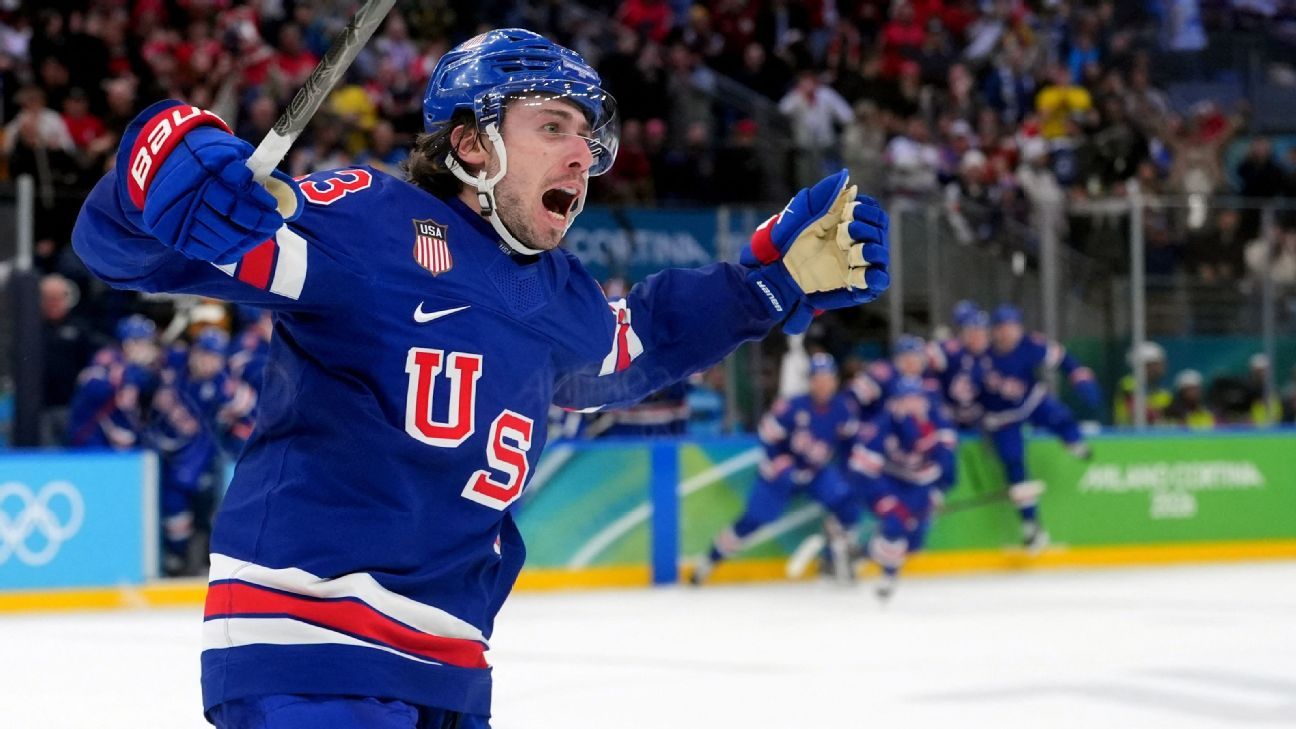
With two of the initial three elimination round matches in the 2026 Olympic men’s ice hockey competition extending into extra time, should followers of the sport really be astonished that the encounter between the United States and Sweden also went beyond regulation?
This particular tournament, marking the first time active NHL players have participated since the 2014 Sochi Games, saw Team USA commence the event holding the second-highest probabilities for a gold medal, trailing only Canada.
The squad ranked third? Sweden. And indeed,Tre Kronorproved to be a formidable adversary in this particular engagement, managing to net a tying goal with merely 1:31 left in the third period, before Quinn Hughes secured the victory in overtime.
What insights did we gather about Team USA following this demanding performance? Which athletes distinguished themselves most—and what significant questions remain as the squad gears up to face Slovakia in the semifinals?
Takeaway 1: Quinn Hughes may be Team USA’s most important skater
While netting a game-winning goal in 3-on-3 overtime to progress to the semifinal stage is the singular action that will command considerable focus, Hughes’ display in his team’s recent triumph over Sweden solidifies the notion that he could be the most vital player on the ice for Team USA.
Prior to Wednesday’s game, Hughes stood as the sole skater on the American roster who had logged over 20 minutes in every match. He consistently faces the top opposing lines. He dictates the tempo of the contest in ways that can wear down rivals, simultaneously enabling the U.S. to generate more scoring opportunities.
All of these attributes were on full display during the match against Sweden. He spent over 27 minutes on the ice, with his average shift lasting 56 seconds. This represented the longest ice time of any American competitor, surpassing Sweden’s Erik Karlsson’s average shift duration by three seconds.
His overtime goal was made even more impactful by this. Hughes remained on the ice for the final minute and 15 seconds. He executed maneuvers that compelled Sweden’s center, Joel Eriksson Ek, his teammate on the Minnesota Wild, to maintain intense focus as he closed in on the net. Subsequently, Hughes located an open lane and unleashed the shot that propelled the U.S. into the semifinals.
QUINN HUGHES! USA WINS! 🦅pic.twitter.com/WxbCRKxPiO
— NBC Olympics & Paralympics (@NBCOlympics)February 18, 2026
Takeaway 2: Was Team USA a bit too conservative in the third period?
We will soon delve into Team USA’s collective defensive effort. However, why did the U.S. adopt a more cautious approach in the third period compared to their performance in the second, when they were consistently creating scoring chances?
It’s important to acknowledge that the U.S. entered Wednesday’s game with a plus-7 goal differential in the second period. Dylan Larkin’s goal advanced this to a plus-8 margin, forming part of a period where they established a consistent rhythm. Larkin’s deflected shot contributed to this surge, which saw the U.S. progressively create opportunities at the net front against Sweden. Witnessing their ability to assault the net fostered the expectation that the third period would see more of the same.
DYLAN LARKIN FLIES IN AND OPENS UP THE SCORING. 🇺🇸#WinterOlympicspic.twitter.com/Lmu8uuDeij
— NBC Olympics & Paralympics (@NBCOlympics)February 18, 2026
Nevertheless, Team USA’s shot count drastically dropped from a total of 20 throughout the second period to just four shots in the third. It initially seemed that the U.S. would exit the quarterfinal achieving the round’s first shutout, before Mika Zibanejad scored with 91 seconds remaining, compelling an overtime period.
During overtime, the U.S. managed more shots—five—in a frame that lasted barely 90 seconds, in contrast to the quantity they had accumulated across the entirety of the third period.
Takeaway 3: Was this the strongest defensive performance of the men’s tournament?
The impetus truly began when Charlie McAvoy delivered a hit on Gabriel Landeskog. The subsequent objective was to prevent Sweden from registering a shot on goal for the initial six minutes. Even when the Swedes eventually managed a shot, it was a long-range attempt that Connor Hellebuyck confidently parried away with his blocker.
Everything Hughes and McAvoy accomplished in their own zone was complemented by the efforts of Brock Faber, Jake Sanderson, Jaccob Slavin, and Zach Werenski, with Noah Hanifin serving as the seventh defenseman when required. U.S. forward J.T. Miller frequently sacrificed his body to block shots, while the penalty kill unit maintained its status as the sole flawless squad in the men’s competition—having conceded zero power-play goals across 10 attempts.
And naturally, having Hellebuyck, who executed 27 saves, was a significant advantage.
Such steadfastness on a day when Germany surrendered six goals, Canada overcame defensive lapses to win in extra time against Czechia, and Switzerland lost in overtime after holding a two-goal lead against Finland, only reinforces why the Americans are advancing to the next stage following an exceptional defensive display.

We’ve discussed extensively what rendered the elder Hughes brother such a pivotal participant for Team USA in the broader context.
However, concerning the extent of his actions against Sweden? Those are precisely the elements that position Hughes as one of the premier defensemen—and indeed, one of the finest players irrespective of position—globally.
He was indispensable to their defensive endeavors, registered an assist on his team’s initial goal, spent more time on the ice than any other skater, and ultimately scored the decisive goal in extra time.
Big question for the semis
What valuable lessons can be applied when facing Slovakia? Team USA showcased its most robust defensive performance of the tournament, but will now confront an offensive powerhouse.
Slovakia erupted for six goals against Germany, continuing their trend of strong offensive output at the Olympics overall. The defending bronze medalists rank fourth in average goals per game. This includes scoring four goals against Finland and netting three goals in a prior loss to Sweden during the opening round.
Emulating much, if not all, of their strategy from the Sweden game could determine whether Team USA competes for gold or bronze.
Overall team grade: B+
The four shots recorded in the third period represent the only factor preventing the U.S. from achieving a superior evaluation here. Despite the Americans scoring merely one goal in the second period, that frame seemed to offer them an opportunity to secure additional goals before the Swedes compelled overtime with a late game-equalizing score.
Nonetheless, Team USA’s defensive showing establishes a clear roadmap for their continued progression toward vying for a gold medal.