
Currently, merely 16 teams remain.
We’ve witnessed numerous unexpected outcomes in the initial weekend of the current NCAA championship event. Both Iowa, which defeated top-seeded Florida in a surprising turn on Sunday, and Iowa State, which vanquished Kentucky despite the absence of All-American Joshua Jefferson on the same day, are competing concurrently in the tournament for the initial occasion.
Alabama has been the same attacking powerhouse it was throughout the entire season, despite the absence of Aden Holloway. And, we won’t label Texas a Cinderella story — but it’s the nearest equivalent to an underdog tale in this year’s contest. (According to ESPN’s data, this marks the second consecutive year the Sweet 16 comprises solely teams from major conferences – the only two occurrences in the NCAA tournament’s entire history where the ultimate 16 participants originate exclusively from prominent conferences.)
Matters become more intricate at the top of the rankings. The No. 1 overall seed Duke remains a formidable squad, but the Blue Devils are lacking a certain element without Caleb Foster and Patrick Ngongba II not being at full strength. Their current form doesn’t resemble the squad that triumphed over Michigan in February. Houston, Illinois and Purdue seem to be narrowing the distance with the cohort of surviving top seeds, too, a feat they hadn’t genuinely managed throughout the standard season.
Presented is our perspective on the prevailing outlook of the national championship pursuit with the Sweet 16 commencing within a handful of days.
All times Eastern
Discover how the bracket for the round of 32 was finalized:
Saturday | Sunday


1. Arizona Wildcats
Initial seeding:No. 1 (West)
Championship outcomes:Triumphed over No. 16 Long Island 92-58 (first round); triumphed over No. 9 Utah State 78-66 (round of 32)
Indeed, the Arizona Wildcats possess significant roster depth, an outstanding coach and a comprehensive array of talent to claim the program’s — and the West Coast’s — inaugural national championship since 1997. Consequently, numerous supporters have chosen them as the overall victors. However, one potentially underestimated aptitude is: A remarkable propensity for earning free throw opportunities. College basketball fans often dislike contests featuring frequent foul whistles; they prefer to witness squads engaging in fast-paced play, maintaining a dynamic and thrilling atmosphere. Nevertheless, such a style of play does not invariably guarantee triumphs. Arizona stands among the nation’s premier teams at inducing fouls and advancing to the free throw line, a tactic proving highly efficacious. The Wildcats have registered an average of 26.3 free throw attempts per contest this campaign. They’ve amassed 72 free throw attempts across two NCAA tournament matchups. Should their field goals cease to connect, they are still capable of accumulating points by this means.
Up next:vs. Arkansas (Thursday, 9:45 p.m., CBS)

2. Michigan Wolverines
Initial seeding:No. 1 (Midwest)
Championship outcomes:Triumphed over No. 16 Howard 101-80 (first round); triumphed over No. 9 Saint Louis 95-72 (round of 32)
There was a particular juncture on Saturday versus Saint Louis when Michigan’s potential truly became apparent. The Wolverines’ 7-foot-3 center Aday Mara possessed the ball close to the apex of the 3-point line in the second half. Morez Johnson Jr. stationed himself close to the hoop, anticipating an opportunity. AP All-American Yaxel Lendeborg similarly positioned himself on the outer court, where he has achieved a 48% shooting percentage since the commencement of the Big Ten tournament. This totals three athletes measuring 6-foot-9 or greater in height — three prospective first-round selections for the 2026 NBA draft — all poised to initiate an action. The Wolverines collectively shoot 37% from beyond the arc and boast one of the top three defensive units nationwide. Merely three squads this season have managed to unravel the enigma of Michigan’s supremacy. Simply put, this team possesses an excessive number of methods to overcome opponents.
Regarding that particular maneuver? Mara had an abundance of choices, but he passed it to Johnson for a successful alley-oop play.
Up next:vs. Alabama (Friday, 7:35 p.m., TBS/truTV)

3. Duke Blue Devils
Initial seeding:The No. 1 overall (East)
Championship outcomes:Triumphed over No. 16 Siena 71-65 (first round); triumphed over No. 9 TCU 81-58 (round of 32)
Frequently, analytics are deliberated as if they were complex algebraic formulas, often obscuring rather than illuminating the sport. This is regrettable, as analytical data can reveal significant insights into the impact a single athlete can have on their squad. A clear example: With Caleb Foster out of action due to an injury, Isaiah Evans has become the second most influential offensive contributor within Duke’s lineup behind Cameron Boozer, according to EvanMiya. Evans also is the third most crucial defensive asset for the team with Patrick Ngongba II (13 minutes against TCU on Saturday) still not operating at peak capacity. Duke has returned to the Sweet 16 for the fourth occasion in five seasons primarily due to the fact that Boozer is the foremost collegiate basketball athlete globally; he has registered 41 points (comprising 66% shooting from inside the arc and 18-of-19 from the free throw line), along with 24 rebounds and seven assists in the NCAA tournament to date. But Evans (16.5 points per game) has risen to the occasion for an undermanned Duke team during the most pivotal phase of the campaign and has made a significant impact.
Up next:vs. St. John’s (Friday, 7:10 p.m., CBS)
4. Houston Cougars
Initial seeding:No. 2 (South)
Championship outcomes:Triumphed over No. 15 Idaho 78-47 (first round); triumphed over No. 10 Texas A&M 88-57 (round of 32)
Kelvin Sampson consistently reserves his finest performances for the concluding stages. Commencing with the 2021-22 season, his Cougars typically exhibit their strongest basketball from February 1st through the conclusion of the season. To date, their overall record stands at 70-15 during that timeframe, encompassing their current progression to the Sweet 16. As soon as the calendar reaches February, they transform into one of the nation’s most formidable programs. This year, the Cougars have held the No. 2 position in adjusted defensive efficiency since February 1st. From the start of the Big 12 tournament, they have maintained a 42% shooting accuracy from beyond the arc. And in their three most recent victories, they have limited their adversaries (Kansas, Idaho, Texas A&M) to an average of 50.3 points per game. Redshirt senior Emanuel Sharp and first-year player Kingston Flemings shine as the prominent figures in the backcourt for a squad aiming to conclude the season powerfully once more.
Up next:vs. Illinois (Thursday, 10:05 p.m., TBS/truTV)

5. Illinois Fighting Illini
Initial seeding:No. 3 (South)
Championship outcomes:Triumphed over No. 14 Penn 105-70 (first round); triumphed over No. 11 VCU 76-55 (round of 32)
Ranked
first in adjusted offensive efficiency for the bulk of the season, Illinois put together massive runs to advance to the Sweet 16 for the second time in three years. In the first round against Penn, the Illini started the second half ahead by 10 points but 10 minutes later pushed their advantage to 26. On Saturday against VCU, they turned a seven-point lead at halftime into a 22-point edge after a 24-9 run; the Illini registered 141 points per 100 possessions in that game, a more efficient scoring clip than that of the Denver Nuggets. Few teams have these kinds of knockout punches in their arsenal. Led by freshman Keaton Wagler (32 points, nine assists, 50% from beyond the arc in two NCAA tournament games), this group hasn’t even broken a sweat yet on its way to the second weekend.
Up next:vs. Houston (Thursday, 10:05 p.m., TBS/truTV)

6. Iowa State Cyclones
Original seed:No. 2 (Midwest)
Tournament results:Defeated No. 15 Tennessee State 108-74 (first round); defeated No. 7 Kentucky 82-63 (round of 32)
Tamin Lipsey played the game of his life on Sunday. He took command and refocused the Cyclones after Kentucky’s 20-9 start, and he ended the night with a career-high 26 points, 10 assists and three turnovers. The Cyclones’ second-round win proved that, even without injured All-American Joshua Jefferson, they’re still capable of being an aggressively defensive team and a fluid offensive squad that whips the ball around the court until it finds the best shot. Iowa State has been 18-2 this season when Lipsey, the 6-foot-1 native of Ames, Iowa, records a 3-to-1 assist-to-turnover ratio or better. He reached that mark on Sunday, helping his team record 34 points in the paint and score 25 points off 20 Kentucky turnovers. The Cyclones might struggle against the best teams in the field if Jefferson doesn’t return. But when their hometown hero is good, they’ll always have a chance.
Up next:vs. Tennessee (Friday, 10:10 p.m., TBS/truTV)

7. Purdue Boilermakers
Original seed:No. 2 (West)
Tournament results:Defeated No. 15 Queens University 104-71 (first round); defeated No. 7 Miami 79-69 (round of 32)
Sometimes, it just comes down to the numbers — especially when the numbers are jaw-dropping. Purdue has won its past six games, including the Big Ten tournament championship over Michigan. Over that stretch, the Boilermakers, per BartTorvik, have had the best offense in America — even superior to that of Illinois, the top team in adjusted offensive efficiency. It gets better. The Boilermakers have made 177 of their 342 field goal attempts (52%) during that span. Since the start of the Big Ten tourney, they have taken nearly 22 3-pointers per game, making 40% if them, and have grabbed 40% of their missed shots too. What does it all mean? Right now, Purdue is an offensive bulldozer that is launching 3-pointers like the Golden State Warriors, hitting shots all over the floor and securing second-chance opportunities whenever it misses. Good luck trying to slow this group down.
Up next:vs. Texas (Thursday, 7:10 p.m., CBS)

8. Michigan State Spartans
Original seed:No. 2 (East)
Tournament results:Defeated No. 15 Bryant 92-67 (first round); defeated No. 6 Louisville 77-69 (round of 32)
Tom Izzo’s best teams feature dominant point guards. He won his only national title with Mateen Cleaves in 2000 and reached the Final Four with former Big Ten players of the year Kalin Lucas (2009, 2010) and Cassius Winston (2019). This year, his dominant PG is Jeremy Fears Jr., who leads the nation in assists with 9.4 per game. In the NCAA tournament wins over North Dakota State and Louisville, Fears had 27 assists and just nine turnovers, combined. This season’s Spartans — who also have a top-15 defense — form a tight-knit group that has followed Fears’ lead on offense. At any moment, Coen Carr can slash to the rim for a dunk or Jaxon Kohler can space the floor with a corner 3. Fears himself can create off the dribble and score. The best passer in college basketball, on a squad that has made 42% of its shots beyond the arc over the past month, has been Izzo’s ticket to another Sweet 16 appearance.
Up next:vs. UConn (Friday, 9:45 p.m., CBS)

9. St. John’s Red Storm
Original seed:No. 5 (East)
Tournament results:Defeated No. 12 Northern Iowa 79-53 (first round); defeated No. 4 Kansas 67-65 (round of 32)
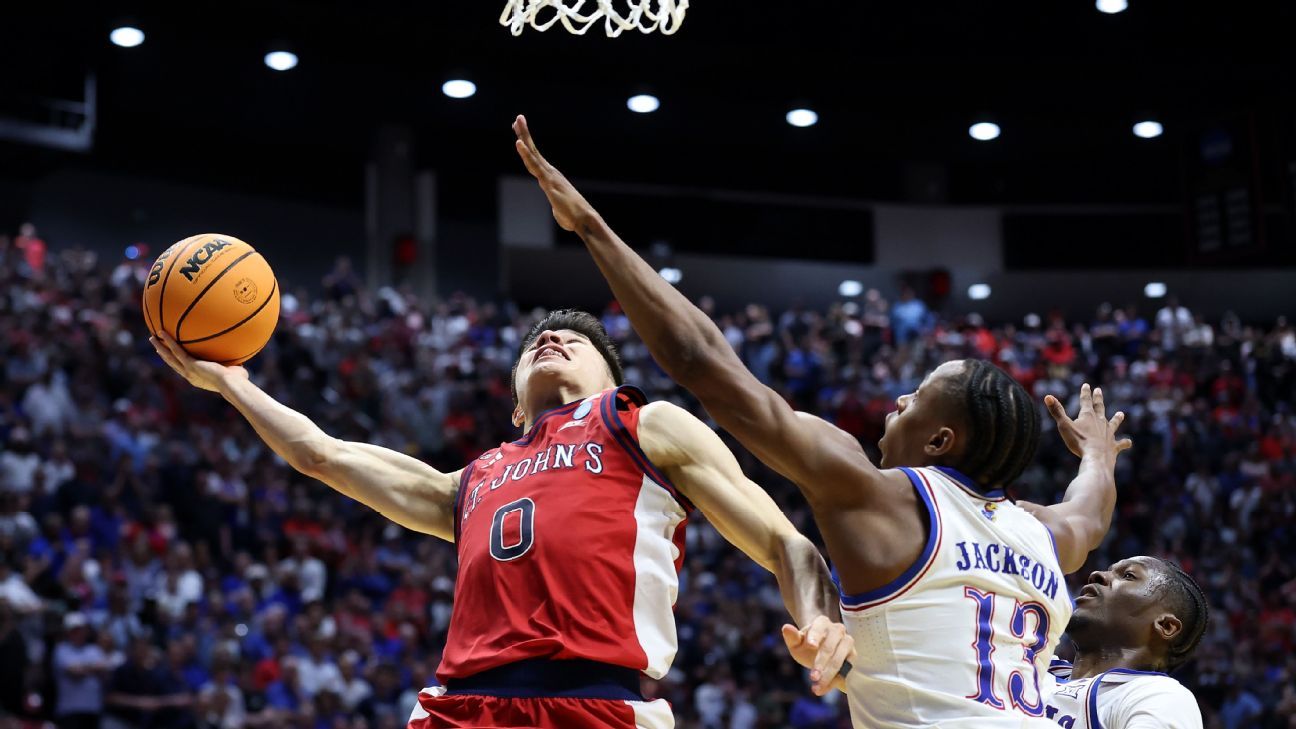
Rick Pitino has coached in the NBA twice. He has battled scandals at multiple programs. He has coached overseas. Now, after returning to college basketball a few years ago, he’s the king of New York. Because he has led St. John’s to the Sweet 16 for the first time since 1999. It’s the fourth program he has taken to the second weekend of the NCAA tournament. But this particular team didn’t do it with finesse. St. John’s shot 51% from inside the arc (218th nationally) and 33% from beyond (192nd nationally) this season. But none of that showed up on Sunday against Kansas. Other than a boost from Bryce Hopkins (an unexpected 6-for-9 outing from the 3-point line after making 31% of those shots this season entering the game), the Red Storm beat Kansas with a tenacious defense (18 points off 16 Kansas turnovers) and by outlasting their opponent. Right down to Dylan Darling’s winning layup right at the buzzer. St. John’s has lost just one game since Jan. 3 because it just refuses to break in the most significant moments.
Up next:vs. Duke (Friday, 7:10 p.m., CBS)

10. UConn Huskies
Original seed:No. 2 (East)
Tournament results:Defeated No. 15 Furman 82-71 (first round); defeated No. 7 UCLA 73-57 (round of 32)
Dan Hurley is back in the Sweet 16 with a roster that’s experienced some turnover, yet still has some sense of continuity. The Huskies have also had highs: including a 20-point loss to St. John’s. They’ve had lows: weird losses at Marquette and vs. Creighton. Those, frankly, lowered expectations for this team entering the NCAA tournament. And it seemed like UConn was holding to those expectations. It had more trouble than anticipated early against UCLA, despite the Bruins not having their best player. But, as they’ve also done this season, the Huskies demonstrated they have the pieces to win ugly, get rebounds, defend well and hit shots. Braylon Mullins doesn’t look like a freshman anymore. Alex Karaban had
I will rephrase the text while maintaining all HTML tags and original formatting precisely.
Holding the top spot in adjusted offensive efficiency for most of the season, Illinois orchestrated impressive scoring streaks, propelling them to the Sweet 16 for the second occasion within three years. During their initial match against Penn, the Illini commenced the second half with a 10-point lead, yet expanded their dominance to 26 points merely ten minutes thereafter. Come Saturday versus VCU, they transformed a seven-point halftime cushion into a commanding 22-point advantage following a 24-9 surge; in that contest, the Illini notched 141 points per 100 possessions, showcasing a more effective scoring rate than the Denver Nuggets. Scarcely any teams possess such decisive offensive power in their repertoire. Spearheaded by first-year player Keaton Wagler (32 points, nine assists, 50% from three-point range across two NCAA tournament contests), this squad has yet to exert significant effort en route to the second weekend.
Up next:vs. Houston (Thursday, 10:05 p.m., TBS/truTV)
6. Iowa State Cyclones
Initial seeding:No. 2 (Midwest)
Contest outcomes:Triumphed over No. 15 Tennessee State 108-74 (opening round); bested No. 7 Kentucky 82-63 (round of 32)
Tamin Lipsey delivered an extraordinary performance on Sunday. He assumed control and re-centered the Cyclones following Kentucky’s 20-9 commencement, concluding the evening with a personal best of 26 points, 10 assists, and three turnovers. The Cyclones’ victory in the second round demonstrated that, even in the absence of the sidelined All-American Joshua Jefferson, they retain the capacity to operate as a tenacious defensive unit and a smooth offensive ensemble, circulating the ball across the court until an optimal scoring opportunity arises. Iowa State has maintained an 18-2 record this season whenever Lipsey, the 6-foot-1 local from Ames, Iowa, achieves an assist-to-turnover ratio of 3-to-1 or superior. He attained that benchmark on Sunday, facilitating his team in logging 34 points in the key and securing 25 points from 20 Kentucky turnovers. The Cyclones could face challenges against the premier teams in the bracket if Jefferson does not make a comeback. However, when their local standout performs well, they will perpetually possess an opportunity.
Up next:vs. Tennessee (Friday, 10:10 p.m., TBS/truTV)
7. Purdue Boilermakers
Initial seeding:No. 2 (West)
Contest outcomes:Bested No. 15 Queens University 104-71 (opening round); overcame No. 7 Miami 79-69 (round of 32)
Occasionally, the situation boils down simply to statistics — particularly when those figures are astounding. Purdue has emerged victorious in its last six matchups, a streak encompassing the Big Ten tournament title clash against Michigan. Throughout that period, the Boilermakers, according to BartTorvik, have showcased the nation’s most formidable offense — surpassing even Illinois, the leading squad in adjusted offensive efficiency. Moreover, the situation improves. The Boilermakers have converted 177 out of their 342 field goal attempts (52%) within that timeframe. Since the commencement of the Big Ten tournament, they have attempted nearly 22 three-pointers per game, sinking 40% of them, and have also secured 40% of their missed shots. What is the implication of all this? Presently, Purdue stands as an offensive juggernaut, launching three-pointers akin to the Golden State Warriors, sinking shots from every court position, and seizing second-chance opportunities upon any missed attempt. Best of fortune attempting to impede this collective.
Up next:vs. Texas (Thursday, 7:10 p.m., CBS)
8. Michigan State Spartans
Initial seeding:No. 2 (East)
Contest outcomes:Triumphed over No. 15 Bryant 92-67 (opening round); bested No. 6 Louisville 77-69 (round of 32)
The most successful squads coached by Tom Izzo are characterized by commanding point guards. He secured his singular national championship with Mateen Cleaves in 2000 and advanced to the Final Four with previous Big Ten players of the year Kalin Lucas (2009, 2010) and Cassius Winston (2019). For the current season, his influential point guard is Jeremy Fears Jr., who tops the country in assists, averaging 9.4 per contest. Across the NCAA tournament victories against North Dakota State and Louisville, Fears amassed a total of 27 assists against merely nine turnovers. The current season’s Spartans — who additionally boast a top-15 defense — comprise a cohesive unit that has adhered to Fears’ offensive direction. At any given instant, Coen Carr possesses the ability to drive to the basket for a slam dunk, or Jaxon Kohler can stretch the court with a three-pointer from the corner. Fears himself is adept at creating scoring opportunities off the dribble. The premier passer in collegiate basketball, playing for a team that has converted 42% of its long-range attempts over the last month, has served as Izzo’s pathway to yet another Sweet 16 showing.
Up next:vs. UConn (Friday, 9:45 p.m., CBS)
9. St. John’s Red Storm
Initial seeding:No. 5 (East)
Contest outcomes:Bested No. 12 Northern Iowa 79-53 (opening round); overcame No. 4 Kansas 67-65 (round of 32)
Rick Pitino has served as a coach in the NBA on two separate occasions. He has confronted controversies across numerous programs. He has also coached internationally. Currently, following his return to collegiate basketball a few years prior, he reigns as the monarch of New York. This is due to his guidance of St. John’s to the Sweet 16, a feat not achieved since 1999. This marks the fourth institution he has steered to the second weekend of the NCAA tournament. Yet, this specific squad did not accomplish it through elegance. St. John’s recorded a 51% shooting percentage from within the arc (ranking 218th nationwide) and 33% from long-range (192nd nationwide) during this season. However, none of those metrics were apparent on Sunday when facing Kansas. Apart from a significant contribution from Bryce Hopkins (an unforeseen 6-for-9 performance from beyond the arc, having previously hit 31% of those shots this season), the Red Storm vanquished Kansas through relentless defense (garnering 18 points from 16 Kansas turnovers) and by persevering longer than their adversary. Culminating in Dylan Darling’s game-winning layup precisely as time expired. St. John’s has suffered only a single defeat since January 3rd, owing to its steadfast refusal to falter during the most crucial junctures.
Up next:vs. Duke (Friday, 7:10 p.m., CBS)
10. UConn Huskies
Initial seeding:No. 2 (East)
Contest outcomes:Bested No. 15 Furman 82-71 (opening round); overcame No. 7 UCLA 73-57 (round of 32)
Dan Hurley returns to the Sweet 16 leading a squad that has undergone some personnel changes, yet retains a degree of consistency. The Huskies have experienced both triumphs and setbacks this season, including a significant 20-point loss to St. John’s. They have also faced downturns, marked by unexpected losses at Marquette and against Creighton. These instances, candidly, diminished anticipations for this squad upon entering the NCAA tournament. And it appeared UConn was adhering to those projections. They encountered more difficulty than foreseen early on against UCLA, even though the Bruins were without their top player. However, mirroring their season-long pattern, the Huskies showcased they possess the components to secure gritty victories, grab boards, play strong defense, and convert attempts. Braylon Mullins no longer exhibits the traits of a first-year player. Alex Karaban had
an unprecedented 27 points in his career on Sunday. Tarris Reed Jr. has proven indomitable on his most impressive evenings. Generally, the Huskies restricted UCLA to 91 points for every 100 possessions. They possess the capabilities to forge, or equal, historical achievements, partly due to their profound self-awareness, possibly exceeding that of any other squad in the competition.
Coming up:against Michigan State (Friday, 9:45 p.m., CBS)
11. Arkansas Razorbacks
Original seed:No. 4 (West)
Tournament results:Defeated No. 13 Hawai’i 97-78 (first round); defeated No. 12 High Point 94-88 (round of 32)
Derrick Rose guided Memphis to the 2008 national championship match, recognized as one of the game’s most dynamic point guards. John Wall’s swiftness was unparalleled throughout his single college season in 2009-10, during which he propelled Kentucky to the Elite Eight. De’Aaron Fox’s remarkable effectiveness fueled another Kentucky surge to the Elite Eight in the 2016-17 season. Each was mentored by John Calipari. This season at Arkansas, Calipari features a blend of these three talents in his standout freshman, Darius Acuff Jr. Acuff provided the sole response for the Razorbacks against the upset-seeking High Point and Rob Martin (30 points) in Saturday’s second-round contest. However, as that close match concluded, the entire basketball community understood who would attempt the decisive shots: Acuff (36 points, six assists). He has convincingly demonstrated that he stands as the premier player in the tournament at present.
Coming up:against Arizona (Thursday, 9:45 p.m., CBS)

12. Alabama Crimson Tide
Original seed:No. 3 (Midwest)
Tournament results:Defeated No. 13 Hofstra 90-70 (first round); defeated No. 5 Texas Tech 90-65 (round of 32)
Not many teams, upon discovering their second-best player – a guard who had topped the squad in scoring in four of the 11 preceding contests before the NCAA tournament – was sidelined by legal complications, could then proceed to win two NCAA tournament matchups decisively. Yet, this is precisely what Alabama accomplished mere days after Aden Holloway’s arrest on a felony drug accusation. The Tide maintained a 29-point advantage over Texas Tech in Sunday’s concluding five minutes, following their 20-point triumph over the favored Cinderella selection, Hofstra, two days prior. Nate Oats’ well-oiled system is performing effectively in the initial weekend due to Labaron Philon Jr. shouldering the scoring responsibility and athletes such as Latrell Wrightsell stepping in to compensate for Holloway’s unavailability. During Sunday’s second half, they achieved a scoring rate of 164 points per 100 possessions, a pace that would even impress the legendary Showtime Lakers. In essence: Despite being understaffed, Alabama employs a strategy capable of overwhelming rival teams.
Coming up:against Michigan (Friday, 7:35 p.m., TBS/truTV)

13. Nebraska Cornhuskers
Original seed:No. 4 (South)
Tournament results:Defeated No. 13 Troy 76-47 (first round); defeated No. 5 Vanderbilt 74-72 (round of 32)
The most compelling narrative of the NCAA tournament persists. Over seventy years prior, in 1954, Jerry Bush took on the position of men’s basketball coach at Nebraska. His daughter, Karen, gave birth to a son named Fred in 1972. Fred recently guided Nebraska to its inaugural Sweet 16 appearance in school annals alongside his son, Sam Hoiberg, who contributed eight points and six assists in an exhilarating contest versus Vanderbilt on Saturday. It’s a remarkable tale. The third-to-last possession – preceding Tyler Tanner’s near game-winner for the Commodores with a half-court shot – nevertheless epitomizes Nebraska’s season. Before Braden Frager’s eventual game-winning layup for the Huskers, Tanner found himself ensnared by two defenders near the baseline. This explains why Pryce Sandfort (19.0 PPG in the NCAA tournament) and his teammates boast the Big Ten’s top defense this campaign.
Coming up:against Iowa (Friday, 7:30 p.m., TBS/truTV)

14. Tennessee Volunteers
Original seed:No. 6 (Midwest)
Tournament results:Defeated No. 11 Miami (Ohio) 78-56 (first round); defeated No. 3 Virginia 79-72 (round of 32)
Over ten years ago, Rick Barnes requested Garrett Medenwald to become part of his staff at Texas as an assistant strength and conditioning coach. Promptly and without delay, Medenwald loaded his vehicle and traveled from Wisconsin. He has remained alongside Barnes continuously since then. At one point in this sport, athletes eschewed strength training, concerned it might negatively affect their performance. However, Barnes adopted the contrary view and dedicated resources to a strength coaching team well before it was commonplace. Consequently, Tennessee has stood as one of the most physically robust teams in men’s college basketball throughout Barnes’ time leading the Volunteers. That physical prowess is most evident defensively: The Vols have consistently ranked among the top 15 in adjusted defensive efficiency in seven of Barnes’ eleven seasons, encompassing the current squad, which compelled Virginia to take challenging shots in the final moments and contended vigorously with the Cavaliers in the key for Sunday’s victory.
Coming up:against Iowa State (Friday, 10:10 p.m., TBS/truTV)

15. Iowa Hawkeyes
Original seed:No. 9 (South)
Tournament results:Defeated No. 8 Clemson 67-61 (first round); defeated No. 1 Florida 73-72 (round of 32)
A squad’s season can transform in a flash. Observe: this particular team. The Hawkeyes had a 3-7 record in their preceding 10 contests before the NCAA tournament commenced. Throughout that period, they ranked below 50th in both offensive and defensive efficiency, according to BartTorvik, and achieved only 31% accuracy from beyond the arc. They appeared fated for an early elimination from the NCAA tournament – certainly not their initial Sweet 16 showing since 1999. It is now evident that Iowa’s recent downturn was merely a temporary setback. Recall that before that month-long slump, the Hawkeyes were among the top 25 in both offensive and defensive efficiency during Ben McCollum’s debut season leading the team. Furthermore, they had compelled turnovers on almost one-fifth of their adversaries’ possessions (ranking 10th nationwide) and converted 38% of their attempts from three-point range. They were a formidable squad. Then, several weeks subsequent, Alvaro Folgueiras sank the decisive 3-pointer in the shocking defeat of top-seed Florida. And in an instant, the Hawkeyes are once more victorious. In the NCAA tournament, they truly resemble the formidable iteration that performed exceptionally well during the initial three months of the season.
Coming up:against Nebraska (Thursday, 7:30 p.m., TBS/truTV)

16. Texas Longhorns
Original seed:No. 11 (West)
Tournament results:Defeated No. 11 NC State 68-66 (First Four); defeated No. 6 BYU 79-71 (first round); defeated No. 3 Gonzaga 74-68 (round of 32)
The Sweet 16 has evolved into a customary achievement for Sean Miller: He has now advanced to the second weekend commanding three distinct programs (and across both his separate tenures at Xavier). However, this particular instance is the most astonishing. Scant indicators suggested that Texas, with Jordan Pope and Tramon Mark at the forefront, would reach the Sweet 16 for only the second occasion since 2008. The Longhorns held a 1-5 record heading into the NCAA tournament, having previously been ranked 10th in defensive efficiency within the SEC. Nevertheless, those statistics obscured two of Texas’ strong points: 6-foot-8 guard Dailyn Swain (averaging 12.6 points, 5.3 assists, 6.3 rebounds, 1.3 steals across three NCAA tournament games) and 7-footer Matas Vokietaitis (18.3 PPG, 11.0 RPG in the NCAA tournament) have bewildered all three rivals thus far in the postseason. The Longhorns limited NC State, BYU, and Gonzaga – all squads positioned among the top 35 nationally in offensive efficiency – to a commendable average of 103 points per 100 possessions.
Coming up:against Purdue (Thursday, 7:10 p.m., CBS)