
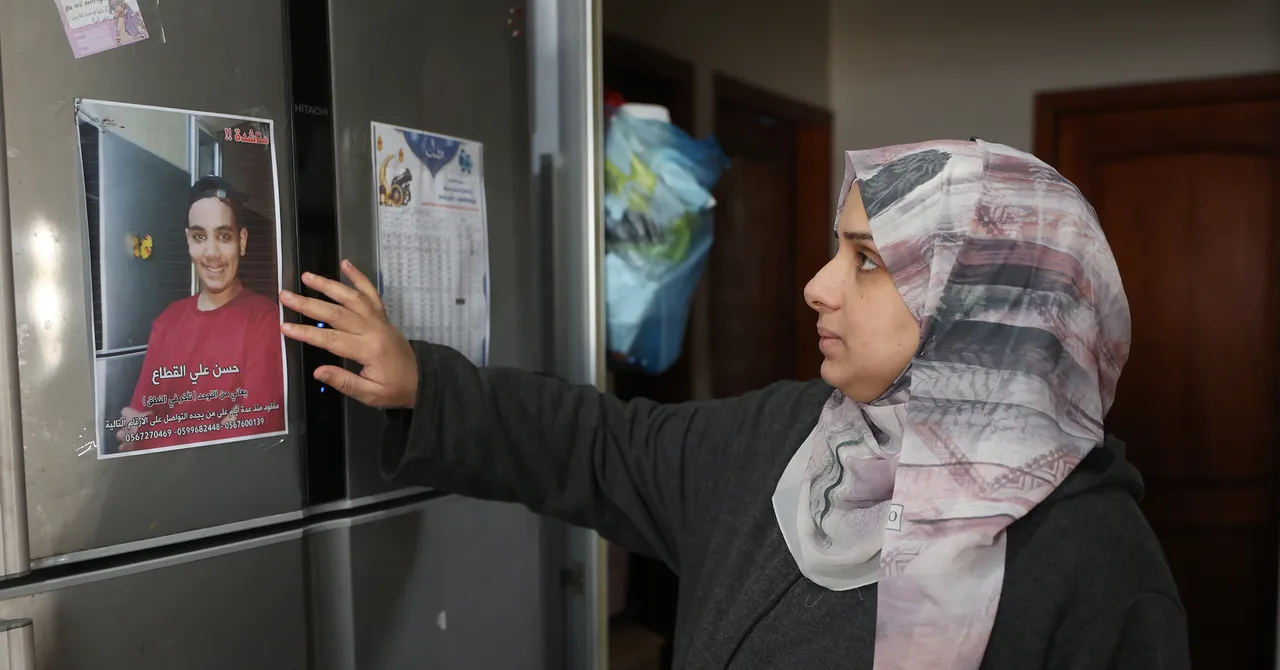
In the pre-dawngloom, Abeer Skaik turned to her husband, Ali Al-Qatta, and declared that this was the day they would finally locate their son. Ali assented wordlessly, and she passed him the stack of leaflets. Each one featured a photograph of 16-year-old Hassan beaming broadly, his posture relaxed, wearing a simple red T-shirt. He gazes straight at the camera, completely unreserved. At the peak of the sheet, in prominent lettering, Abeer had inscribed a single word in vivid crimson script:Munashada!—a fervent appeal.
Abeer observed as Ali entered a car with a few trusted companions and departed. They commenced the 30-kilometer journey south, from al-Tuffah, east of Gaza City, heading to the European Hospital in Khan Younis. They had learned that a contingent of individuals held captive by Israel, including children, were scheduled for release there.
The gate was already congested. Families stood pressed together, swathed in blankets against the chill, gripping photographs and identification cards. Ali circulated the flyers among his friends. When the vehicles carrying liberated individuals pulled up, he and the others proceeded cautiously through the confined spaces between groups of people. Some of those who had just been freed were being enveloped in hugs. Ali lingered at the periphery of each reunion. “Have you seen my son?” he inquired. One after another, people indicated no. The crowds diminished. It was 2 am by the time Ali returned. Abeer watched her husband set the photographs on the table. They stood and exchanged glances without speaking, Ali’s eyes remote as if he was stepping into an unfamiliar dwelling. Ten months had passed since they had last been with their son.
Prior to the October 7 assaults, before a UN commission and a multitude of Palestinian and international rights groups established that Israel is perpetrating mass atrocities in Gaza, Abeer’s existence had been structured by Hassan’s routines. He awoke at the consistent hour every morning, consumed identical meals in the same sequence, required the house to be cleaned in a particular manner—the floor scrubbed, the table wiped after every meal. When he was 11 months old, Hassan’s parents noticed that he could not crawl or sit and that he didn’t vocalize the way his sister had at that age. Following an extensive sequence of clinical evaluations, Hassan, then 5, was identified as having autism spectrum disorder. Abeer recounts that Israel had refused the family’s application to secure therapy for Hassan outside Gaza. So Abeer began self-educating in therapy methods, how to establish behavioral routines, how to handle his sensory overload. Together, she and her husband, Ali, organized Hassan’s days around security and predictability, and they discovered ways to imbue their house with joy. Hassan chuckled when his father playfully doused him in the bath just the way he requested, showed a boundless eagerness for flipping through the pages of magazines and scrutinizing photos in restaurant menus, and enjoyed reclining on soft pillows with his mother. “I used to say I had four eyes,” Abeer states. “Mine and his. Mine was always watchful.”
The explosions were the first thing to shatter Hassan. Every blast made the 16-year-old clasp a trembling hand to his chest and murmur, “Mama, my heart is terrified.” Relocation traumatized him again. He shrieked each of the four times they had to flee. “Why am I abandoning my home? I refuse to depart from home. I want my bed,” he said. Hassan, who could not endure feeling unclean even for a few hours, went ten entire days without showering. One day while they were seeking refuge at a relative’s home, he toted a small bottle of water, trailed his mother around, and pleaded for a shower.
By April 2024, dearth had permeated all aspects of daily life. Famine intensified as Israel severed food supplies. Clean water was scarce. Abeer shed about 40 pounds. Days before Hassan vanished, he lashed out at his mother over what meager provisions were left—only an arid mixture they called bread, made of assorted grains that were formerly marketed as livestock fodder, which left it with a foul odor. He did not comprehend why there was no actual bread, no rice, no milk, no meat. Hassan gazed at what he’d been given, shoved it aside, and yelled, “What are you feeding me?” In a moment of sheer agitation, he overturned the table and bolted from the dwelling.
{content}
Source:{feed_title}