
Key Takeaways:
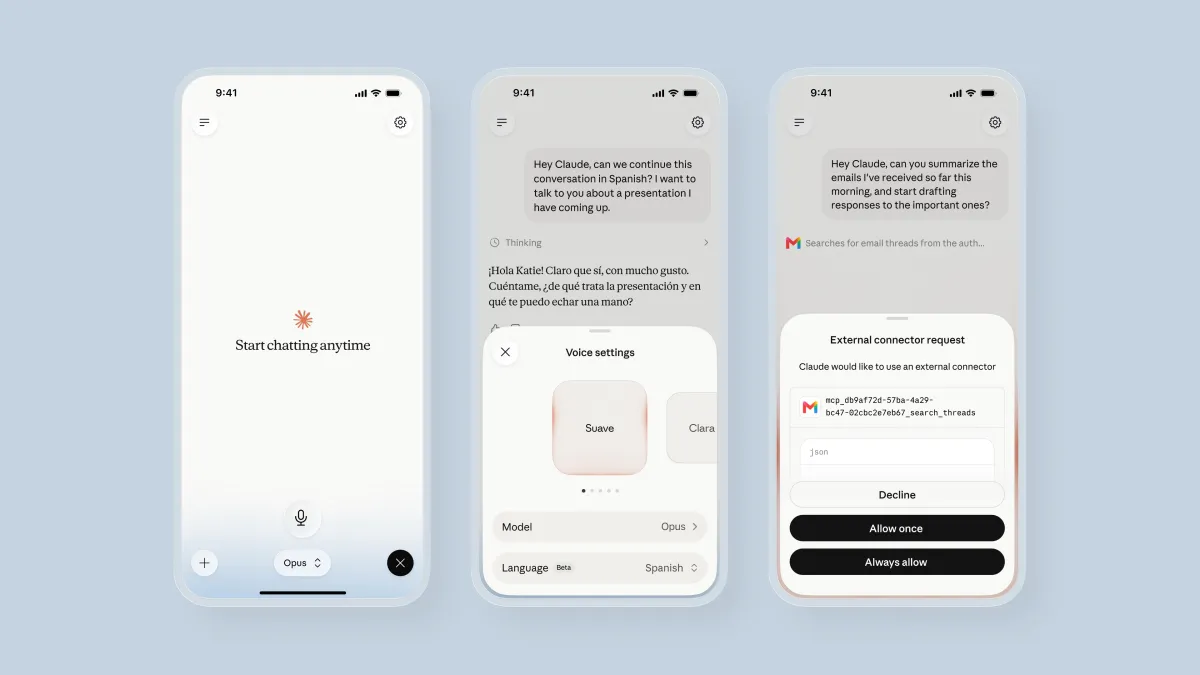
- Expanded Model Flexibility:Anthropic’s Claude voice mode now allows users to select between Opus, Sonnet, and Haiku models, offering a range of capabilities from rapid responses to complex reasoning, a significant upgrade from the previous Haiku-only restriction.
- Unparalleled App Integration:A standout feature is Claude’s new ability to tap into external applications like Gmail, Google Calendar, Slack, Canva, and Notion, enabling direct task execution through voice commands and positioning it ahead of rivals like OpenAI in this specific functionality.
- Enhanced Conversational Depth & Global Reach:The update supports longer, more intricate discussions for professional tasks and introduces beta multilingual support across ten languages, broadening Claude’s utility for a diverse, global user base, though some core voice model improvements seen elsewhere are absent.
Anthropic Elevates Claude’s Voice Mode with Model Flexibility and Robust App Integration
In the rapidly evolving landscape of conversational AI, the race to deliver more intuitive and powerful human-computer interaction is heating up. Weeks after OpenAI unveiled its latest family of conversational models and significantly enhanced ChatGPT’s voice mode, rival Anthropic is stepping into the spotlight with a strategic update to make Claude even more voice-friendly. The company announced Thursday that its updated voice mode now grants users the freedom to choose between its powerful Opus, balanced Sonnet, and agile Haiku models, marking a substantial leap forward in user control and functional versatility.
Previously, Claude’s voice mode, first introduced last year, was solely powered by the Haiku model. While Haiku delivered impressively quick responses, its design, optimized for speed, often fell short when users required deeper analysis or more complex, sustained conversations. This limitation meant that while quick queries were handled with ease, the system wasn’t ideally suited for the nuanced demands of professional work or in-depth brainstorming sessions. The new update directly addresses this by allowing the voice mode to intelligently pick the last model a user engaged with in text chat, defaulting to the fastest version of that model for voice interactions, thus blending convenience with intelligent customization.
Unlocking Deeper Conversations and Professional Utility
The implications of this model flexibility are profound. Anthropic highlights that the enhanced voice mode is now equipped to handle a much broader spectrum of user needs, particularly in professional contexts. Imagine using Claude to rehearse a critical client pitch, receiving real-time feedback on your communication style, tone, and clarity. Or perhaps engaging in a dynamic brainstorming session for product market research, where Claude can contribute ideas, organize thoughts, and challenge assumptions, all through natural spoken dialogue. This move transforms Claude from a rapid-fire answer machine into a collaborative partner capable of supporting longer, more complex conversational workflows.
A Game-Changer: Direct Integration with Productivity Apps
Perhaps the most compelling aspect of this update, and a significant differentiator in the competitive AI landscape, is Claude’s newfound ability to seamlessly integrate with a suite of popular productivity applications. Users can now harness Claude’s voice mode to tap into tools like Gmail, Google Calendar, Slack, Canva, and Notion. This means that mundane but essential tasks can now be executed purely through voice commands: “Hey Claude, update my meeting slot for tomorrow to 3 PM,” or “Claude, draft an email to the marketing team summarizing our last meeting,” or even “Create a new document in Notion outlining our Q3 strategy.” The potential for streamlining workflows and reducing friction in daily tasks is immense, effectively turning Claude into a proactive, vocal assistant embedded within your digital workspace.
This robust integration capability stands in stark contrast to the recent advancements from competitors like OpenAI. While OpenAI’s voice mode received an update to its conversational style, making interactions feel more natural and responsive, it currently lacks the ability to directly leverage different external tools to accomplish work. This strategic divergence positions Anthropic’s Claude with a distinct advantage for users seeking not just a conversational partner, but a truly actionable digital assistant that can bridge the gap between spoken command and tangible output across their software ecosystem.

Expanding Global Reach with Multilingual Support
Further enhancing its accessibility, Anthropic had earlier this year introduced multilingual support to Claude’s voice mode in beta. Now, this feature is more prominent, allowing users to converse in a variety of languages, including English, French, German, Hindi, Indonesian, Italian, Japanese, Korean, Brazilian Portuguese, and Latin American/Spanish. While users currently need to manually specify the language they wish to use, this broad linguistic support significantly expands Claude’s potential user base, making it a valuable tool for international teams and global communication. It underscores Anthropic’s commitment to creating an AI assistant that transcends geographical and linguistic barriers, enabling more inclusive and diverse interactions.
The new voice mode is currently available to all users in beta across various platforms, ensuring broad access for early adopters to test and provide feedback on these new capabilities. However, it’s worth noting that free users will experience some restrictions, primarily being limited to using the faster Haiku model and connecting with only one external application. This tiered access encourages engagement with Anthropic’s premium offerings while still providing a taste of the new features to a wider audience.
A Nuanced Approach: What’s Missing from the Voice Model Itself
While the enhancements to model selection and app integration are significant, Anthropic has confirmed that it did not make any fundamental changes to the underlying voice model with this release, nor has it detailed the specific voice stack it employs. This means that, unlike some of OpenAI’s recent voice updates, users might not experience improvements in the conversational nuances, such as more sophisticated interruption handling, more human-like intonation, or dynamic pacing that makes spoken interactions feel even more natural. Anthropic’s focus appears to be squarely on functional expansion and utility through model choice and integration, rather than refining the core auditory experience of the AI’s voice itself. This highlights a strategic decision to prioritize practical application and task completion over purely aesthetic or natural language processing refinements in the voice interface for this particular update.
The Bottom Line
Anthropic’s latest update to Claude’s voice mode marks a pivotal moment in the competitive AI landscape. By empowering users with model selection flexibility and, more critically, robust direct integration with popular productivity applications, Claude moves beyond mere conversational AI to become an actionable, indispensable digital assistant. While competitors like OpenAI have focused on refining the conversational experience, Anthropic’s strategic emphasis on multi-app functionality provides a clear practical advantage for professionals seeking to streamline tasks and enhance productivity through voice commands. This move solidifies Claude’s position as a serious contender for users who prioritize real-world utility and integrated workflow management in their AI tools.
When you purchase through links in our articles, we may earn a small commission. This doesn’t affect our editorial independence.
{content}
Source:{feed_title}