
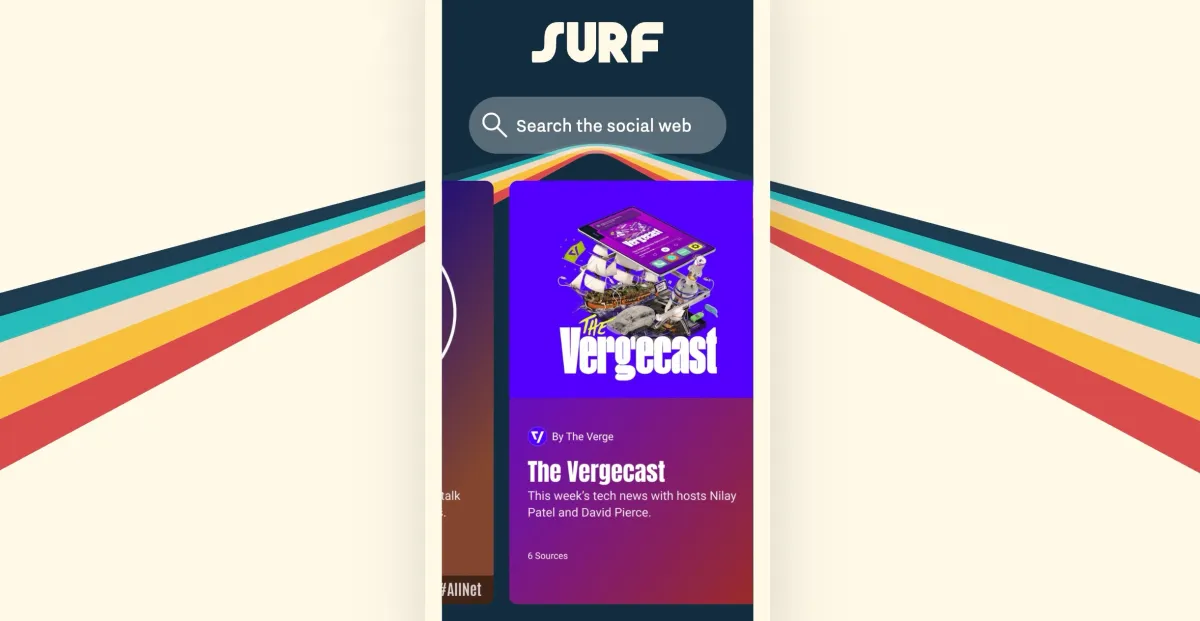
Describing Surf is somewhat challenging. It functions in a tripartite manner: serving as a client for federated social applications such as Bluesky and Mastodon; an aggregator enabling subscriptions to nearly any website, podcast, or YouTube channel; and a mechanism for compiling and tracking curated streams of engaging material, akin to Flipboard’s magazine format. Essentially, it acts as a navigational tool for the fediverse or the open social web, assuming these terms resonate with you. Furthermore, it represents one of the most captivating concepts regarding the internet’s forthcoming evolution.
Following a prolonged beta phase spanning more than a year, Surf is poised for its official launch this Thursday. Currently, the sole publicly accessible experience exists on the web, through what Surf terms “social websites” (mobile applications are still in beta development).The Vergestands among Surf’s launch partners, having developed numerous such websites. For instance, navigating to theDecoderpage on Surf will allow you to access all recent episodes of the program, complemented by a substantial volume of social discussion surrounding it. Participation in the community is open to anyone simply by employing a hashtag (Surf, above all, places a significant emphasis on hashtags as an organizational method for the internet), and the feed’s administrators possess the ability to govern content visibility and presentation.
Registration for Surf can be accomplished using either a Mastodon or Bluesky account; alternatively, one can register with both and subsequently establish a Surf account to centralize management. Upon entry, users can commence searching for and organizing content — Flipboard asserts that its search encompasses billions of posts spanning ActivityPub (the open protocol driving Mastodon), AT Protocol (the open protocol powering Bluesky), and the broader web. Ultimately, users need not concern themselves with the underlying protocols; Flipboard’s objective is to consolidate all content, irrespective of its origin. The only requirement is to subscribe to streams organized by others, or to create and disseminate your own.
This is where the concept begins to become rather intricate. Should you activate the heart icon to express approval for a post on Surf, you are, in effect, signaling your appreciation for that content via your linked social account. Likewise, submitting a comment translates to an actual reply to the original post using your personal submission. Incorporating an item into a Surf feed could entail generating a Mastodon post for that purpose. Such is the underlying framework of the fediverse, simultaneously captivating and perplexing. The notion of a singular account facilitating ubiquitous posting, thereby obviating the need to oversee distinct accounts and communities across platforms like YouTube, Instagram, TikTok, and others, holds immense appeal; however, the practical implementation remains a subject of ongoing exploration.
An illustrative perspective on federated social networks is to view them as vast, organized repositories of user-generated content — every link, selfie, joke, video, and so forth, is deposited within this database. To date, the majority of social applications have opted to display this repository as a compact, Twitter-esque chronological feed. Surf, however, offers an alternative presentation: It showcases video-centric feeds featuring prominent previews and embedded players, transforms podcast file streams into a format akin to a podcast player, and displays links in a Flipboard-esque magazine layout. (A particularly impressive feature of Surf is its ability to categorize feeds by content type; for example, searching for “SNL clips” and selecting the video tab yields an inexhaustible stream of relevant material, curated by users across Bluesky and Mastodon.)
Having participated in Surf’s beta testing almost from its inception, I acknowledge that while certain aspects of the platform — and the broader fediverse — continue to be somewhat intricate, there is an undeniable potency in its operational methodology. Its usage evokes the sensation of scrolling through TikTok, with the key distinction being that rather than relying on an algorithm, my feed is meticulously curated by discerning individuals across the internet. The team behind Flipboard is undoubtedly endeavoring to establish both a platform and a commercial venture from Surf, yet the system retains an open architecture by design; consequently, even if Surf ceases to exist, the content residing within the platform will persist. During an era where digital platforms appear increasingly volatile and opaque, Surf emerges as a commendable stride toward an alternative trajectory.
{content}
Source:{feed_title}