
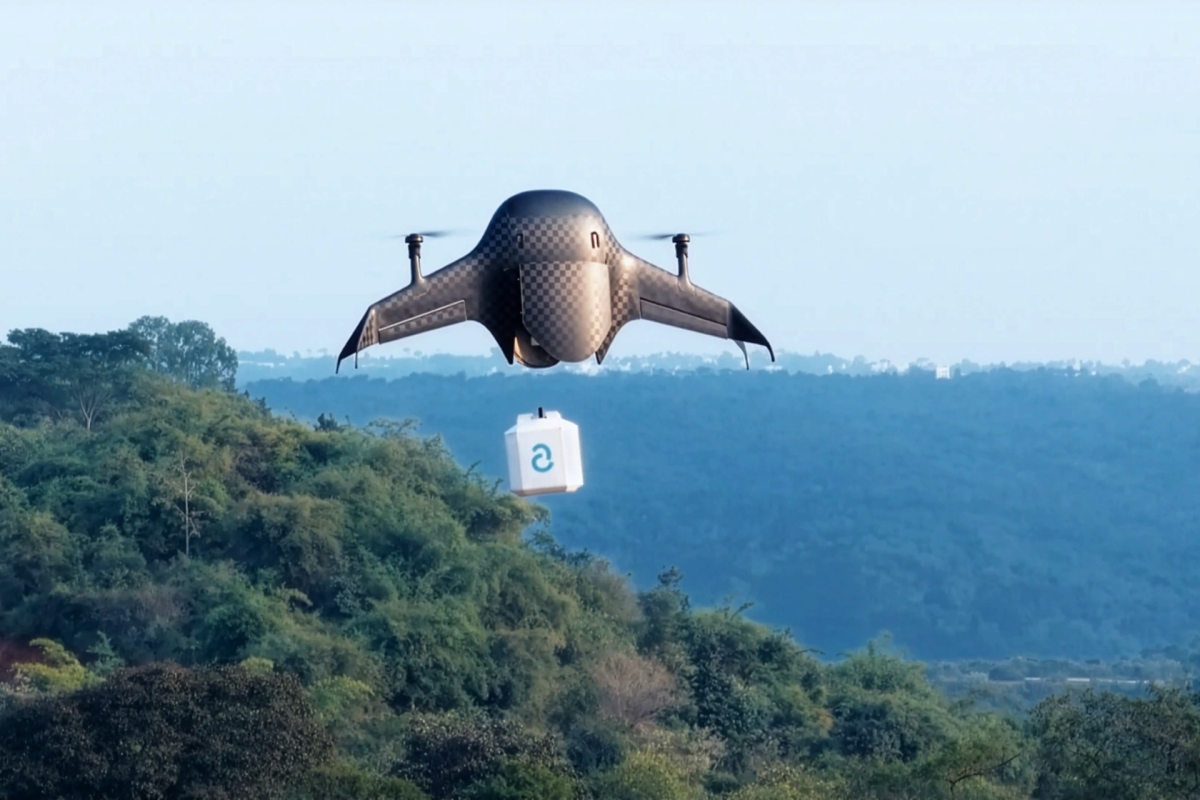
Airbound, an Indian startup building autonomous drones, has raised $37 million in fresh capital as it pushes to make moving goods through the air as cheap as trucking them by road.
Key Takeaways
- Massive Capital Infusion:Airbound secured $37 million in Series A funding, bringing its total raised to nearly $50 million, signaling strong investor confidence in its vision to revolutionize logistics.
- Disruptive Design Philosophy:The startup is innovating drone design to carry payloads significantly heavier than the aircraft itself, aiming to achieve cost parity with traditional road freight.
- Ambitious Network Expansion:Beyond current healthcare partnerships, Airbound plans a vast three-city drone network in Andhra Pradesh, targeting 10,000 daily flights, positioning itself as the “Boeing” of aerial logistics.
Airbound Soars with $37M, Charting a Course for Drone Logistics to Rival Trucking Costs
In a significant leap for the burgeoning autonomous drone sector, Airbound, an Indian startup at the forefront of aerial logistics innovation, has successfully closed a $37 million Series A funding round. This substantial capital injection propels Airbound closer to its audacious goal: transforming drone-based goods movement into an economically viable alternative to conventional road trucking. The three-year-old venture, with this latest round, now boasts nearly $50 million in total funding, demonstrating robust investor belief in its disruptive potential.
Fueling the Future: Investor Confidence Takes Flight
Less than a year after its impressive $8.65 million seed round, Airbound’s Series A was led by prominent investment firm Greenoaks. The round also saw strategic participation from a stellar lineup of investors including DoorDash, Lachy Groom, Lightspeed, and Humba Ventures. This diverse group of backers, encompassing venture capitalists and industry players, underscores the broad appeal and perceived scalability of Airbound’s vision. The fresh capital is earmarked to accelerate the development of its next-generation aircraft and expand its operational footprint, particularly in the Indian market.
Redefining Flight Economics: Airbound’s Core Innovation
The drone delivery industry, while promising, has historically grappled with the challenge of matching the cost-effectiveness and versatility of ground transportation. Airbound is confronting this head-on by fundamentally redesigning the aircraft itself. Founder and CEO Naman Pushp highlights a critical inefficiency in conventional aviation: aircraft expend considerable energy lifting their own weight rather than the payload. Airbound’s paradigm-shifting solution involves building vertical-flight drones engineered to weigh significantly less than the cargo they carry.
The startup’s current model, the TRT, weighs approximately 3.3 pounds and can efficiently transport around 2.2 pounds of payload. Looking ahead, the next iteration, already in advanced development, is projected to weigh merely 6.6 pounds while boasting an impressive payload capacity of up to 11 pounds. This focus on maximizing payload-to-aircraft weight ratio is central to achieving the desired economic efficiencies. Furthermore, Airbound’s drones utilize a distinctive rocket-like, tail-sitter design, enabling vertical takeoff and landing (VTOL) in an upright position before seamlessly transitioning to horizontal flight. This VTOL capability is a non-negotiable design principle for Pushp, ensuring independence from traditional runways even as the company scales to larger aircraft. “We want to build towards a world where everything has cost parity with trucking,” Pushp declared, outlining the company’s ambitious long-term objective.
Real-World Deployments: Bridging the Last Mile in Healthcare
Since its inception in 2023, Airbound has already demonstrated significant operational prowess, completing over 13,000 autonomous flights across the southern Indian cities of Bengaluru and Guntur. A cornerstone of its early success lies in a strategic partnership with Narayana Health, a prominent Indian hospital network. Airbound’s drones are actively transporting critical diagnostic samples between healthcare facilities, showcasing the immediate, life-saving impact of drone technology.
On the Narayana route, a single active Airbound drone can ferry diagnostic samples approximately 2.5 miles in a mere seven minutes. This dramatic speed contrasts sharply with the three to five hours typically required for the same samples to be transported by truck, a timeframe often extended by the necessity of bundling enough samples for road transport. This efficiency gain is not just about speed; it’s about accelerating diagnoses and improving patient outcomes. The partnership is set for expansion, with Narayana’s new Banashankari hospital in Bengaluru being designed with Airbound’s drones in mind, foregoing an on-site diagnostic lab or blood bank in favor of seamless drone connectivity to centralized facilities.
Vision for Scale: The Andhra Pradesh Network and the “Boeing Role”
Airbound’s ambitions extend far beyond individual hospital routes. The company has set its sights on establishing an expansive drone delivery network connecting three cities within the state of Andhra Pradesh. A signed agreement with the state government paves the way for an eventual target of 10,000 flights per day, catering to retail, e-commerce, and healthcare deliveries. Achieving this daily flight volume will necessitate a fleet of between 250 and 1,000 aircraft, depending on route lengths, with Pushp anticipating the lower end of that spectrum.
Crucially, this agreement does not involve government contracts or subsidies. Instead, the Andhra Pradesh government is collaborating with Airbound to establish the necessary regulatory framework, enabling the startup to generate revenue from businesses utilizing its delivery services. While other Indian startups like Skye Air Mobility and TSAW Drones are also building aerial logistics operations, and drone manufacturers such as Garuda Aerospace explore similar use cases, Airbound distinguishes itself with a unique strategic positioning. Pushp articulates this as aspiring to play the “Boeing role”—building the foundational aircraft that other logistics networks can leverage, rather than solely striving to be the largest delivery operator itself. This strategic focus positions Airbound as a technology enabler for the wider drone logistics ecosystem.
Navigating the Bottlenecks: Regulation and Long-Term Vision
Airbound meticulously designs and manufactures its aircraft at a sprawling 43,000-square-foot facility in Bengaluru, maintaining tight control over airframe and other core system development. While Pushp remains discreet about current production capacity, he asserts that manufacturing will not pose a bottleneck as the company scales. The true challenge, he notes, lies in regulation, particularly securing approvals for Beyond Visual Line of Sight (BVLOS) operations. This critical certification, allowing drones to fly beyond an operator’s direct sight, is indispensable for operating delivery networks at the scale Airbound envisions.
These regulatory constraints have, to date, limited Airbound’s ability to translate its extensive flight operations into substantial commercial revenue. Despite employing a team of over 150 individuals, the startup largely remains in a pre-revenue phase. However, this is aligned with Pushp’s long-term strategic outlook: “The goal is to be a giant in a few decades, not to make revenue as soon as we can.” This statement underscores Airbound’s commitment to foundational innovation and market-building, prioritizing future dominance over immediate financial returns.
When you purchase through links in our articles, we may earn a small commission. This doesn’t affect our editorial independence.
{content}
Source:{feed_title}