
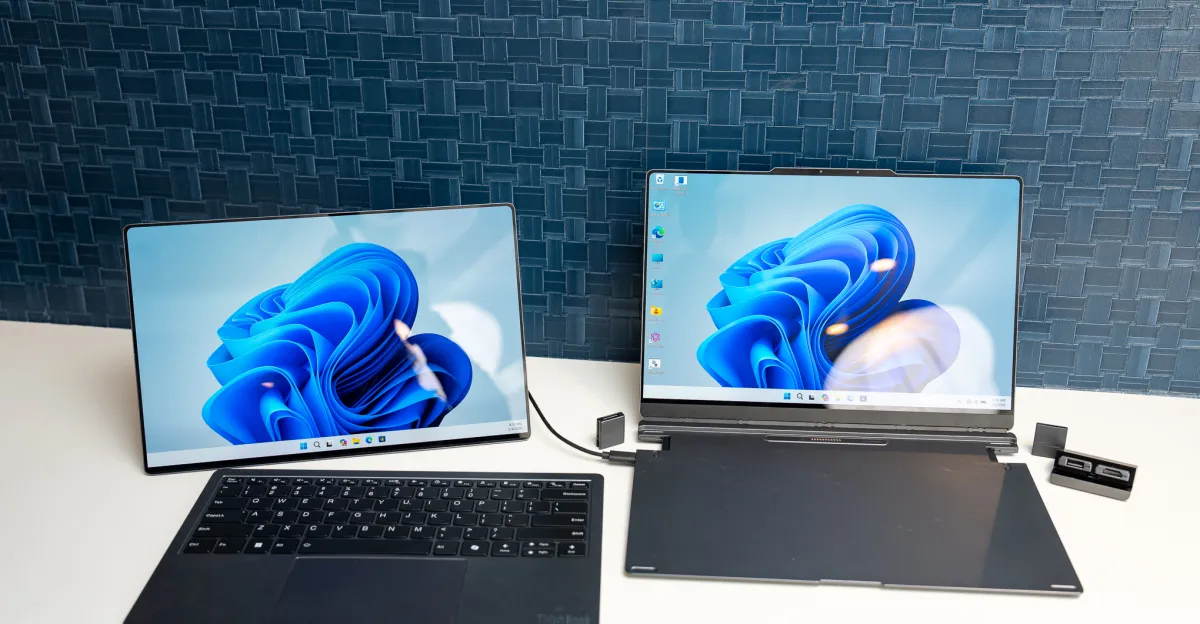
Among Lenovo’s significant notebook design ideas unveiled for MWC 2026 is a modular ThinkBook featuring dual displays. Formally designated the ThinkBook Modular AI PC Concept, this prototype represents a 14-inch efficiency device, equipped with a pair of interchangeable, hot-swappable ports, along with an auxiliary 14-inch screen, fastened magnetically to the back of its cover. This secondary screen is detachable, capable of being supported by a magnetic stand (which resides beneath the notebook), and linked through USB-C.
Yet, this prototype PC boasts another ingenious feature: its keyboard/trackpad module can be detached and swapped with the secondary display, transforming the device into a twin-screen notebook, operated using its keyboard and trackpad linked wirelessly via Bluetooth — reminiscent of the Asus Zenbook Duo.
The notion of modular ports alone immediately captivated me. Lenovo demonstrated options for this design, encompassing USB-C, USB-A, and HDMI interfaces — an offering not as comprehensive as the extensive ecosystem Framework has cultivated. Nevertheless, should this ever reach commercial production, it represents a foundational step. In contrast to Framework, these hot-swappable ports utilize an M.2 interface for connecting to the notebook, rather than USB-C. However, their removal and reinsertion proved remarkably simple, and Lenovo also presented a compact, appealing pouch for transporting a few ports. Beyond the pair of interchangeable ports, the ThinkBook prototype features a single fixed USB-C port for power delivery or connecting the supplementary display.
While the ports appeared sufficiently impressive, Lenovo, true to form, ventured into extravagant secondary-screen displays too. Both displays are multi-touch OLED panels, boasting a 16:10 4K (3840 x 2400) resolution, a 120Hz refresh frequency, and 500 nits of luminance. Additional anticipated specifications encompass an Intel Core Ultra 7 255H Arrow Lake processor, 32GB of volatile memory, and a 1TB solid-state drive.
Its eventual production remains uncertain, but a primary concern regarding its feasibility stems from its power source: the battery. The ThinkBook Modular is equipped with merely a 33Wh battery to energize all this sophisticated equipment. This capacity is notably less than even a 13-inch MacBook Air, and it features not merely one, but a pair of high-resolution, energy-intensive OLED panels. I apprehend that this notebook would exhibit feeble battery endurance, at least in its present slender and portable configuration (weighing only 2.54 pounds / 1.15kg with a single display, and 3.11 pounds / 1.41kg with both screens attached). However, Lenovo might yet astonish us within the next year or two by launching a version with a more substantial battery or a more power-efficient processor.
Even if the secondary OLED were discarded, it would nonetheless remain captivating — for who wouldn’t desire the ability to select their preferred connectivity interfaces?
Visuals by Antonio G. Di Benedetto / The Verge
{content}
Source:{feed_title}