
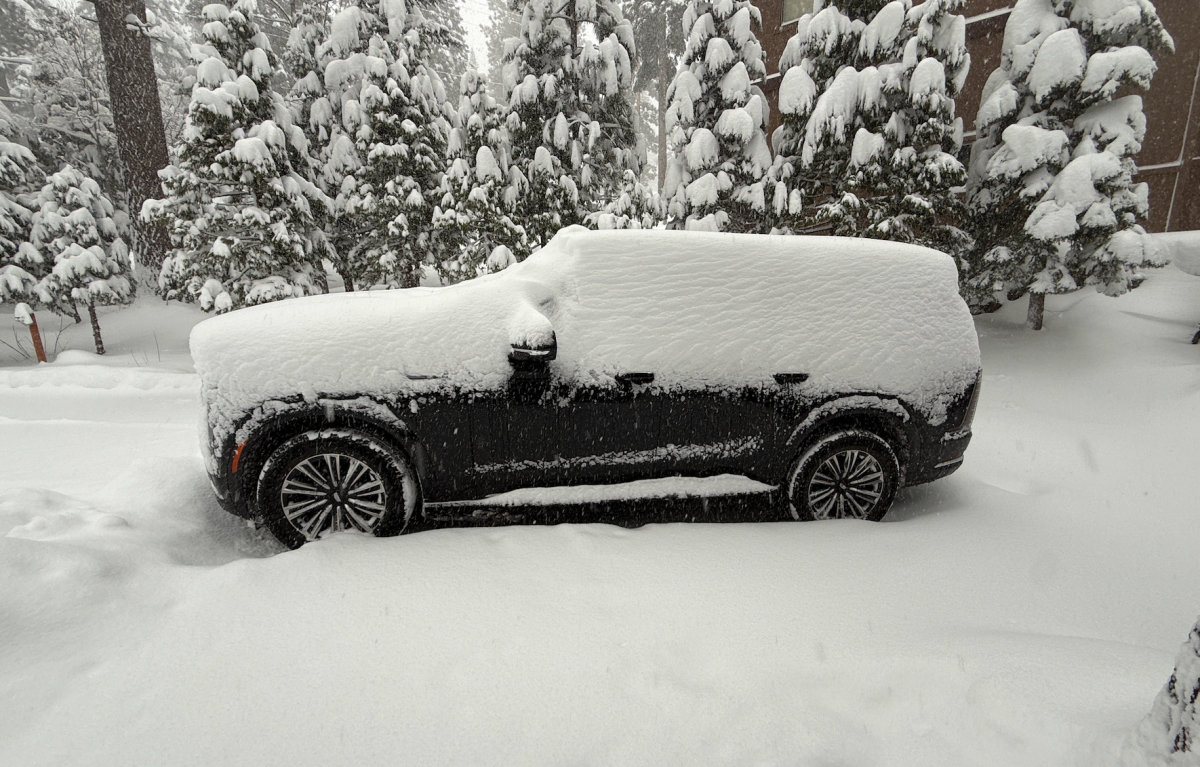
Prior to embarking on a journey to Tahoe last weekend, General Motors extended an invitation for me to utilize the firm’s 9,000-pound opulent behemoth – the novel electric Escalade IQL (commencing at $130,405) – for a seven-day assessment drive. It’s important to mention, prior to proceeding, that I do not possess the credentials of a seasoned automotive critic. TechCrunch boasts highly skilled transportation journalists; I do not count myself among them. My role is merely that of an automobile aficionado, and our household owns two electric vehicles (a prevalence often observed in the Bay Area).
My enthusiasm was instant. I had initially caught sight of one the previous summer at an automotive exhibition, where various local vehicle retailers had positioned their displays at the close of an expansive display of refined classic cars. My initial thought was an exclamation regarding its immense size, succeeded by an unexpected appreciation for its aesthetic, which, notwithstanding its grand dimensions, exhibits a sense of moderation. Lacking a more precise descriptor, I will characterize it as ‘robust and imposing.’ Its balanced structure simply functions effectively.
My initial thrill diminished quite rapidly upon the vehicle’s delivery to my residence one day prior to our scheduled departure. This apparatus is truly an absolute behemoth — measuring 228.5 inches in length and 94.1 inches in width, it rendered our personal automobiles diminutive by comparison. My inaugural dwelling in San Francisco occupied less spatial area. Attempting to maneuver it up my drive was also somewhat daunting; its considerable size and elevated hood line contribute to a challenge such that when ascending an incline of a particular gradient (our home is situated halfway down a slope; our mailbox resides at its summit), the immediate area before the vehicle becomes obscured from view.
I contemplated simply leaving it parked in the driveway for the entirety of the journey. The only other option involved striving to acclimate myself to the idea of piloting it 200 miles to Tahoe City; consequently, I drove it casually that evening and the following morning, retrieving a meal, attending a fitness session — merely performing routine local errands. Encountering an acquaintance on the thoroughfare, I promptly declared that this vehicle was not my recent acquisition, that I might potentially evaluate it, and queried if its dimensions weren’t preposterous? It conveyed the sensation of a military armored vehicle. I pondered: aside from lodging establishments employing utility vehicles such as the Escalade for guest transport, what sort of individual would opt for an automobile of this magnitude?
Upon the conclusion of five days, it became evident that I had, in fact, become that very sort of individual.
Frankly, I am uncertain as to the exact moment or manner in which I developed an affection for this vehicle. Had I composed this assessment merely two days into the experience, its tone would have been markedly distinct. Even currently, my perception is not so clouded as to overlook its deficiencies.
The Escalade’s impressive showing amidst a severe snowstorm truly captured my admiration, but allow me to guide you through the progression from an initial sentiment of aversion, “Ugh, this vehicle resembles a tank,” to one of enthusiastic affirmation, “Indeed! This vehicle is atank.”
Techcrunch event
Boston, MA
|
June 9, 2026
Simply entering the vehicle demands a slightly greater physical effort than one might reasonably expect. Despite my reasonably active lifestyle, I nonetheless pondered whether this apparatus ought not to be equipped with an automatic running board.
Within the cabin, digital extravagance truly comes to life. The instrument panel features a sprawling 55-inch curved LED display offering 8K resolution, which appears less like a typical automotive interface and more akin to a command center. Occupants in the front seating area are provided with individual displays. Those in the second row similarly benefit from 12.6-inch personal monitors, accompanied by retractable tray tables, twin wireless charging pads, and — in the most opulent trim level — therapeutic massage seating designed to make them completely forget their vehicular surroundings. Google Maps manages the directional guidance. Moreover, the polarized screen innovation warrants particular commendation: as one of my children engaged in prolonged viewing of Hulu from the front passenger seat, no visual content intruded upon my field of vision from the driver’s position.
The interior space is meticulously designed on the principle of ensuring ample room for every occupant, a promise it unfailingly fulfills. Forward leg space extends to 45.2 inches; the middle row provides 41.3; and even the rearmost row — traditionally a zone where patience erodes during extended journeys — affords 32.3 inches. A septet of adults could comfortably occupy this vehicle for an extended period without experiencing mutual irritation. Heated and cooled leather upholstery, featuring 14-way electrical adjustments, is included as standard in the initial two rows, and the entire system is powered by 5G Wi-Fi connectivity. The automobile is additionally equipped with Super Cruise as a standard feature, which is GM’s proprietary autonomous driving assistance system, which I confess I didn’t fully master. Professional critics appear to hold it in high regard; however, during my trial, the vehicle seemed to veer unsettlingly close to the edge markers of the motorway lane, and in such instances, it initiates a progressive series of alerts. Initially, a crimson steering wheel emblem appears on the display. Subsequently, your seat delivers tactile notifications to your lower back. Disregard these, and an auditory signal — serving as both an admonition and a prompt — permeates the passenger compartment. GM terms this assertive progression a “driver intervention demand.”
Have I made note of the 38-speaker AKG Studio audio setup? It is truly superb.
Regarding its outward appearance — this is an aesthetically pleasing leviathan, though it necessitates a period of adjustment. Initially, I perceived the grille, which serves a purely decorative function, as almost ludicrously grand. This vehicle unequivocally caters to individuals who hold positions of authority, aspire to leadership, or wish to project an image of power while grappling with personal existential ponderings. Upon arriving at a restaurant featuring extensive glass panels one evening, I am quite confident I temporarily impaired the vision of half the diners as I maneuvered into a parking space orthogonal to the structure, with the Escalade’s headlamps projecting an intense illumination through the fenestrations.
Subsequently, one encounters the luminous spectacle the automobile orchestrates each time it senses your proximity, either through the key fob or the MyCadillac application. It’s as though the vehicle itself poses the query, “Greetings, esteemed driver, what is our destination?” even before your hand has made contact with a door handle. (In Cadillac’s specific terminology, this feature is attributed to its “sophisticated, full-LED external illumination system,” emphasized by an “illuminated crystal shield” grille and emblem, in conjunction with upright LED headlights and “programmable tail lights.”)
It is, from an impartial perspective, somewhat ostentatious. I instantly developed an affinity for it.

Notwithstanding its substantial dimensions, the Escalade IQL exhibits surprising agility. Not agile in the manner of a “sports car weaving through vehicular flow,” but rather with an agility that prompts the thought, “It’s hard to fathom that such a massive entity doesn’t maneuver like a naval warship.”
We now turn our attention to the points of vexation. The forward storage compartment — or “frunk,” as it is termed in the specialized vocabulary of electric vehicle enthusiasts — functions in an enigmatic and irritating manner. Its activation necessitates maintaining pressure on the control until the process concludes. Premature disengagement results in its arresting midway through its ascent, remaining suspended in a state of automotive limbo, compelling a complete re-initiation of the operation. Deactivation similarly calls for an identical continuous application of force. The aft luggage compartment, by contrast, mandates two separate presses succeeded by an instant relinquishment of the button. Excessive retention yields no response.
On a related note, twice, the vehicle declined to shut off after I’d
concluded the journey. The car merely remained stationary, still operating, even after being put into park and having its door opened (a command that usually deactivates the vehicle). The remedy: access the front trunk, then secure it, engage drive,subsequentlyengage park, and then fully alight.
Regarding its software, it performs quite adequately unless one has previously possessed a Tesla, in which scenario, brace for dissatisfaction. This observation appears universally valid — all acquaintances of mine who possess both a Tesla and a different electric vehicle articulate this identical sentiment. Upon grasping the seamless manner in which Tesla’s software bridges the gap between desired action and its fulfillment, the software from all other car manufacturers appears to be a concession.
This leads us to the lowest point of the journey: recharging in Tahoe amidst winter. Despite its commendable qualities, the Escalade IQL is, unequivocally, an energy-intensive vehicle. Its battery pack, a colossal 205 kWh unit, is necessarily large, as the vehicle consumes approximately 45 kWh every 100 miles, an amount substantially greater than similar electric sport utility vehicles. Cadillac projects a 460-mile range from a complete charge, a figure sustainable under optimal circumstances. However, Tahoe during winter does not present optimal conditions. Furthermore, we had arrived with a lower charge level than advisable. Numerous detours en route, including an urgent diversion to procure shirts for a family member who had neglected to pack any, had depleted the battery more rapidly than anticipated. When the moment came to recharge, it was truly imperative.
We journeyed to a Tesla Supercharger in Tahoe City, which was displayed on the MyCadillac application, yet upon connecting, no power transfer occurred. Two additional charging points were attempted. A General Motors spokesperson elucidated, somewhat unhelpfully, that Tesla restricts non-Tesla vehicles to 6 kilowatts per hour regardless, yet this revelation proved disheartening. An EVGo station in the vicinity had ceased operations a month beforehand. ChargePoint’s pair of units at the Tahoe City Public Utility parking area were, in turn, inoperable and capable of establishing a connection but unable to facilitate any actual charging. For a short while, we considered a 35-mile trip to Incline Village, calculated the implications of being stranded, and ultimately dismissed the idea. Subsequently, I located an Electrify America station situated 12 miles distant. We proceeded through accumulating snow, reaching the destination just before 11 p.m., and it functioned. I remained there for an hour, contending with weariness, prior to driving back to our accommodation.
The subsequent morning brought forth an additional predicament: the tire pressure had decreased to 53 and 56 PSI at the front (suggested: 61) and 62 PSI at the back (suggested: 68). I am uncertain if the vehicle was supplied in that condition or if another factor was at play — regardless, it entailed an individual standing at a service station inflating tires while enduring a direct assault of ice fragments on their face. That individual was my spouse. The tires maintained their pressure thereafter, even as the week continued to present challenges. Considering it was a family excursion, things were progressing splendidly.
Indeed, at this juncture, I would have declared the Escalade IQL to be undeniably opulent and perfectly suited for families of four or more who prioritize ample room and advanced technology. I would have informed you that it arrived encumbered by genuine compromises: its prominent hood impeding forward sight, parking difficulties stemming from its sheer size, a scarce charging network for such an energy-hungry vehicle, and tires obligated to bear a mass of 9,000 pounds. It is a magnificent automobile, I would have remarked, but it isn’t quite my preference.
However, the snowfall, once begun, persisted incessantly. In a mere two days, an eight-foot accumulation rendered skiing unfeasible — the primary objective of the excursion — and made driving an unnerving prospect. Yet, I discovered that I harbored no fear due to our possession of the Escalade, which, owing to its substantial mass, conveyed the sensation of maneuvering a tank through the snowy terrain. That which could have been distressing instead felt tranquil.
I furthermore became accustomed to its dimensions. By the conclusion of the preceding week, I had ceased silently uttering apologies to anyone awaiting my deliberation on where to park the vehicle. I no longer concerned myself with the implications of driving an automobile whose fundamental design ethos proclaims: the proprietor of this conveyance does not endure queues. With eight feet of snow having descended, and groceries being a necessity, I was the one with the formidable machine, you fools! I could also perceive my spouse developing an affection for the automobile.

Subsequently, the snowfall ceased and the sun emerged, rendering the Escalade merely a very soiled vehicle parked in the driveway (my apologies, GM!). I still find it appealing, moreover, and I recognize this sentiment isn’t solely attributable to the urgent circumstances. I enjoy its elevated driving position, with the audio system immersing the interior in a cherished musical selection. That illumination display continues to captivate me. The front trunk remains somewhat peculiar. I shall not quickly forget the apprehension of being unable to replenish the power of a 9,000-pound automobile at a location I had presumed suitable. Maneuvering this behemoth into a parking spot is genuinely a demanding undertaking. My views on superfluous consumption are firm. No aspect of that has altered.
I also, inexplicably, desire this vehicle, consequently, when the General Motors intermediary arrives to retrieve it, I might conceal it beneath a tarpaulin — a considerably large one — and inform him he has arrived at an incorrect location.
{content}
Source:{feed_title}