
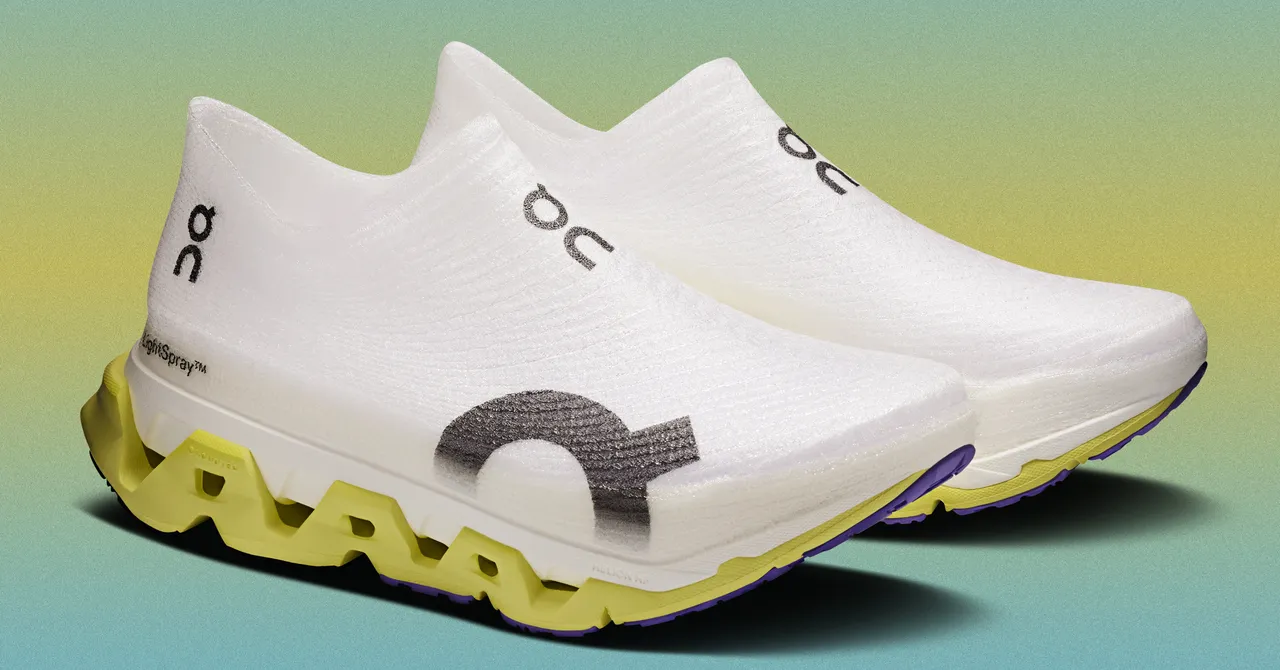
The Swiss footwear companyOn—recognized as one of the swiftly expanding shoe labels—has achieved considerable success, evolving into a $3 billion enterprise, largely due to the massive, voluminous outsoles of its notably flamboyant footwear. On this day, the firm unveiled three fresh athletic shoes and the inauguration of a novel manufacturing facility in South Korea, which aims to produce a significantly larger quantity—at least, that is the stated objective.
In particular, the company is concentrating its efforts on the manufacture of its latest, most unconventional shoe—a colossal-soled, slip-on running shoe featuring a singular forefoot enclosure constructed from “hyper-foam” polymers applied by robotic manipulators. These polymers comprise 40 percent bio-based foam, and the footwear is assembled from merely eight components; On asserts that its streamlined methodology reduces the shoe’s carbon emissions.
The LightSpray Cloudmonster 3 Hyper represents a departure from On’s initial footwear employing its spray-applied toe box method, known as the Cloudboom Strike LS. Beyond incorporating the LightSpray moniker, the key distinction lies in the adoption of the Cloudmonster model, which, within On’s brand mythology, typically offers more cushioned outsoles. This updated iteration features 20 percent greater foam, catering to all those athletes who appreciate a springy rebound. A restricted debut will occur on the company’s online portal and brick-and-mortar outlets in North America commencing March 5, with a worldwide rollout scheduled for April 16.
Each of the new LightSpray shoes tips the scales at 205 grams (under half a pound), rendering them slightly weightier than the 170-gram Cloudboom Strikes. They are also more affordable at $280, compared to the Cloudboom’s more substantial $330 cost.
While WIRED favored the initial version of the LightSpray shoe, no one else, save for a select group of marathon athletes, had the opportunity to utilize it. Manufacturing batches were severely restricted, and the shoes were exceedingly costly. Now, On has significantly augmented its production in South Korea, thereby allowing it to multiply its total output of LightSpray shoes 30-fold by 2026.
“On’s approach to extend the LightSpray technology from competitive racing to general athletic footwear is to render it accessible to a wider demographic beyond top-tier sportsmen,” an On spokesperson informed WIRED via electronic mail.
It remains uncertain if slip-on, unlaced footwear will establish a strong foothold in the market. While brands such as Nike offer slip-ons, the preoccupation with laceless designs is typically confined to unique, specialized footwear like theBack to the Future II-inspired Adapt BB self-fastening sneakers. Certain dedicated athletes, conversely, favor seeking a more organic running experience offered by minimalist-soled footwear such as ‘barefoot’ models; however, On is reiterating its commitment to exceptionally large cushioning elements. Consumers, it appears, appreciate them, as On is also unveiling two additional Cloudmonster models. One is the Cloudmonster 3 with traditional lacing, and the other is a standard Cloudmonster 3 Hyper with laces and a forefoot enclosure without the LightSpray application. (Laces, how antiquated!)
On states its additional strategic objective is intensifying its worldwide manufacturing output of the LightSpray shoes, “over the forthcoming years.”
{content}
Source:{feed_title}