
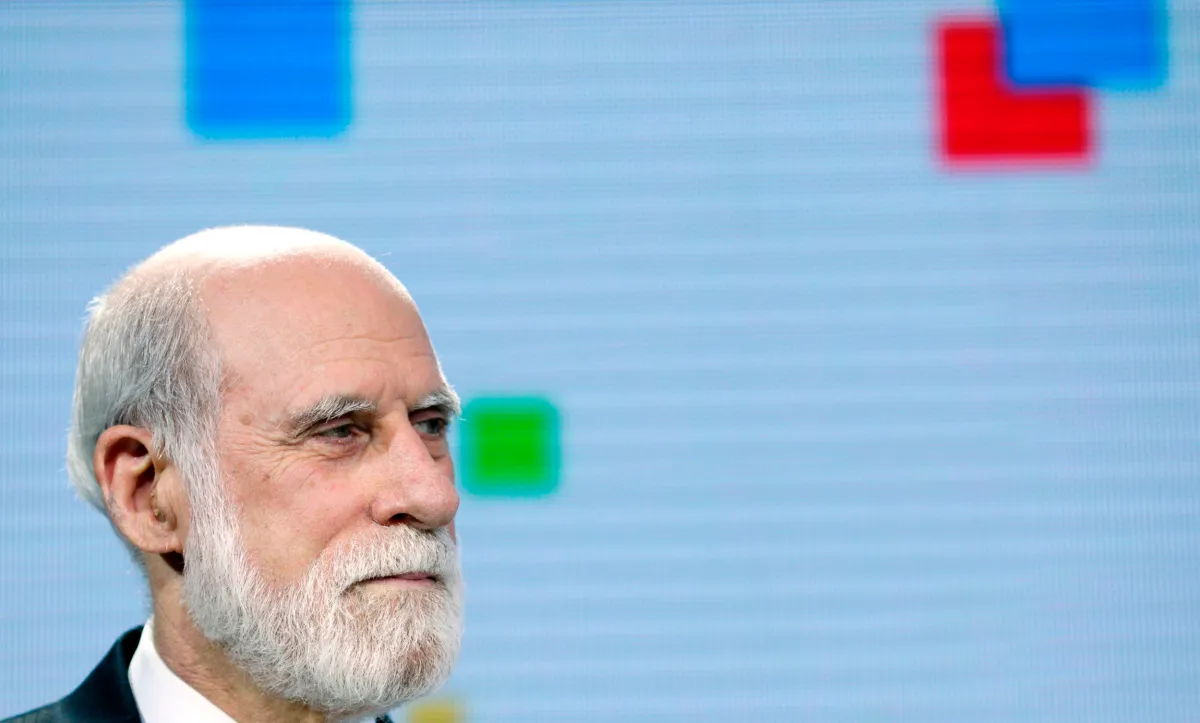
Vinton Cerf, often hailed as a “Father of the Internet,” is stepping down from his role as Google’s chief internet evangelist next week, marking the conclusion of an extraordinary career that has profoundly shaped the digital age. His departure comes after more than two decades at Google, following a lifetime dedicated to pioneering the foundational technologies of the internet.
While speaking via video feed at the Open Frontier conference hosted by the Laude Institute, Cerf’s imminent retirement was acknowledged by Dave Patterson, the UC Berkeley professor renowned for co-developing RISC processor architecture. Patterson’s tribute resonated through the room, underscoring the immense respect Cerf commands across the tech community.
“Vint…has been at Google more than 20 years, and he is retiring a week from today, and so I think we ought to give him a round of applause for a relatively good career,” Patterson announced, prompting enthusiastic cheers from the conference attendees. Google did not respond to a request for comment by publication time regarding Cerf’s retirement.
Cerf, 83, alongside his collaborator Robert Kahn, is widely credited as an architect of the fundamental networking protocols that underpin the internet we navigate today. His seminal work, beginning in the 1970s, involved developing and popularizing TCP/IP — the Transmission Control Protocol/Internet Protocol — a basic set of rules that enables diverse computer networks to communicate seamlessly with each other. This monumental achievement has earned him a plethora of accolades, including numerous honorary degrees, the Presidential Medal of Freedom, and the prestigious Turing Award, often referred to as the Nobel Prize of computing, among many other honors.
Since 2005, Cerf has served as a vice president and chief internet evangelist at Google, a role that saw him advocate for the internet’s continued open development, explore its future applications, and address challenges related to digital preservation and access. One could argue, perhaps wryly, that by this point, “the internet is fully evangelized, for good or ill,” a testament to the pervasive reach of the technology he helped create.
Cerf was speaking on a panel alongside other distinguished computer scientists known for their significant contributions to durable open source projects. This esteemed group included Patterson; François Chollet, the brilliant mind behind the Keras deep-learning library and co-founder of Ndea; John Ousterhout, the Stanford computer scientist responsible for the Tcl programming language, who also co-founded Electric Cloud; and Matei Zaharia, co-founder and chief technologist at Databricks. Their collective wisdom offered invaluable advice about the strategies and principles required to build open source systems that possess longevity and resilience — guidance that has become increasingly critical as a new generation of founders places substantial bets on open infrastructure to drive the next wave of AI products and innovations.
Much of the conference’s discourse naturally gravitated towards the growing concerns surrounding the centralization of advanced AI models within a handful of highly resourced laboratories. This trend stands in stark contrast to the inherently decentralized, open internet paradigm that facilitated the unprecedented durability and global adoption of Cerf’s own protocols. However, Cerf offered a compelling prediction: the emergent rise of AI agents — sophisticated software entities capable of acting autonomously and coordinating complex tasks with other software — will invariably push tech companies back towards the imperative of standardized protocols. This perspective suggests that the future of AI may echo the early days of the internet, where interoperability was paramount.
“The agentic model of AI, with multiple agents from multiple sources interacting with each other, is going to force composability, and a requirement for interoperability and standardization,” Cerf asserted. His argument posits that as AI systems become more autonomous and collaborative across different platforms and developers, a common language and set of rules will become essential for their effective and reliable operation. This vision implies a future where AI’s success hinges on a shared infrastructure of communication, much like the internet relies on TCP/IP.
If Cerf’s foresight proves accurate, the companies or consortia that manage to define and champion these crucial interoperability standards early on could wield an outsized influence over the architecture and functionality of the burgeoning agentic economy. This dynamic would be strikingly similar to the “protocol wars” of the early internet, where competition to establish dominant communication standards had lasting effects on the digital landscape. It highlights a critical strategic battleground for the future of artificial intelligence, where open standards could either democratize or centralize control over the next wave of technological evolution.
While some of his fellow panelists speculated that natural language communication between large language model (LLM) agents might suffice for future interactions, Cerf remained firm in his conviction that more formal, precise standards would be an absolute necessity. He articulated his concerns about the inherent limitations of human language when applied to machine-to-machine interactions.
“I don’t think English is going to be the best choice. There’s a flexibility in it, but there’s ambiguity, and I think precision for interagent interaction is going to be very, very important. An agent really needs to be sure the other agent understands what it is that they just agreed to do together,” Cerf explained. He drew a vivid analogy to illustrate his point, underscoring the potential for miscommunication in a complex AI environment.
“Remember the old telephone game where you wish you’d whispered in somebody’s ear and then by the time it got to 10 people away the message was totally different? Imagine a bunch of agents talking to each other in natural language, you know, that’s kind of terrifying.” This anecdote perfectly encapsulates his argument for structured, unambiguous protocols over the inherent messiness of human language for critical machine interactions.
In a more light-hearted moment that offered a glimpse into Cerf’s personal style, Patterson fondly recalled meeting the internet pioneer as a grad student back in the 1970s. Cerf is famously known for his distinctive wardrobe, often favoring elegant three-piece suits, a sartorial choice that set him apart even in his early career.
“He’s always been the best dressed computer scientist I’ve ever met,” Patterson quipped. “My memory of Vint is that he came as a grad student with a shirt and tie in the 70s.” Cerf, with a smile, confirmed the anecdote, revealing the deliberate nature of his unique presentation.
“It absolutely is true,” Cerf acknowledged. “I even had a vest, and for some reason I always wanted to stick out, and instead of having long hair, and something in my nose, I thought just dressing differently was one way to do it.” This personal touch highlights the blend of intellect and individuality that has defined Cerf’s remarkable journey through the technological frontier.
When you purchase through links in our articles, we may earn a small commission. This doesn’t affect our editorial independence.
{content}
Source:{feed_title}