
The smart glasses industry has long been a tortured dream of Silicon Valley. The premise is appealing enough: What if, to enjoy the benefits of mobile computing, people didn’t have to stare at their phones all day long and could, instead, simply wear a lightweight computing device on their face? Science fiction fans (a demographic that is strong in the tech industry) can see this vision perfectly.
Key Takeaways
- Beyond the Hype Cycle:After years of significant investment and minimal return, the smart glasses industry is showing tangible signs of an inflection point, moving from conceptual ambition to practical application with improved form factors and software.
- Innovation Meets Practicality:Companies like Xreal are leading with devices like Project Aura, which, despite a tethered design, offer a rich ecosystem of immersive apps and versatile use cases for both consumers and professionals.
- The Path to Profitability:While sales are rising, the industry still grapples with achieving profitability. Strategic cost management, margin improvement, and eventual commercial launches are crucial for companies like Xreal aiming to break even and secure long-term viability.
Smart Glasses: From Sci-Fi Dream to Tangible Reality (Finally?)
For decades, the notion of wearing a computer on your face, seamlessly blending digital information with the physical world, has captivated the imaginations of innovators and science fiction enthusiasts alike. It’s a vision deeply embedded in Silicon Valley’s ethos: freeing humanity from the tyranny of the handheld screen. Yet, for much of the last decade, this alluring promise has resembled a financial black hole, swallowing gargantuan investments from tech giants and startups with little to no tangible profit emerging.
“Everybody’s losing money,” stated Chi Xu, the visionary founder and CEO of Xreal, a long-standing partner of Google in the burgeoning smart glasses space. I had the opportunity to speak with Xu at Google’s I/O conference in Mountain View last week, where he was showcasing Xreal’s ambitious Project Aura—their latest endeavor to craft functional extended reality (XR) glasses that users genuinely desire. His candid admission underscored a pervasive challenge, immediately followed by an explanation: “That’s because it’s very hard, what we’re doing.”
The Tortured Path: A Decade of Disappointment
Indeed, the journey of smart glasses has been fraught with hurdles. Early iterations were often plagued by a host of obvious issues: bulky, uncomfortable, and socially awkward form factors that invited more ridicule than adoption. The software, when it existed, was often negligibly beneficial, failing to provide a compelling reason for consumers to integrate such a device into their daily lives. Battery life was notoriously poor, processing power insufficient, and the overall user experience fell far short of the futuristic ideals portrayed in popular culture.
This era saw numerous high-profile failures and shelved projects, leading many to dismiss smart glasses as a perpetual niche, a technology destined to remain on the periphery of mainstream adoption. The dream was tantalizing, but the execution was consistently jarring. Companies poured billions into research and development, building complex supply chains and intricate optical systems, only to find consumers resistant to wearing something that felt more like a medical device or a prop from a dystopian film than a natural extension of their digital lives.
Signs of a Shift: Meta and the Evolving Landscape
Now, however, a palpable shift is occurring. Industry insiders, including Xu, express a growing conviction that their business has finally turned a corner, potentially reaching a long-awaited inflection point. This renewed optimism is largely fueled by significant advancements in miniaturization, display technology, and the development of more intuitive software interfaces. The hardware is becoming lighter, sleeker, and more discreet, while the underlying operating systems and applications are beginning to offer truly valuable experiences.
A significant catalyst for this renewed interest has been Meta’s 2023 partnership with Ray-Ban. This collaboration launched a line of models that, while still limited in functionality compared to full AR/VR headsets, managed to achieve impressive unit sales. While Meta’s Reality Labs division, responsible for these glasses, still operates at a massive loss—highlighting the enduring financial challenges—the Ray-Ban partnership demonstrated a crucial breakthrough: people are willing to buy and wear smart glasses if they are stylish, comfortable, and offer a basic level of practical utility, such as discreet photo/video capture and audio streaming.
This market validation, combined with ongoing technological breakthroughs, has ignited a fresh wave of innovation. Xu believes that the current convergence of mature hardware, robust operating systems, and intuitive user interfaces is precisely what Xreal needs to finally become a leader in this evolving space. “You need all the key pieces ready — you need the hardware ready, the operating system needs to be ready, and then you need a great user interface,” Xu emphasized, outlining the trifecta necessary for success.
Xreal’s Project Aura: A Glimpse into the Future
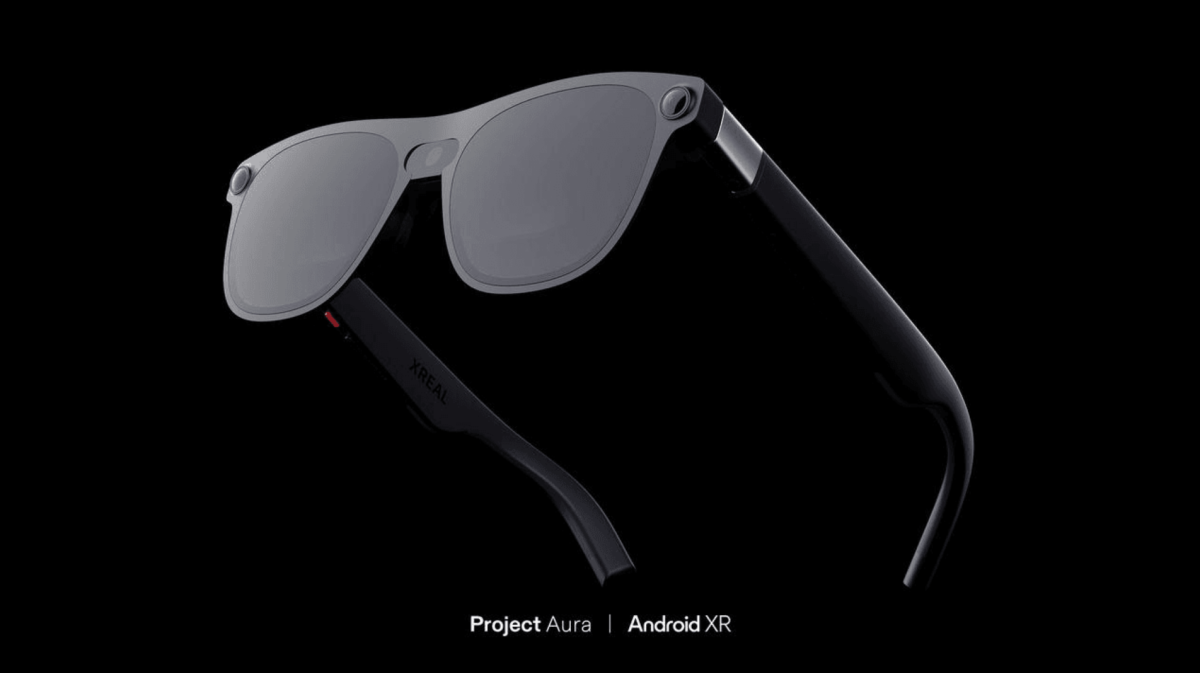
Xreal’s newest model, Project Aura, embodies this new generation of smart glasses. These wired glasses feature stunning OLED displays embedded directly within the frames, allowing users to watch high-resolution videos and interact with digital content in a deeply immersive way. While the Aura comes somewhat awkwardly tethered to a “puck”—essentially a phone-shaped mini-computer that powers the entire experience—this design choice is a calculated trade-off. Users can simply slip the puck into their pocket, and in exchange for this minor inconvenience, they unlock a far wider variety of robust and engaging experiences.
The functional breadth of Project Aura is impressive. It promises an immersive Google Maps app, where directions can float visibly in your line of sight; VR YouTube videos that transform your surroundings into a personal cinema; and a “painting app” that leverages advanced hand tracking to let you create holographic imagery visible only to you. Beyond these, there are reportedly games playable via intuitive hand gestures and basic web surfing functionality, making the glasses a versatile tool for both entertainment and productivity.
Xreal highlights the seamless integration into daily life: “Whether you are following a floating recipe while cooking, setting up a private workspace at a coffee shop or on a flight, or watching a movie on a virtual big screen at home, the experience is seamless,” the company promises. Xu further articulates a vision that extends beyond the casual consumer, envisioning significant professional applications. “It’s not just about watching the NBA game in a hologram type of format, you could also go to a coffee shop and do some work,” he noted, pointing to the potential for enhanced productivity and discreet information access in various professional settings.
The Road to Commercialization and Profitability
Currently, Project Aura is accessible primarily to developers, allowing them to build out the burgeoning ecosystem of applications that will define its eventual success. The plan, however, is for a commercial launch later this year, making these advanced smart glasses available to a wider consumer base. Parallel to this product rollout, Xreal is actively pursuing an initial public offering (IPO), which Xu anticipates will take place before the close of 2026, though he remained tight-lipped on specific details.
In the meantime, the company is diligently focused on the critical task of turning a profit—a challenge that has haunted the entire industry. Xu proudly notes that Xreal has been steadily raising its gross margin while simultaneously lowering its costs for marketing and sales. These strategic financial maneuvers are geared towards a clear objective: “Next year is the year when we could actually break even,” he states, signaling a pivotal moment for the company and a potential blueprint for others in the sector.
The journey from a financial black hole to profitability is arduous, but Xreal’s calculated approach to product development, market strategy, and financial management suggests a mature understanding of the landscape. Their focus on delivering tangible value, coupled with a keen eye on the bottom line, positions them as a key player to watch as smart glasses inch closer to widespread adoption.
Bottom Line
The smart glasses industry, long burdened by unfulfilled promises and significant financial losses, is undeniably entering a new, more promising chapter. With advancements in form factor, display technology, and software ecosystems, devices like Xreal’s Project Aura are demonstrating that the dream of seamless, wearable computing is finally becoming a tangible reality. While the path to mass market adoption and sustainable profitability remains challenging, the strategic efforts of companies like Xreal to balance innovation with sound business practices suggest that smart glasses are no longer just a futuristic fantasy, but a burgeoning platform poised to redefine how we interact with information and the world around us.
{content}
Source:{feed_title}