
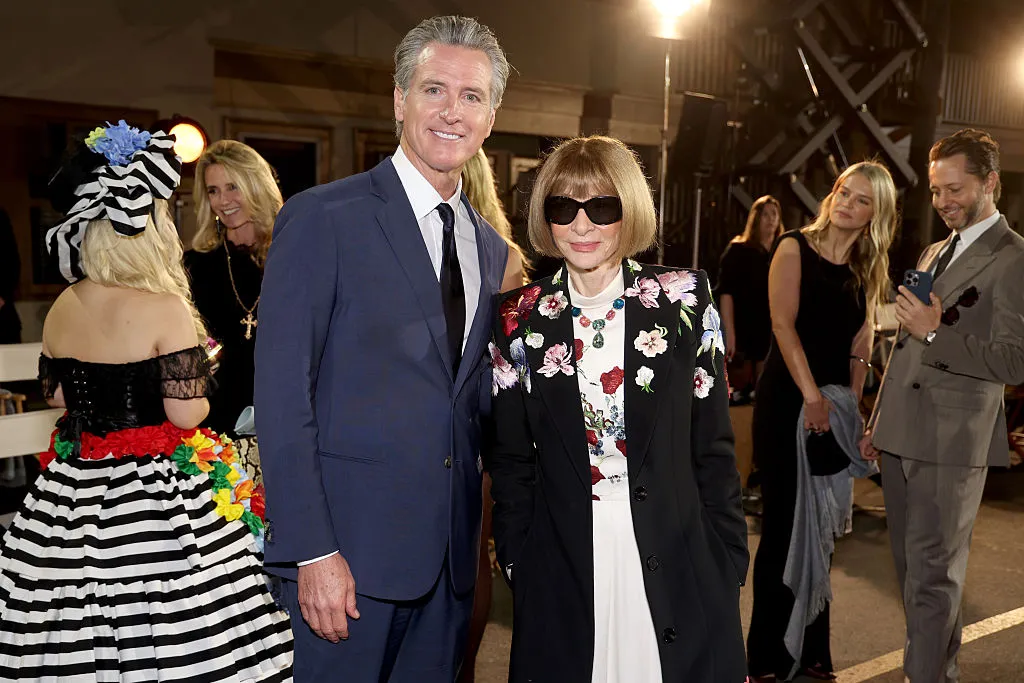
Vogue World is coming to San Francisco next year — perhaps another indication that tech billionaires have become leaders in the fashion zeitgeist.
Of course, the announcement of the enormous fashion/art/music event doesn’t say that. Instead, Anna Wintour wrote that Vogue believes in celebrating cities and “San Francisco is a city like none other.”
“It’s a place of diverse communities living side by side, a place that loves the arts, loves creativity, and isn’t afraid of change.” She also noted the city’s history of rebelliousness and innovation.
“I love that San Francisco has always stood up for values and the things it believes in,” Wintour wrote. “Vogue World will support San Francisco’s creative minds and strengthen the entire ecosystem — and it will offer another opportunity to show San Francisco is on the rise.”
There were rumors that Vogue World would head to San Francisco after Winter was seen having meetings with the city’s mayor, Daniel Lurie.
—
**Key Takeaways:**
* **Vogue’s Strategic Pivot:** Anna Wintour’s decision to bring Vogue World to San Francisco signals a definitive embrace of the tech industry’s growing cultural and economic influence on high fashion.
* **The Evolving Tech Aesthetic:** Once synonymous with hoodies and practical wear, the tech world is increasingly engaging with and even shaping fashion trends, driven by prominent figures and company branding.
* **San Francisco: A New Fashion Frontier:** Despite its unconventional style reputation compared to traditional fashion capitals, San Francisco is being repositioned by Vogue as a hub of innovation and creativity ripe for fashion exploration, leveraging its status as the global epicenter of AI.
—
Vogue World, the global fashion spectacle typically reserved for the established fashion capitals of the world, is setting its sights on San Francisco next year. This announcement, while framed by Anna Wintour as a celebration of the city’s unique spirit, innovation, and diverse communities, carries a far deeper, more strategic message: the tech industry, and its billionaire titans, have officially arrived at the forefront of the fashion zeitgeist.
The Westward Shift: Vogue Embraces the Innovation Hub
For years, Vogue World has graced the runways and streets of New York, London, Paris, and most recently, Milan. These cities are synonymous with haute couture, established designers, and centuries of fashion history. San Francisco, by contrast, has largely been associated with a different kind of innovation—that of silicon and code, not silk and haute. Wintour’s statement, praising San Francisco as “a city like none other,” a “place that loves the arts, loves creativity, and isn’t afraid of change,” subtly bridges this gap, connecting the city’s rebellious and innovative history to the very values Vogue seeks to champion.
The rumors of this westward migration had been circulating, fueled by Wintour’s reported meetings with San Francisco Mayor Daniel Lurie. The move is a bold declaration, positioning the city not just as a tech powerhouse, but as a fertile ground for cultural and sartorial transformation.
The Met Gala: A Clear Signal of Tech’s Ascent
This pivot isn’t entirely out of the blue. The past year has seen Wintour and Vogue increasingly cozy up to the most powerful names in technology. The culmination of this courtship was undoubtedly this year’s Met Gala, an event often dubbed “fashion’s biggest night,” which saw an unprecedented influx of tech’s elite. Jeff Bezos and his wife, Lauren Sanchez, served as lead sponsors, a role traditionally held by luxury fashion houses or prominent philanthropists. Google’s Sergey Brin and Meta’s Mark Zuckerberg made notable appearances, with Zuckerberg’s attendance marking his first at the exclusive event. Companies like OpenAI, Meta, and Snap reportedly purchased tables at $350,000 a pop, a significant investment indicating their desire for cultural cachet.
While tech giants like TikTok, Apple, and Instagram have sponsored the Met Gala in previous years, the sheer volume and prominence of tech figures this year led some to dub it the “tech gala.” Further solidifying this shift, Lauren Sanchez graced the cover of Vogue last year after her engagement to Bezos. For the fashion world, this was Wintour’s unmistakable stamp of approval—not just for Sanchez’s entry into the fashion world, but a broader validation that tech leaders, and by extension, the tech industry itself, were worthy of mainstream cultural recognition and high fashion’s embrace. Though Bezos and Sanchez are often associated with Florida and Amazon’s Seattle headquarters, San Francisco remains the symbolic epicenter of tech, making it the natural choice for Vogue’s next major statement.
San Francisco’s Style Paradox: From Bohemian to Billionaire Basic?
The choice of San Francisco, however, presents a fascinating paradox for the fashion world. While the city has a rich history as a land of free-spirited bohemians, artists, and counter-culture movements, its modern identity is often linked to the tech industry’s famously understated, even anti-fashion, aesthetic. The stereotypical tech uniform—hoodies, Patagonia vests, and expensive athletic shoes—stands in stark contrast to the glamour and sartorial elegance expected of a Vogue-backed event.
Consider Alexandr Wang, the billionaire founder of Scale AI, now running Meta’s critical Superintelligence Labs. He recently appeared for an interview in front of a packed stadium in a faded Nintendo T-shirt and what looked suspiciously like Crocs. Comfortable, certainly. High fashion, decidedly not. This image embodies the casual, utilitarian approach to attire that has long defined the Bay Area’s tech scene, making it seem an unlikely candidate for a global fashion spectacle.
Redefining the Tech Aesthetic: From Function to Fashion-Forward
Yet, this perception might be rapidly changing. Mark Zuckerberg, once the poster child for the plain gray T-shirt, has demonstrably elevated his style in recent years, appearing with his wife Priscilla Chan front row at a Prada show. Meta’s new campaign for its smart glasses, featuring a slew of celebrity ambassadors, mimics the sleek, aspirational aesthetics of luxury brands like Saint Laurent or Balenciaga, blurring the lines between tech and high fashion. Even companies like OpenAI and Palantir have ventured into “merch collabs,” releasing lines that cleverly play on the minimalist, understated style of tech workers, with some pieces echoing the design sensibilities of figures like Virgil Abloh’s Off-White.
This evolution suggests that the “understated, Northern California style” isn’t an obstacle, but a canvas. Surrounded by breathtaking natural beauty and cooler temperatures, San Francisco’s unique environment could inspire a new wave of functional yet fashionable designs. The prospect of “Claude-inspired terra cotta-colored gowns” or “Vogue-emblazoned quarter-zips” is no longer a stretch, but a potential reality, hinting at a future where tech influences not just what we wear, but how we conceptualize fashion itself.
Wintour’s Unmistakable Vision: Relevance and Revenue
Vogue, as a media publication and cultural barometer, has always followed the money and sought to maintain relevance. In a world increasingly shaped by artificial intelligence and digital innovation, turning towards the worldwide headquarters of AI is not merely brilliant business—it’s essential for cultural longevity. Anna Wintour, renowned for her strategic acumen, understands that true influence today extends beyond traditional artistic circles into the realm of technological power.
By choosing San Francisco, Wintour isn’t just acknowledging the tech industry’s economic might; she is actively engaging with its cultural trajectory. It’s a bold move that challenges conventional fashion geography, demonstrating that “style” can be found and redefined in unexpected places. The decision is a testament to Wintour’s foresight, cementing Vogue’s position at the intersection of power, culture, and commerce, wherever that intersection may lead next.
The Bottom Line
Vogue World’s arrival in San Francisco is far more than just another event; it’s a powerful cultural statement. It signifies the complete integration of the tech industry into mainstream high fashion, driven by Anna Wintour’s strategic brilliance to capture relevance and revenue. This move acknowledges the shifting landscape of global influence, where the innovators of Silicon Valley are now shaping not just our digital lives, but our sartorial future, pushing fashion to embrace a new aesthetic defined by innovation, understated luxury, and immense economic power. The hoodie might not be replaced by a ballgown overnight, but the conversation has decidedly begun.
When you purchase through links in our articles, we may earn a small commission. This doesn’t affect our editorial independence.
{content}
Source:{feed_title}