
Key Takeaways:
- Lucid Motors is undergoing a comprehensive “operational reset” aimed at achieving $1.4 billion in cash reductions across capital expenditures, inventory, and operating expenses to secure liquidity into 2027.
- The company is staking its future on three “must-win” strategic initiatives: the development of a crucial mid-sized EV (now delayed to 2027), the completion of its manufacturing plant in Saudi Arabia, and a high-margin robotaxi program with Uber and Nuro.
- Under new CEO Silvio Napoli, Lucid is confronting past failures head-on with a leadership shake-up, significant layoffs, and a commitment to prioritize quality and disciplined execution over rushed product launches.
Lucid Motors Unveils Sweeping “Operational Reset” to Reclaim Momentum
Lucid Motors, the luxury electric vehicle manufacturer, announced a drastic “operational reset” on Tuesday, outlining a strategic pivot designed to stem mounting losses and re-establish its footing in the competitive EV market. Central to this turnaround is a commitment to achieve $1.4 billion in cash reductions, alongside a sharp focus on three “must-win” and potentially lucrative priorities: advancing its robotaxi program, finalizing its state-of-the-art factory in Saudi Arabia, and launching a highly anticipated mid-sized electric vehicle. However, the timeline for that critical mid-sized vehicle, initially slated to ship by the end of 2026 with a projected starting price under $50,000, has now been pushed back to next year, signaling a more cautious approach to product development.
A Candid Assessment from New Leadership
Steering this ambitious overhaul is Lucid’s new CEO, Silvio Napoli, who did not mince words during his inaugural quarterly earnings call. His vision for the company is clear: “Mid-size will launch only when every process and quality requirement have been met,” Napoli stated, emphasizing a firm resolve to learn from past missteps. “We will not repeat the mistakes of the past by bringing a product to market before it is ready.” This statement underscores a significant shift in corporate philosophy, prioritizing meticulous development and flawless execution over accelerated market entry.
Napoli’s unvarnished assessment of Lucid’s trajectory was particularly striking. “The way we operate has to change,” he declared. “While there is no question that Lucid brought leading innovations and outstanding products to the market, we have disappointed on several fronts, and for far too long. We have not executed consistently, we miss commitments, launched products before they were ready, underinvested in service, responded too slowly to quality issues, and allowed complexity to slow decisions down.” Such transparency from a new leader is a rare move, signaling a genuine commitment to addressing systemic issues that have contributed to the company’s recent struggles with growing EV inventory and unchecked spending.
Implementing the Change: Strategic Cuts and Leadership Shifts
The “operational reset” is not merely a set of pronouncements but a series of tangible actions already underway. To achieve the targeted $1.4 billion in cash savings, Lucid plans a substantial reduction in capital expenditures by $500 million. Furthermore, the company projects significant savings of between $600 million and $800 million through more efficient inventory management, a crucial area given the challenges of managing EV production cycles. An additional $200 million will be trimmed from operating expenses, reflecting a company-wide drive for greater fiscal discipline. If successful, these aggressive measures are expected to provide Lucid with sufficient liquidity to sustain operations well into 2027, according to Napoli.
Beyond financial re-engineering, Napoli has wasted no time in reshaping Lucid’s organizational structure and leadership. The company has seen a significant shake-up in its executive ranks, welcoming several new top executives, including a new chief financial officer, chief technology officer, chief customer officer, chief digital officer, and chief transformation officer. Napoli himself has streamlined decision-making by cutting in half the number of individuals who directly report to him. These leadership changes are complemented by difficult but necessary workforce reductions; in June alone, Lucid laid off 18% of its workforce, approximately 1,500 employees, coming just four months after a prior cut of 12%. The company also eliminated the second shift of EV production at its Casa Grande, Arizona factory. Cumulatively, these layoffs and the production shift adjustment have already generated $158 million in projected annualized savings, according to Napoli.
Navigating Financial Headwinds: Q2 Performance
Despite these proactive efforts, Lucid’s second-quarter earnings report paints a picture of a company still navigating significant financial headwinds. The EV maker reported revenue of $405 million, a notable increase from $259.4 million in the same quarter last year, reflecting some growth in vehicle deliveries. However, this revenue growth was overshadowed by a widening net loss of $1.26 billion, or $3.30 a share, compared with a loss of $855.3 million, or $2.80 a share, a year earlier. This substantial loss underscores the deep challenges Lucid faces in scaling production and achieving profitability in a capital-intensive industry. The company did, however, conclude the second quarter with a total liquidity of $3 billion, providing a crucial buffer as it embarks on its comprehensive reset.
Three “Must-Win” Pillars for Future Growth and Profitability
While cost reduction is fundamental to this reset, Napoli emphasized that Lucid’s long-term success hinges on three strategic initiatives that he termed “must-win” projects. These are designed not just to stabilize the company, but to propel it toward sustained profitability by diversifying revenue streams and expanding its market footprint.
1. The Delayed Promise: Lucid’s Mid-Sized EV (“Cosmos”)
The upcoming mid-sized EV, internally codenamed “Cosmos,” represents the first model from Lucid’s crucial mid-sized platform. Napoli reiterated that this platform “remains an essential element of Lucid’s strategic plan” as it aims to tap into a broader, more accessible market segment below the premium Lucid Air. However, the decision to delay its launch until 2027 reflects the CEO’s stated commitment to quality over speed. “The work ahead is substantial,” Napoli acknowledged, linking the delay directly to a desire to avoid the “not executed consistently” and “responded too slowly” to quality problems that plagued earlier product introductions. This move, while potentially impacting short-term sales forecasts, is framed as a necessary step to ensure the vehicle meets Lucid’s exacting standards and avoids the costly reputational damage of premature launches.
2. Global Ambitions: The Saudi Arabian Manufacturing Hub
Completing the AMP-2 factory in Saudi Arabia is another cornerstone of Lucid’s long-term strategy. This facility is not just about expanding production capacity; it represents a deepening of Lucid’s strategic partnership with the Kingdom of Saudi Arabia’s Public Investment Fund (PIF), a major shareholder in Lucid. This factory is envisioned as a key hub for Lucid’s international expansion, particularly into the Middle East and potentially other emerging markets, offering significant advantages in logistics, supply chain, and market access as the global EV transition gathers pace.
3. Autonomous Revenue Streams: The Robotaxi Venture
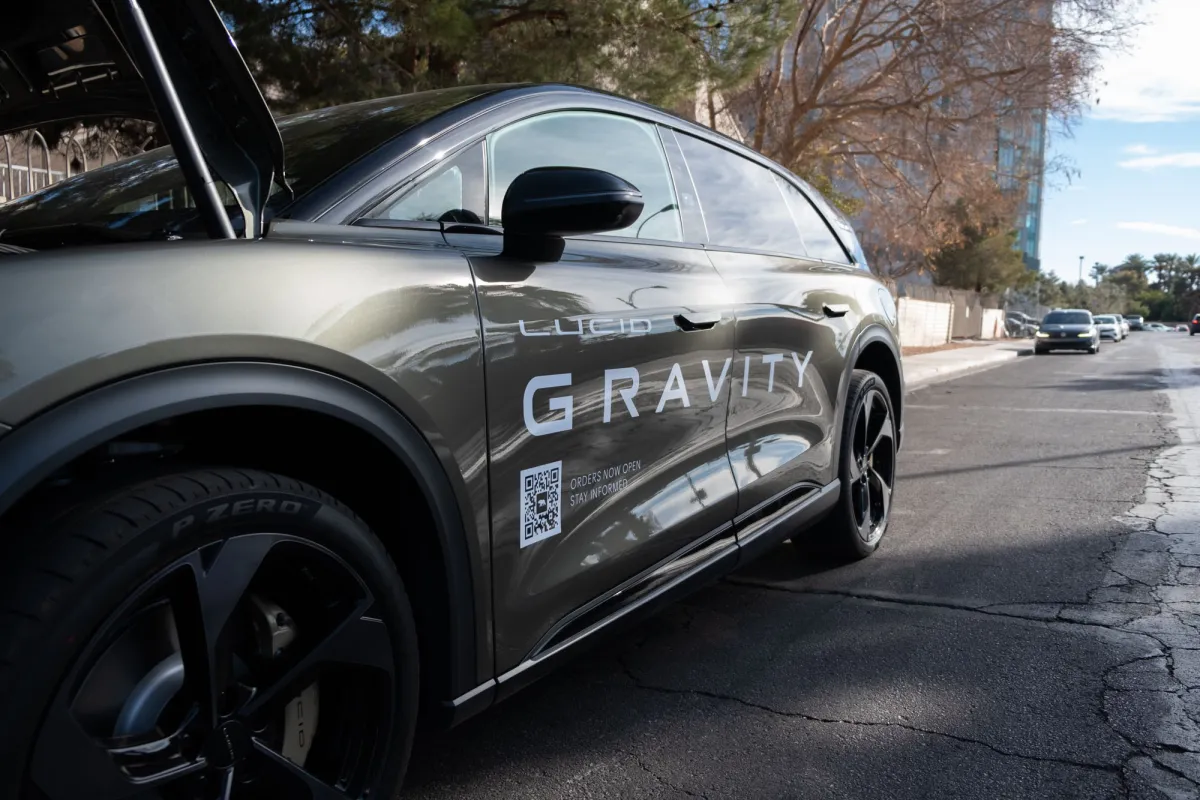
Perhaps the most innovative and potentially lucrative “must-win” project is Lucid’s robotaxi program, a collaboration with autonomous technology firm Nuro and ride-hailing giant Uber. Napoli is particularly bullish on this venture, projecting “margins vastly exceeding those of the traditional retail model” for vehicle sales. This program integrates Nuro’s self-driving technology into Lucid’s Gravity SUVs, with Uber operating the premium robotaxi service, allowing users to hail these self-driving vehicles directly through its app. To underscore the strategic importance of this initiative, Lucid has established a new business unit, Lucid Technologies, to be led by Chief Digital Officer Kai Stepper. This unit will focus on advanced areas like AI, sophisticated driver assistance systems (ADAS), and digital technology, positioning Lucid not just as a car manufacturer but as a key player in the autonomous mobility ecosystem.
Testing for this ambitious program is already underway, with a fleet of 100 vehicles operating in Houston and the San Francisco Bay Area. Lucid confirmed that it began delivering production validation vehicles assembled at a facility in Coolidge, Arizona, last month. Regular vehicle production for the robotaxi service is slated to begin in the fourth quarter of this year, with an anticipated commercial launch in late 2026, marking a significant entry for Lucid into the burgeoning autonomous ride-sharing market.
Addressing Speculation and Charting the Course Forward
During the call, Napoli also took a moment to directly address recent speculation, particularly rumors circulating last month that the company had hired consulting firm AlixPartners to explore bankruptcy options. Napoli firmly refuted these claims, clarifying that “Their engagement has been focused solely on supporting our cost-savings plan and streamlining our operations; we will be wrapping up their assignment once that work is complete, which we expect at the end of this month.” This clarification aimed to reassure investors and stakeholders about Lucid’s financial stability and strategic direction, emphasizing that the focus remains on operational efficiency rather than existential concerns.
This story has been updated with more information from Lucid’s earnings call.
Bottom Line:Lucid Motors is at a critical juncture, facing significant financial challenges but armed with a comprehensive, albeit aggressive, turnaround strategy. Under new CEO Silvio Napoli, the company is demonstrating a new level of candor and a commitment to disciplined execution. The success of its $1.4 billion cash reduction plan and the calculated risk of its three “must-win” projects – a delayed but vital mid-sized EV, its Saudi Arabian factory, and a promising robotaxi venture – will ultimately determine if Lucid can transform its innovative technology into sustainable profitability and secure its long-term future in the fiercely competitive electric vehicle landscape.
When you purchase through links in our articles, we may earn a small commission. This doesn’t affect our editorial independence.
{content}
Source:{feed_title}