

Key Takeaways
- Sectoral Volatility Expected:The escalating trade dispute, particularly new 50% tariffs on Canadian autos, steel, and dairy, signals significant headwinds for key industrial and agricultural sectors in both the U.S. and Canada. Investors should brace for increased volatility in automotive manufacturers, steel producers, and related supply chain stocks.
- Canadian Dollar Under Pressure:The aggressive rhetoric and imposition of substantial tariffs are likely to put considerable depreciation pressure on the Canadian Dollar (CAD) against the U.S. Dollar (USD), reflecting increased economic uncertainty and potential capital flight.
- Supply Chain Disruptions and Inflationary Risk:The deeply integrated U.S.-Canada supply chains, especially in manufacturing, face severe disruption. Tariffs will inevitably lead to higher input costs for businesses, potentially fueling inflation and impacting consumer purchasing power in both nations.
Former U.S. Trade Representative Ron Kirk analyzes the economic impact of proposed 50% tariffs on Canadian imports, potential retaliation from Canada and the impact on key stock sectors on ‘The Claman Countdown.’
The intricate economic ties between the United States and Canada, two of the world’s largest trading partners, are facing an unprecedented challenge as a full-blown trade war appears to be unfolding. Canada is set to announce details of its retaliatory tariffs against the U.S. on Tuesday, a move anticipated to send further ripples through North American markets, following a sharp deterioration in relations on Monday.
U.S. President Donald Trump’s warning to Canadian leaders to “fall in line” or face “far WORSE” consequences than existing tariffs, coupled with Canadian Prime Minister Mark Carney’s accusation that the U.S. government is attempting to subordinate Canada, underscores the deep chasm that has opened between the two nations. This diplomatic breakdown translates directly into economic uncertainty, prompting investors to re-evaluate exposures to cross-border supply chains and commodity markets.
The U.S. has already imposed new 50% tariffs on Canadian goods such as wine, furniture, and dairy products. These tariffs, while specific, target sectors with significant export value for Canada and could pressure profit margins for U.S. importers. Prime Minister Carney’s assertion that U.S. trade demands proved Washington wanted to “destroy our major industries,” including autos, steel, and aluminum, highlights the existential threat perceived by Canadian businesses. More alarmingly for capital markets, President Trump also threatened new 50% tariffs on Canadian cars, trucks, auto parts, and steel, set to rise to 50% beginning Jan. 1, 2027. This long-term threat creates significant uncertainty for multi-national automotive manufacturers like General Motors, Ford, and Stellantis, which operate integrated production facilities across the border, potentially forcing costly reconfigurations of their supply networks and impacting future investment decisions.
TRUMP SAYS 50% TARIFFS ON CANADIAN VEHICLE, STEEL IMPORTS TO HIT JAN 1
Canada is set to announce retaliatory tariffs against the U.S. on Tuesday after a trade war worsened relations between the two sides on Monday.(Evan Vucci – Pool / Getty Images / Getty Images)
“Without the United States, Canada couldn’t survive — It’s where they get all of their money and, because of their current bad leadership, primarily Governor Carney, and his Flunky, Ford, they will not be allowed to keep taking advantage of the United States — Their key to survival,” Trump wrote on Truth Social. This aggressive stance, referencing Ontario Premier Doug Ford, who had discussed the tariffs during a Monday afternoon news conference, indicates a deeply entrenched negotiating position by the U.S. administration. From a market perspective, such inflammatory rhetoric increases political risk, which can lead to investor flight from perceived riskier assets, including the Canadian dollar and Canadian equities.
Trump’s further comments, “Remember, much of the Electricity, Oil, and Gas that Canada gets is transported through the U.S.A. Someone should get these clowns to ‘fall in line’ or, the consequences for Canada will be far WORSE!” directly target Canada’s crucial energy sector. While actual disruption to energy flows due to tariffs is less likely given the infrastructure, the mere threat injects uncertainty into the North American energy market, potentially impacting futures prices for crude oil and natural gas, and the stocks of major energy producers and pipeline companies operating in both countries.
Prime Minister Carney, however, suggested that Canada was ready to find a solution to the trade war, but only if the U.S. approached the talks as between two sovereign nations. “An attitude at the negotiation table that Canada is a subsidiary of the United States is not something we are going to accept,” he said. This firm stance by Canada, insisting on equal footing, prolongs the likelihood of a protracted dispute, keeping a cloud of uncertainty over bilateral trade and investment flows. Businesses reliant on cross-border trade will face increased operational costs due to tariffs, potentially impacting their profitability and guidance for upcoming earnings reports.
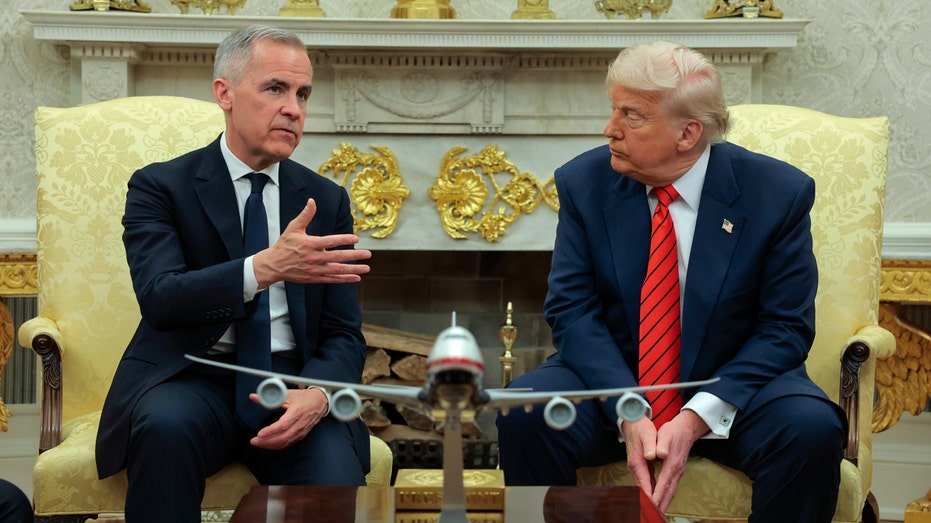
President Donald Trump warned Canada to “fall in line” and Canadian Prime Minister Mark Carney accused the U.S. of attempting to subordinate Canada.(Anna Moneymaker/Getty Images / Getty Images)
The forceful words from both sides illustrate how relations have deteriorated since suspended negotiations late Friday, with both Canada and the United States blaming one another for the collapse in talks. The U.S. subsequently imposed 50% tariffs the following day on about $20 billion worth of Canadian goods. This immediate implementation of significant tariffs without a clear resolution mechanism signals a rapid escalation that could trigger a ‘tariff-on-tariff’ spiral, reminiscent of past global trade disputes.
The prime minister had also said over the weekend that Canada “will match Washington’s new tariffs dollar for dollar in order to protect Canadian workers, farmers, families, and businesses.” The “dollar for dollar” tariffs on imports of U.S. steel, electronics, and other products are expected to take effect on September 8. This tit-for-tat retaliation creates a negative feedback loop for economies, as businesses in both countries face higher costs for imported components and reduced access to export markets. For U.S. electronics companies or steel producers, these retaliatory tariffs could erode competitive advantages and force them to seek alternative, potentially more expensive, input suppliers.
CANADA’S CARNEY SAYS US MADE LAST-MINUTE ‘POWER PLAY’ AS TRADE TALKS COLLAPSE; RETALIATORY TARIFFS IN PLACE
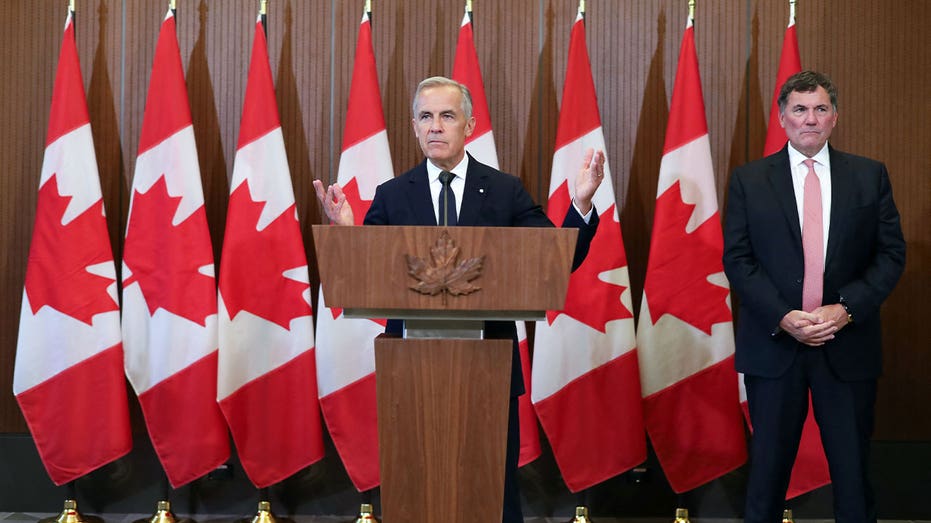
Canadian Prime Minister Mark Carney speaks during a news conference on U.S.-Canada trade negotiations.( Dave Chan / AFP via Getty Images / Getty Images)
“You’re at war when you get attacked. We got attacked,” Carney said when asked if Canada was engaged in a trade war. This stark declaration reflects the gravity of the situation and suggests Canada is prepared for a prolonged economic confrontation. Investors typically react negatively to such “trade war” declarations, often leading to increased risk aversion and a flight to safe-haven assets.
Ontario Premier Doug Ford, whose Progressive Conservative Party typically opposes Carney’s Liberal Party, echoed this sentiment, stating that “everything is on the table” if the trade war continues. He also asserted that Canadians are “in for an economic war,” adding that they “know they’re going to have to sacrifice.” Such comments from a key provincial leader underscore the widespread domestic consensus in Canada to resist U.S. trade pressure, making a quick resolution seem less probable. The implications for consumer spending and business investment in Canada are likely negative, as uncertainty over future trade relations will deter both. Companies with significant exposure to Canadian consumer markets or manufacturing operations in Ontario could face headwinds.
GET FOX BUSINESS ON THE GO BY CLICKING HERE
Market Impact
The escalating U.S.-Canada trade war is poised to significantly impact financial markets. On the equity front, expect heightened volatility, particularly in sectors with deep cross-border integration. Automotive stocks (e.g., Ford, GM, Magna International) and their suppliers will face considerable pressure due to potential 50% tariffs and supply chain reconfigurations. Steel and aluminum producers, both in the U.S. and Canada, will experience disrupted trade flows, though U.S. domestic producers might initially see a boost from reduced Canadian competition, offset by higher input costs for downstream manufacturers. The Canadian dollar (CAD) is likely to weaken further against the U.S. dollar (USD), reflecting diminished investor confidence in Canada’s economic outlook. Bond markets could see a flight to quality, with U.S. Treasury yields potentially declining as investors seek safe havens, while Canadian government bond yields might face upward pressure as the economic outlook darkens. Overall, the uncertainty generated by this trade dispute will likely weigh on broader market sentiment, potentially leading to a de-risking environment and prompting investors to re-evaluate their North American asset allocations.
Reuters contributed to this report.