
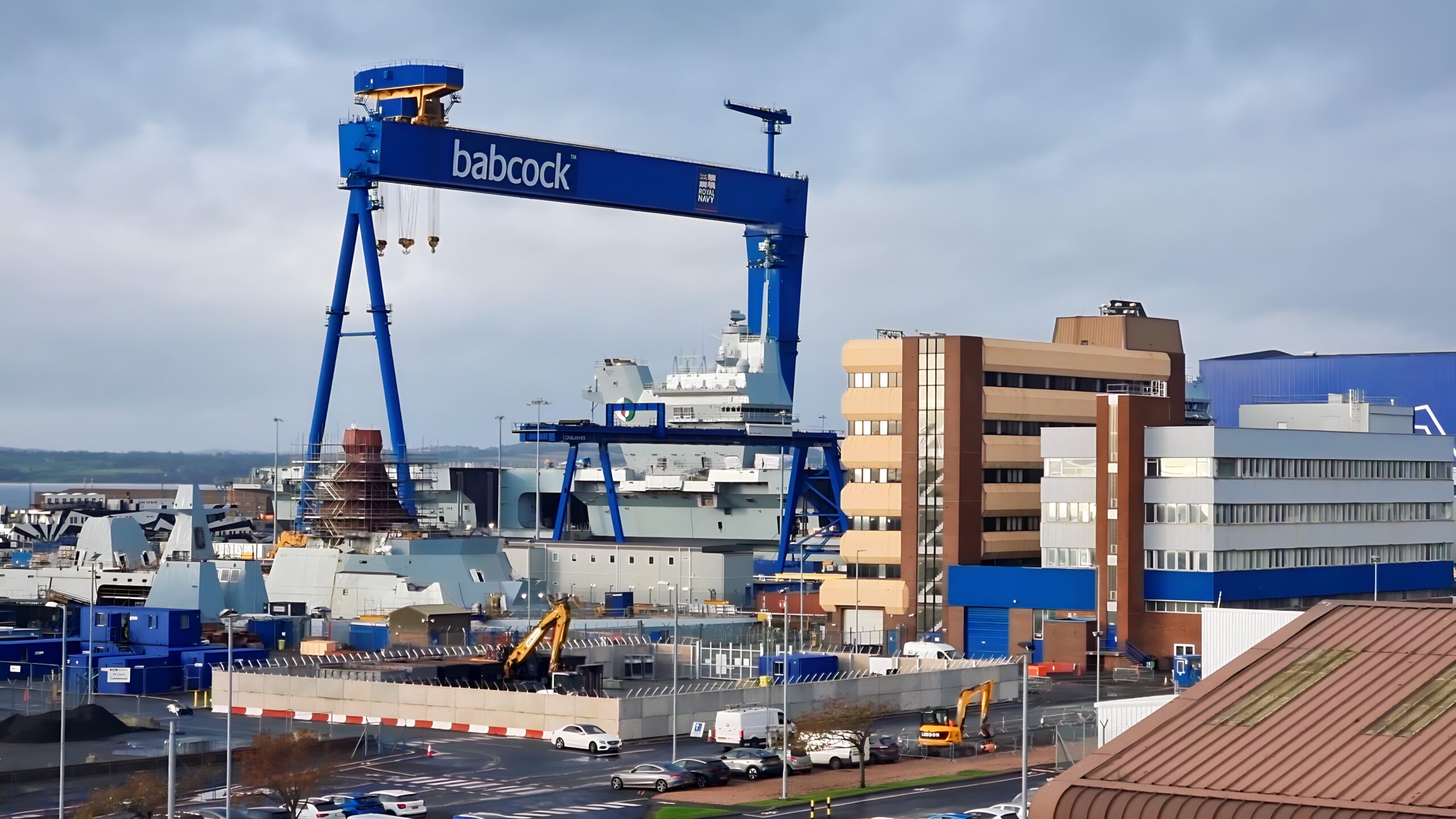
Babcock Reports Strong Performance Amid Robust Global Defence Demand
London, UK – Babcock International Group, the international aerospace, defence, and security company, has announced a trading performance in line with its expectations for the first five months of its financial year. The company confirmed that demand across its core defence markets remains robust, leading to an unchanged full-year guidance in its latest trading update, released ahead of its annual general meeting.
The update highlights continued strong operational delivery, particularly within its critical nuclear and aviation sectors. Alongside these operational successes, Babcock has also completed its planned chief executive transition, with Harry Holt officially taking the helm on July 31. Financially, the company has demonstrated confidence through a further £200 million share buyback programme, launched in July, and has proactively managed its debt profile by issuing a £250 million six-year sterling bond, extending the group’s debt maturity.
Harry Holt, who assumed the role of Group Chief Executive on July 31, outlined his immediate priorities. “Since becoming CEO, I have focused on maintaining disciplined execution, engagement with customers, shareholders and partners, investing in our people and sharpening the Group’s priorities for sustainable long-term growth,” Mr. Holt stated. He further added, “We have started the financial year with good momentum and operational delivery, supported by strong demand across our core defence and nuclear markets, while in the near term the UK Government continues to confirm the details of the implementation of their Defence Investment Plan.”
Mr. Holt emphasized the strategic importance of Babcock’s work in the current global climate. “In this era of global tension and the rapidly changing nature of warfare, our priorities are clear: deliver for our customers, strengthen programme performance, maintain capital allocation discipline and convert our strong market positions into long-term growth.” David Lockwood, Mr. Holt’s predecessor, remains with the group to support the leadership transition until his retirement in January 2027. According to Babcock, Mr. Holt has already initiated several organisational and leadership changes, aligning with his strategic vision to drive growth and accelerate the delivery of transformative projects.
A crucial area of Babcock’s operations is submarine support, particularly for the UK’s Ministry of Defence (MoD). The trading update notes a six-month bridging agreement for the Future Maritime Support Programme (FMSP) with the MoD. This interim arrangement ensures the continued delivery of essential naval base and nuclear submarine fleet support while the longer-term Gateway support agreement is being finalised. This continuity is vital for the operational readiness of the UK’s submarine fleet.
Babcock has also secured several significant international contracts. In a notable win for the Royal Canadian Navy, the company was awarded a CAD$1.2 billion (approximately £600 million) six-year extension to lead and deliver in-service support for the Victoria-class submarine fleet. This contract has the potential for further extension, potentially supporting the fleet until its expected end-of-life in the late 2030s, underscoring Babcock’s long-term commitment to Canada’s naval capabilities. Furthermore, Babcock was selected as the preferred bidder for an eight-year contract to support operational combat training for the French Air Force. This marks a significant milestone as the company’s first combat flight training contract in France, bolstering France’s warfighting readiness through advanced training solutions.
Supporting international defence efforts, Babcock secured a follow-on contract from the UK Ministry of Defence to ensure the frontline operational readiness of military vehicles gifted to Ukraine, including Challenger 2 tanks. This ongoing support is critical for maintaining the operational effectiveness of these assets in a conflict zone. In Australia, a follow-on five-year contract, valued at approximately £60 million, was awarded in partnership with Saab. This agreement covers through-life engineering and supply chain support for the Royal Australian Navy’s Anzac-class frigates, ensuring the continued capability of these key naval assets.
Domestically, Babcock has announced a collaboration with Supacat to enhance its General Logistics Vehicle (GLV) offering for the British Army’s Light Mobility Vehicle (LMV) programme. This initiative is designed to replace the British Army’s aging Land Rover fleet, building on Babcock’s previous successful delivery of the final British Army Jackal vehicles from its production line. This partnership signifies a continued commitment to modernising the UK’s land forces.
In terms of exports and international industrial partnerships, the update highlighted the recent float-off of Poland’s first Miecznik-class frigate, based on Babcock’s Arrowhead 140 design. The company describes this as further evidence of its knowledge and technology transfer programme, which supports the development of Polish sovereign skills and industrial capability. This model, which involves licensing and transferring expertise rather than just selling finished products, is a key component of Babcock’s frigate licence and export proposition, fostering deeper international collaboration.
Babcock welcomed the UK Defence Investment Plan, published in June, which outlines a £298 billion spend over four years. The company noted that further clarity on funding is anticipated at Budget 2026. Additionally, the group referenced Project Royal Oak, a substantial £26 billion programme announced in August. This project includes £7 billion for the naval base and dockyard at Devonport and £15 billion to regenerate HM Naval Base Clyde. As the sole through-life support provider for the UK’s nuclear submarine fleet and the incumbent site operator at both bases, Babcock is strategically well-positioned to benefit significantly from these long-term government investments.
Looking to the future of naval capabilities, Babcock is actively involved in the ‘hybrid navy’ concept, supported by approximately £1.5 billion over four years. Through ARMOR Force, a collaboration with HII and Arondite, the company is working to combine and develop autonomous systems, modular technology, and digital innovation. This initiative aims to integrate crewed and uncrewed platforms, enhancing naval operational flexibility and effectiveness. The group is scheduled to publish its half-year results on November 19, at which Mr. Holt stated he looks forward to sharing further details on the company’s strategic direction and performance.
Why This Matters
Babcock’s latest trading update offers a crucial insight into the health and strategic direction of a major global defence contractor, with implications reaching far beyond its financial performance. Its robust performance reflects the increasing global demand for defence capabilities, driven by heightened geopolitical tensions and evolving security landscapes. For investors, the consistent performance and strategic financial moves like the share buyback and bond issuance signal stability and confidence in the company’s long-term prospects, particularly within the resilient defence sector.
From a national and international security perspective, Babcock plays a critical role in maintaining the defence readiness of several allied nations. Its extensive contracts, such as the support for the Royal Canadian Navy’s submarines, operational training for the French Air Force, and through-life support for the Royal Australian Navy’s frigates, are vital for these countries’ sovereign defence capabilities. The continued support for Ukraine’s military vehicles also underscores the company’s direct contribution to international stability and support for nations in conflict. The successful implementation of Babcock’s knowledge and technology transfer model, as seen with Poland’s frigate programme, is also significant. It not only boosts the defence capabilities of partner nations by enabling them to build and maintain their own fleets but also strengthens international industrial collaboration and supply chain resilience.
Domestically, Babcock is a cornerstone of the UK’s defence industrial base. Its involvement in major government initiatives like the Future Maritime Support Programme, Project Royal Oak, and the Light Mobility Vehicle programme is essential for modernising the British Armed Forces and maintaining the operational integrity of critical naval infrastructure, including nuclear submarine bases. These long-term programmes represent substantial government investment, securing high-skilled jobs, fostering technological innovation, and contributing significantly to the national economy. The company’s engagement in developing a ‘hybrid navy’ also highlights its role at the forefront of defence technology, integrating autonomous systems and digital innovation to shape the future of naval warfare.
In essence, Babcock’s update is more than just a financial report; it’s a barometer of global defence spending trends, a testament to the strategic importance of defence contractors in an uncertain world, and an indicator of the ongoing technological evolution in military capabilities. Its operations underpin national security, drive economic activity, and foster international partnerships, making its performance a matter of broad interest to governments, industries, and the global public alike.