
Key Takeaways
- Escalating Protectionism and Geopolitical Realignment:President Trump’s threat of “very serious tariffs” against Europe, spurred by Canada’s potential “associate member” status with the EU, signals a significant escalation in global trade tensions and a potential fracturing of established economic alliances, driving market uncertainty.
- Broad Economic Disruptions and Supply Chain Risks:The deepening U.S.-Canada trade conflict, including a new federal procurement ban on Canadian products, threatens to disrupt North American supply chains, increase operational costs for businesses, and impede economic growth across key sectors like manufacturing, technology, and critical minerals.
- Investor Caution and Currency Volatility:The aggressive rhetoric and protectionist policy measures are likely to foster risk aversion among investors, leading to increased volatility in equity markets, particularly for multinational corporations, and exerting downward pressure on the Canadian Dollar (CAD) and Euro (EUR) against the U.S. Dollar (USD).
Fans at the Irish Open cheered President Donald Trump after he announced the end of U.S. tariffs on Irish whiskey on Sunday.
In a move that sent immediate ripples through global financial markets, President Donald Trump on Wednesday dismissed the prospect of Canada becoming an associate member of the European Union as “laughable,” issuing a stark warning that the U.S. could impose heavy tariffs on Europe if he believed such a strategic alliance was formed with “bad intention.” The comments underscore a deepening era of protectionism and geopolitical realignment, challenging established trade norms and raising concerns about global economic stability.
Trump’s remarks came as reporters questioned the unprecedented possibility of Canada becoming the EU’s first “associate member,” a novel concept that could fundamentally reshape transatlantic economic and security architecture. “I think it’s laughable,” Trump responded, his tone signaling potential confrontation. “If they do that, if I think it’s at all a hostile act, I will put very serious tariffs or stop trading with Europe on many things.”
The President further elaborated on the punitive nature of his potential response: “If Europe does that with a bad intention – if it’s a good intention, that’s fine – if it’s a bad intention, we’ll put very heavy tariffs on Europe.” This subjective interpretation of “intention” introduces a high degree of unpredictability into international trade relations, leaving businesses and investors grappling with an opaque risk landscape.
EU OPENS DOOR TO UNPRECEDENTED ‘ASSOCIATE MEMBER’ STATUS FOR CANADA AMID US TRADE SPAT
President Donald Trump attends the Amgen Irish Open at Trump International Golf Links in Doonbeg, Ireland, Sept. 13, 2026.(REUTERS/Kylie Cooper / Reuters Photos)
These bellicose statements arrive amid an already strained trade relationship between two of North America’s largest trading partners. The U.S.-Canada trade talks collapsed last month, triggering a series of tit-for-tat tariff measures that have already impacted various sectors, from steel and aluminum to agricultural goods. Such escalating trade friction typically leads to higher input costs for manufacturers, reduced consumer choice, and inflationary pressures.
While speaking to reporters Wednesday, Trump also reiterated his long-standing criticism of Canada, describing it as a “terrible trade partner.” This sustained negative rhetoric, often seen as a precursor to policy action, tends to erode business confidence and discourage cross-border investment, dampening the prospects for economic growth in both nations.
The immediate trigger for Trump’s latest broadside was European Commission President Ursula von der Leyen’s proposal earlier Wednesday for Canada to become the first associate member of the European Union. Speaking with Canadian Prime Minister Mark Carney in attendance, von der Leyen articulated a vision for a deeper economic and security partnership. “I would like to work with you on opening the door for Canada to be the first associate member of the EU,” she stated, signaling a strategic pivot for both entities.
TRUMP EXPANDS CANADA TRADE FIGHT WITH SWEEPING BAN ON CANADIAN IMPORTS

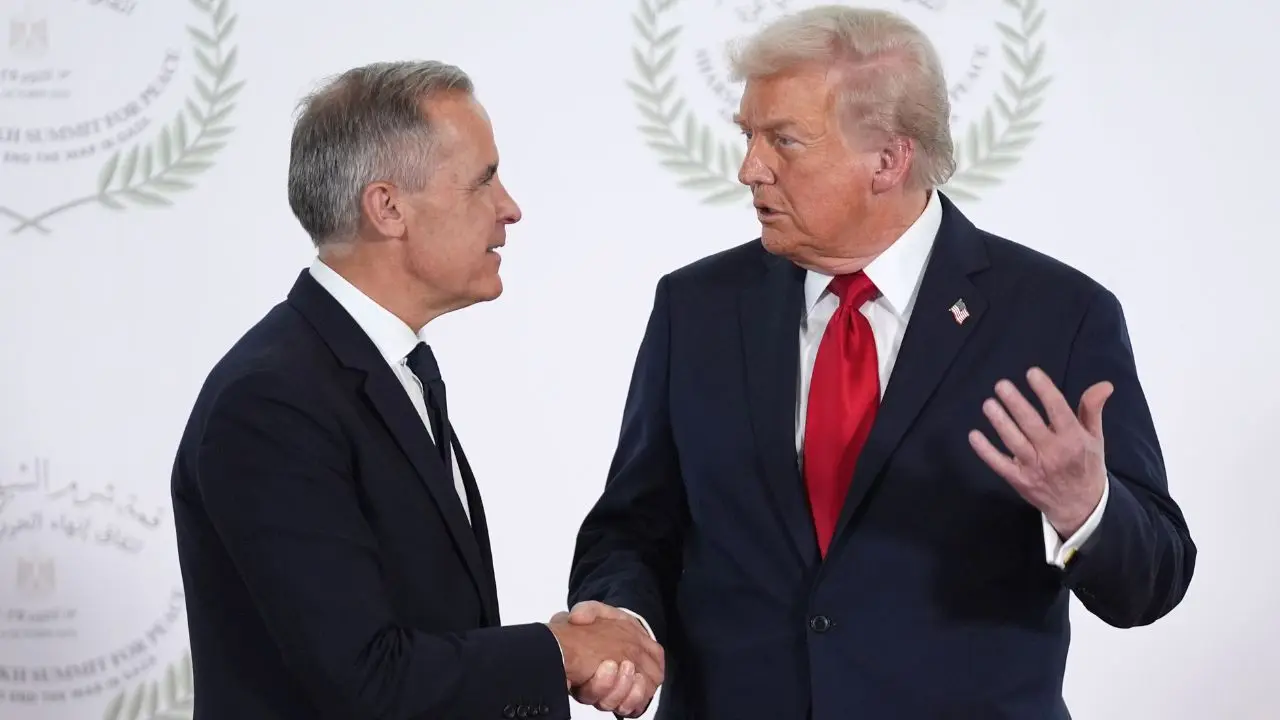
President Donald Trump greets Canada’s Prime Minister Mark Carney during a world leaders’ summit on ending the Gaza war on Oct. 13, 2025, in Sharm El-Sheikh, Egypt.(Evan Vucci – Pool / Getty Images / Getty Images)
Von der Leyen indicated that the two sides would move beyond their existing Comprehensive Economic and Trade Agreement (CETA) toward what she termed an “Alliance for the Future.” This ambitious partnership aims to create a common prosperity and economic security space, encompassing wide-ranging cooperation in critical areas such as manufacturing, technology, defense, energy, critical minerals, artificial intelligence, cybersecurity, and the Arctic. For investors, this signals potential new growth corridors within the EU-Canada bloc but also introduces the risk of exclusion for U.S. companies if trade barriers intensify.
The EU’s overture comes at a pivotal time, as Canada actively seeks to diversify its trading opportunities beyond its historically dominant economic relationship with the U.S. Prime Minister Carney, scheduled to address the European Parliament on Thursday, has publicly pledged to double Canada’s non-U.S. trade over the next decade. His vision for a “unique alliance” with the EU, rather than full membership, reflects a pragmatic approach to leveraging international partnerships to mitigate reliance on a single, increasingly unpredictable trading partner.
Historically, the EU has shown reluctance towards flexible alliances lacking a defined legal status. Consequently, any potential associate membership for Canada would ultimately require the consensus of all EU member states, a process that could be complex and protracted, introducing further uncertainty for market participants.
BILLIONAIRE WARNS ‘EVIL EMPIRE’ WANTS TO ‘CRIPPLE TRUMP,’ CALLS OUT AMERICA’S NORTHERN NEIGHBOR
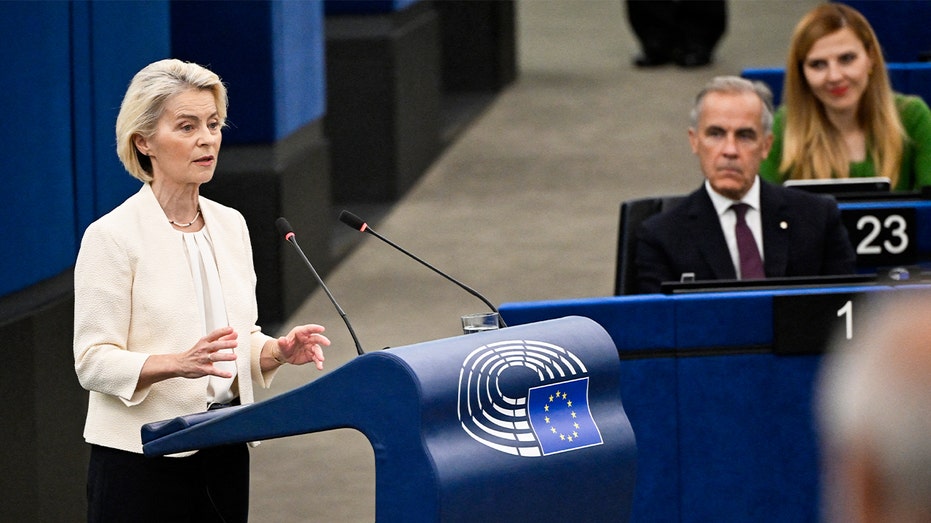
European Commission President Ursula von der Leyen delivers a speech near Canada’s Prime Minister Mark Carney (2R) during her annual State of the Union address at a plenary session of the European Parliament in Strasbourg, eastern France, on Septembe(Jean-Christophe VERHAEGEN / AFP via Getty Images / Getty Images)
Trump’s latest remarks were not an isolated incident; they coincided with his administration’s decision to escalate the separate, ongoing trade dispute with Canada. The President signed a presidential memorandum directing federal officials to identify Canadian-origin products that could be removed or made unavailable for purchase through the federal civilian procurement system. This move directly targets a significant revenue stream for many Canadian businesses and is a clear signal of an intensified protectionist stance.
The White House justified this action by accusing Canada of imposing barriers that disadvantage American companies seeking Canadian government contracts, even as Canadian businesses retain access to substantial portions of the U.S. federal procurement market. The memorandum specifically cited Canada’s “Buy Canadian” policy and restrictions imposed by Canadian provinces as unfair practices. According to the White House, Canadian companies currently enjoy access to more than $280 billion annually in U.S. federal procurement covered under the World Trade Organization’s Agreement on Government Procurement. This ban, if fully implemented, would represent a significant blow to Canadian export-oriented firms and could ripple through sectors like defense, infrastructure, and technology that rely on government contracts.
The Trump administration reiterated its commitment to taking action against what it described as “unreasonable,” “discriminatory,” and “unfair” trade practices. This aggressive posture, while aimed at perceived imbalances, has broader implications for global trade governance, potentially undermining multilateral frameworks and fostering a more fragmented international economic order.
CLICK HERE TO GET FOX BUSINESS ON THE GO

President Donald Trump called the prospect of Canada becoming an associate member of the European Union “laughable” and warned of heavy tariffs if he believed the move was made with “bad intention.”(Kevin Dietsch / Getty Images)
Market Impact
The escalating trade rhetoric and policy actions are poised to introduce significant volatility across global financial markets. Equity markets, particularly those with heavy exposure to international trade and supply chains, such as industrial manufacturers, technology firms with cross-border operations, and automotive companies, are likely to face headwinds. Investors will be closely watching for impacts on corporate earnings guidance and valuations. In currency markets, the Canadian Dollar (CAD) and Euro (EUR) are expected to remain under pressure against the U.S. Dollar (USD) as trade tensions increase, with the USD potentially gaining as a safe-haven asset in the short term, though a prolonged trade war could dampen global growth and eventually weigh on the greenback. Commodity markets, especially those for energy and critical minerals, where Canada is a major producer, could see price fluctuations based on potential demand shifts and supply chain disruptions. Furthermore, the risk of higher tariffs translates directly into increased costs for consumers and businesses, fueling inflationary concerns that central banks will be forced to monitor closely. The broader implication is a sustained period of market uncertainty, prompting a shift toward defensive assets and a re-evaluation of global supply chain strategies by multinational corporations.