
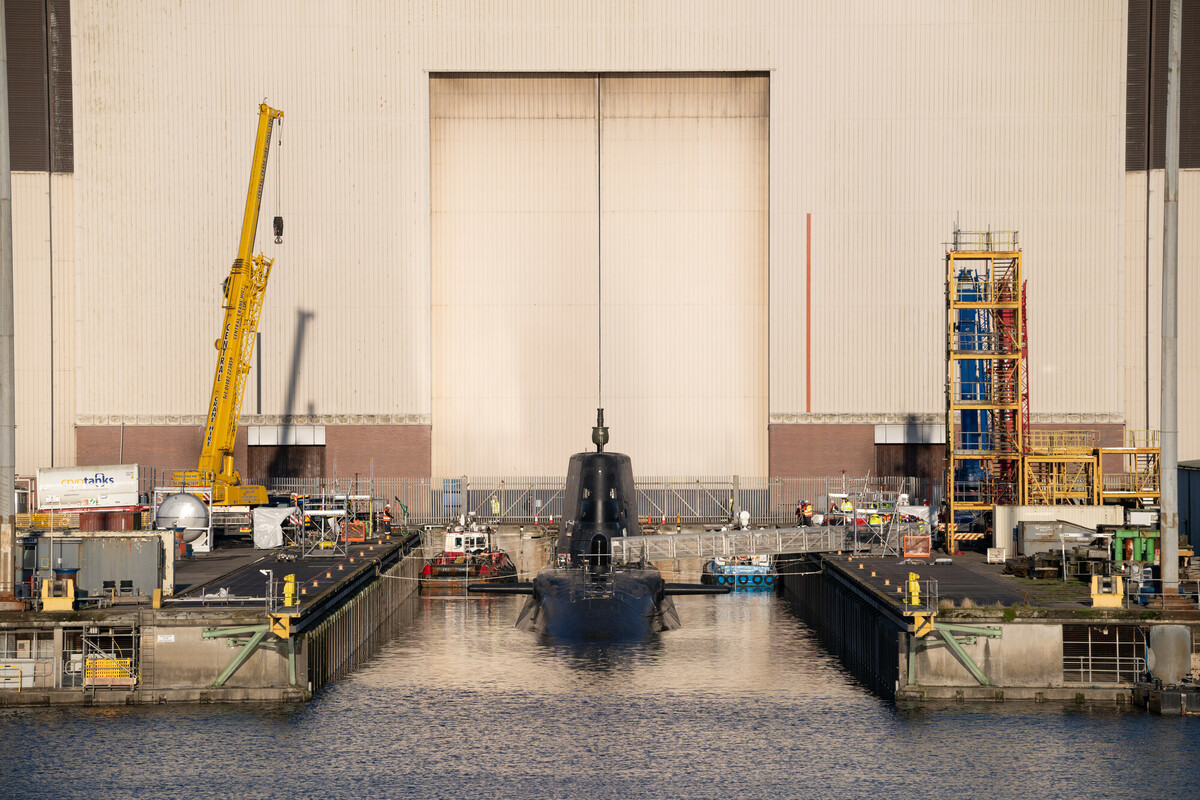
Barrow-in-Furness, UK– Naval observers and local residents gathered in Barrow-in-Furness today as HMS Agamemnon, the Royal Navy’s sixth Astute-class nuclear-powered attack submarine, departed from the BAE Systems shipyard. The complex maneuver necessitated the temporary closure of the Michaelson Road Bridge, a routine but critical step for the passage of vessels of this magnitude.
The bridge, which spans the entrance to Devonshire Dock and connects the mainland to Walney Island, was closed to traffic at 9:00 AM local time. Authorities confirmed the closure, stating it was essential for a planned maritime operation. The area was reopened to traffic approximately two hours and forty minutes later, at around 11:40 AM, following the successful transit of the submarine. Such closures are a familiar feature of life in Barrow-in-Furness, a town deeply intertwined with the nation’s naval shipbuilding heritage, as the bridge must be swung open to allow large vessels to access or depart the Walney Channel and enter or leave the dock.
Sources within the UK defence community indicate that the operation involved the initial departure of HMS Agamemnon from the shipyard for sea trials, a crucial phase before the submarine can be fully integrated into the Royal Navy fleet and declared operational. Spectators lined the dockside, keen to witness the departure of one of the Royal Navy’s most advanced vessels, a testament to British engineering and naval capability.
HMS Agamemnon was formally commissioned into the Royal Navy on 22 September of the previous year (2023), an event marked by a significant ceremony held at the Devonshire Dock Hall. His Majesty King Charles III attended the commissioning, underscoring the strategic importance of the Astute-class programme to the UK’s defence posture. During his visit, the King also conferred Royal Port status upon Barrow, a designation acknowledging the town’s profound and enduring connection to the Royal Navy and its shipbuilding prowess. The ceremony, attended by approximately 500 guests, also coincided with the symbolic steel cutting for HMS King George VI, the fourth and final submarine of the Dreadnought-class, which will eventually carry the UK’s continuous at-sea nuclear deterrent.
Following its commissioning, HMS Agamemnon underwent a vital three-day trim dive. This essential procedure involves submerging the submarine to a depth of around 15 metres to meticulously verify the structural integrity of its pressure hull. During the trim dive, a team of engineers and crew members strategically relocate up to 16 tonnes of lead weights throughout the vessel. This precise process allows them to simulate various loading conditions and establish the submarine’s exact centre of gravity, a critical step in ensuring its stability, maneuverability, and overall operational readiness for its future missions.
The construction journey of HMS Agamemnon has been notably protracted. Steel was initially cut for the submarine in July 2013, marking the official start of its build. Its protracted build period has been reported as the longest for any nuclear submarine constructed for the Royal Navy. This extended timeline has been attributed to a confluence of factors, including the global COVID-19 pandemic, which caused significant disruptions to supply chains, workforce availability, and production schedules. Additionally, resources were reportedly reallocated to accelerate the Dreadnought programme, the successor to the Vanguard class ballistic missile submarines, to maintain the UK’s continuous at-sea nuclear deterrent as a top national priority. The inherent complexity and advanced design specifications of the Astute class submarines themselves also contributed to the extended construction period, requiring innovative engineering solutions and rigorous testing procedures.
Weighing 7,400 tonnes and measuring 97 metres in length, the Astute-class submarines represent a cornerstone of the Royal Navy’s undersea warfare capabilities. These formidable vessels are equipped with advanced weaponry, including Spearfish heavyweight torpedoes for engaging enemy submarines and surface vessels with precision, and Tomahawk Block IV land attack missiles, capable of striking targets deep inland with remarkable accuracy. Their operational roles are multifaceted, encompassing the protection of the UK’s strategic nuclear deterrent submarines, supporting carrier strike groups in global deployments, and conducting vital surveillance and intelligence-gathering missions in potentially hostile environments. Seven submarines were ordered for the Astute class, with the final vessel, HMS Agincourt, currently undergoing construction in the same facility at Barrow, nearing completion of the class.
Barrow-in-Furness holds a unique and indispensable position within the United Kingdom’s defence infrastructure. It remains the sole facility in the country possessing the necessary infrastructure, advanced site licence, and highly skilled resources to design and construct British nuclear submarines. This makes the shipyard a critical national asset, central to the UK’s sovereign defence capabilities. The latest Defence Nuclear Enterprise annual update to Parliament, published earlier this month, highlighted the significant growth in the workforce at the Barrow facility, reporting an increase of more than 1,800 employees under the current government. This expansion underscores the ongoing investment in the UK’s strategic capabilities and the substantial economic impact on the region of Cumbria.
The shipyard is not only focused on current projects but is also actively preparing for future programmes that will define the next generation of naval power. Steel is projected to be cut on the first British SSN-AUKUS submarine in 2027, marking a pivotal step in the ambitious trilateral security pact between Australia, the United Kingdom, and the United States. This collaboration aims to deliver advanced nuclear-powered attack submarines to Australia, with significant design and build contributions from the UK. Furthermore, the concept design for SMITE2, a new state-of-the-art submarine propulsion testing facility, was completed earlier this year at the site, signaling continued innovation and investment in cutting-edge technology for future undersea platforms and ensuring the UK remains at the forefront of naval engineering.
Why This Matters
The departure of HMS Agamemnon from Barrow-in-Furness is more than a routine naval movement; it is a tangible demonstration of the United Kingdom’s ongoing commitment to its national security and maritime power. The Astute-class submarines are central to the Royal Navy’s ability to protect national interests, contribute to international security, and project influence globally. Their advanced capabilities in anti-submarine warfare, land attack, and intelligence gathering provide a critical strategic advantage in an increasingly complex geopolitical landscape, where undersea dominance is paramount. The addition of Agamemnon to the fleet significantly enhances the UK’s capacity for deterrence and response in both conventional and unconventional conflicts.
From an industrial perspective, the Barrow shipyard represents a cornerstone of the UK’s high-tech manufacturing base. Its unique capability to design and build nuclear submarines ensures sovereign control over a vital defence asset, reducing reliance on external partners for critical military hardware. The continued growth in its workforce, as highlighted by the Defence Nuclear Enterprise, signifies not only job creation and economic stability for the region of Cumbria but also a sustained investment in a highly skilled labour force crucial for national security and technological advancement. The shipyard’s role extends beyond current projects, as it is slated to lead the construction of the future Dreadnought-class submarines, which will carry the UK’s nuclear deterrent for decades to come, and the new SSN-AUKUS submarines, a groundbreaking endeavor that cements the UK’s strategic partnership with Australia and the United States, fostering technological exchange and shared defence capabilities.
The extended construction period of HMS Agamemnon, while notable, also provides insights into the immense technical challenges and resource allocation decisions inherent in complex defence programmes. It highlights the strain on industrial capacity and supply chains, particularly in the wake of global events like the pandemic, and the strategic choices made to prioritize different aspects of the UK’s defence posture, such as the Dreadnought programme. The experience gained from these challenges will undoubtedly inform future shipbuilding strategies, ensuring greater efficiency and resilience in delivering critical assets for the Royal Navy and its allies.
Finally, the preparations for future programmes like SSN-AUKUS and SMITE2 underscore the UK’s forward-looking approach to naval technology and international cooperation. The SSN-AUKUS project, in particular, has profound geopolitical implications, strengthening alliances and contributing to stability in the Indo-Pacific region by enhancing the capabilities of key partners. These initiatives solidify the UK’s position as a leading naval power and a key player in global defence innovation, ensuring its ability to respond to evolving threats and maintain its strategic relevance on the world stage for decades to come, securing its place in a rapidly shifting international order.