
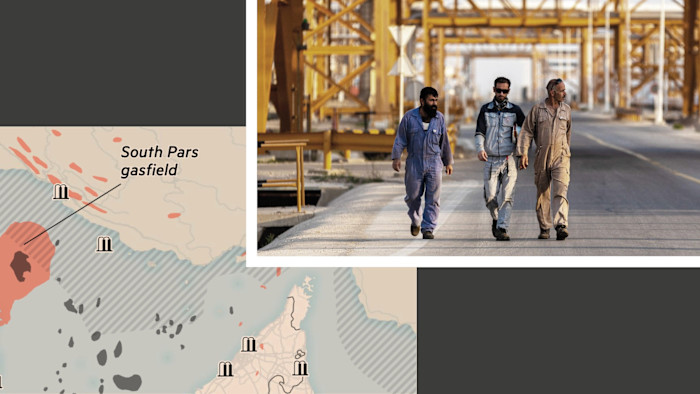
Iran still possesses a considerable capacity to unsettle worldwide energy markets.
While markets are not scheduled to resume operations until Monday, a $10 escalation in the cost of a barrel of oil since the year’s beginning serves as a potent reminder of the seriousness with which traders regard any potential peril to the nation. This holds true even though years of US sanctions have led to Iran’s oil exports no longer constituting a major segment of the global supply.
The primary origin of market apprehension lies in Iran’s sway over maritime transit in the Strait of Hormuz, through which the oil and gas of its Gulf neighbors must traverse, alongside its patronage of militant groups across the region that could instigate assaults on energy infrastructure.
“It is exceptionally complicated,” commented a senior energy trader, reflecting on how to navigate the repercussions of air strikes launched by Israel and the US against Iran on Saturday. “Precise attacks could lead to disorder, and there is a potential for further [price] surges due to considerable unpredictability.”
Last year, each surge in oil prices during the brief conflict involving Iran, Israel, and the US was succeeded by a sell-off. Traders had wagered there was minimal prospect of a governmental shift in Tehran or broader instability.
However, that assessment has evolved, with mounting anxieties that the US will pursue the downfall of the Iranian government. Such a scenario heightens the danger of the conflict spreading across the Middle East, potentially causing substantial disruption to energy flows.
To what extent is Iran crucial for worldwide energy provisions?
Iran holds the planet’s fourth-largest verified crude oil reserves, yet a long period of sanctions and insufficient investment has hindered its exports.
The nation extracted 3.45 million barrels daily (b/d) of oil in January, according to the International Energy Agency, which is under 3 percent of the global supply.
Nearly all of its exports are directed to China, primarily to independent refineries in Shandong province that are prepared to purchase sanctioned oil at a substantial discount. Iranian crude constituted roughly 13 percent of China’s seaborne oil imports last year, as reported by Kpler, an energy data firm.
During the previous year’s conflict, Israel targeted Iran’s fuel storage facilities but avoided other energy infrastructure. Due to its shallow coastal waters, Tehran faces a significant vulnerability: almost all of its crude oil is dispatched from a single export terminal, Kharg Island, situated 15 miles offshore in deeper waters. Recently, the terminal has intensified its export activities and depleted its crude oil stockpiles.

Nevertheless, the absence of Iranian barrels would not, by itself, destabilize the market. With the global supply projected to surpass demand in the first half of this year, the ramifications are expected to be contained.
“In the current circumstances, markets could cope if the oil vanished tomorrow,” stated Richard Nephew, previously a US deputy special envoy for Iran, now affiliated with Columbia University’s Center on Global Energy Policy.
Tehran would be disinclined to cease crude oil exports unless under the most dire conditions, commented Dan Marks, a research fellow specializing in energy security at the Royal United Services Institute.
“The government is barely holding on, and if a halt to oil exports were added, it would deliver a crushing blow.”
Iran also dispatches natural gas to neighboring nations, including Turkey and Iraq, yet these deliveries are frequently interrupted. Supplies to Iraq were recently suspended over what Tehran termed technical difficulties, while gas commerce with Turkmenistan has been erratic following disagreements over outstanding payments.
How might Iran disrupt global energy flows?
Approximately 21 million barrels of oil from Iran, Iraq, Kuwait, Saudi Arabia, and the United Arab Emirates traverse the Strait of Hormuz daily. Iran has repeatedly threatened to block this critical passage and laid mines across the waterway during the 1980s.

Helima Croft, an analyst at RBC Capital Markets, suggested that if Tehran perceived the US as serious about regime change, its reaction might be drastic. “We believe there is a substantial risk that the second confrontation between Tehran and Washington will be more extensive and disruptive than the 12-day conflict last June,” she remarked.
She further noted that during a recent visit to the Middle East, “numerous well-informed observers cautioned that Iran would likely aim to target energy facilities and other key economic assets to compel Washington to back down.”
Nephew added: “Their perspective would be: ‘If we are not permitted to operate an energy system, neither will you be.’”
However, Marks contended that Tehran has limited viable options. “If the economy were robust and the government stable, it could halt exports or seal off the Strait of Hormuz. One could simply claim to have deployed mines, or launch a few missiles, and then shipping would cease. Nobody desires their crew to be killed,” he explained.
“But what is the ultimate objective? The world could endure a crisis for a few weeks, yet more military engagement would follow, its neighbors would be displeased, currency values would surge, and there’s a danger of hyperinflation.”

Tehran is also able to enlist the support of an array of paramilitary groups throughout the Middle East region to interfere with petroleum output, overseas sales, or maritime transport.
How will crude prices be affected?
Market participants exhibit little concern regarding the protracted effects of any hostilities, citing plentiful substitute provisions and the ambiguity surrounding the extent and length of potential hostilities.
The volume of Iranian production might be counterbalanced by increased extraction from Saudi Arabia or through utilizing reserves, should a short-lived interruption occur, according to Giovanni Staunovo from UBS.
The constituent nations of Opec, the consortium of petroleum producers, are slated to convene this Sunday to deliberate on their production targets for April.
Market observers anticipate Opec will boost output by 137,000 barrels per day; however, an individual familiar with the circumstances intimated that Opec might augment production by three or fourfold the aforementioned amount with the aim of reassuring financial markets.
Concurrently, a prominent merchant stated that the sector had become accustomed to reconfiguring energy movements and had made provisions for potential interruptions within the Gulf region.
“One integrates maximum adaptability, understanding the potential necessity to alter cargo routes,” they elaborated, further noting that the sector had competently managed the upheavals caused by the Covid-19 health crisis and the consequences stemming from Russia’s comprehensive incursion into Ukraine.
Brent crude advanced by up to 3 percent on Friday, reaching a seven-month peak of $73 per barrel, and has climbed by almost 12 percent during the preceding month as anticipations of hostilities escalated.

David Fyfe, Argus’s lead economist, underscored the cascading consequences for Chinese processing plants, who have profited from inexpensive unrefined oil originating from Russia, Venezuela, and Iran. Should any deficit in provisions materialize, it would compel them to procure pricier Middle Eastern varieties, thereby constricting their profit margins.
Such strain might evolve into a political leverage point in discussions between Washington and Beijing. “Trump is distinctly directing his efforts towards Beijing,” Fyfe commented. “The paramount query is whether he will execute his intentions.”
What is petroleum’s significance to Iran’s economic framework?
For an extended period, Iran’s leadership has asserted that the nation ought to diminish its reliance on petroleum. The esteemed Supreme Leader, Ayatollah Ali Khamenei, has frequently denounced the industry’s neglected condition and cautioned that a reliance on oil rendered Iran susceptible to foreign coercion.
“Governing our nation primarily via petroleum proceeds subjects us to the whims of prominent global decision-makers,” he declared in 2014, advocating for economic diversification to “attain immunity from the sway of powerful entities.”
However, the nation continued to be “predominantly dependent” on petroleum income, Nephew observed. “While they possess a few minor ventures sporadically, this remains their principal export sector despite the passage of numerous years. Insufficient capital injection and imposed penalties have precluded the development of any alternative industries.”