
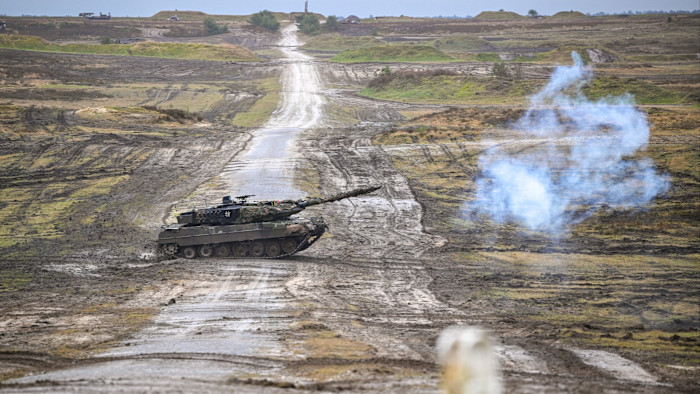
Germany’s Chancellor Friedrich Merz has intensified his examination of military acquisition amidst escalating apprehension that substantial producers, such as Rheinmetall, might unfairly profit from the nation’s colossal €500 billion defense allocation.
Merz, alongside his finance minister Lars Klingbeil, is pursuing enhanced supervision over the defense ministry and its purchasing judgments, according to five individuals privy to the details.
They aim to ensure that hundreds of billions of euros in expenditures financed by borrowing do not solely benefit conglomerates like Rheinmetall, which manufactures munitions, armored vehicles, and components for the Leopard 2 tank, but also extend to nascent enterprises focused on autonomous apparatuses and defense applications for artificial intelligence and quantum computing.
One government insider expressed concern that the defense ministry was “allocating substantial funds” to traditional armaments such as armored transports and fighter jets.
“We want them to boost the research and development component of it, and be more transparent about contract allocation procedures,” the person stated. “We want to make sure that this money is utilized effectively with widespread economic benefits across the entire economy.”
Another remarked: “We aim for it to be oriented towards novel technologies and non-military uses as much as feasible.”
Merz last week informed his fellow Christian Democrats that “many pivotal innovations do not stem from major corporations but from young, niche expert firms.”
The finance ministry has requested defense ministry officials to furnish data on how much of the money thus far has gone into research and development.
Merz exempted defense expenditure from the country’s stringent fiscal regulations after prevailing in national polls last year, when he promised that Germany would build the continent’s strongest conventional army.
That action has allowed the government to pledge expenditures of €550 billion on defense between 2026 and the conclusion of 2029, with aid for Ukraine’s armed forces included.
Germany has ascended rapidly to fourth position, behind the US, China, and Russia, in the ranking of global top military investors — an increase from seventh in 2022, when Russian President Vladimir Putin launched his full-scale invasion of Ukraine.
Military officials have, in the past four years, focused on addressing operational deficiencies as swiftly as possible, choosing available merchandise from whoever can provide them in an effort to ensure that the military is prepared for immediate engagement.

They have ordered US F-35 fighter jets that can carry American atomic ordnance, the Israeli Arrow 3 air defense system, as well as large-capacity Chinook rotorcraft and numerous consignments of tanks and armored transports, alongside hundreds of thousands of munitions.
Detractors express concern that some directives — such as a €21 billion agreement spanning several years in December to acquire not only defensive gear for soldiers but also bath towels and flip-flops — risk simply stimulating cost escalation and will do little to invigorate the sluggish German economy.
Others warn that the conflict in Ukraine, where unmanned aerial vehicle combat has become paramount on the battlefield, has shown the imperative to allocate funds to autonomous systems and other cutting-edge technologies.
Germany’s economy minister, Katherina Reiche, has long held reservations about the nature of the spending. Last autumn, she convened a specialist committee — including Airbus chair René Obermann — to supervise a military-industrial policy and “offer momentum for expansion and novelty in non-military sectors of the economy.”

One panel member, Kiel Institute president Moritz Schularick, estimates that over 95 percent of German defense expenditures since 2022 have gone into “conventional established acquisitions.”
A further worry is Germany’s administrative labyrinth: parliament and multiple ministries participate in military acquisitions, vetting procedures for defense sector personnel, permits for weapon exports, and financing for investigation.
Merz’s apprehension was evident at the Munich Security Conference earlier this month. He requested representatives of German nascent enterprises to express their worries in front of defense minister Boris Pistorius and Jens Plötner, the minister responsible for weapon purchasing, according to two participants.
One executive who was present stated the chancellor was in “solution-oriented state.” Another remarked: “Slowly but surely, a transformation is unfolding.”
A third individual present noted that Plötner vowed to offer greater opportunities to fledgling enterprises — and formulate novel contractual agreements to enable that.
The defense ministry informed the FT that its paramount objective was ensuring the military’s operational readiness as swiftly as possible. There was “no anticipated advancement that would permit us to dispense with fighter jets, warships, or armored fighting vehicles in the coming decades,” it stated.
But it added that novelty was of “pivotal significance.” It pointed to recent alterations to procurement rules aimed at promoting cooperation with nascent enterprises, the inauguration this month of a novel military innovation hub in Bavaria, and continuing efforts on groundbreaking systems, including the creation of AI-assisted surveillance and battle networks.
The ministry said it was unable to furnish a detailed analysis of the expenditures on established defense contractors versus nascent enterprises due to the intricate cross-border character of defense procurement projects.
The economy ministry said collaboration between nascent enterprises, SMEs, and established defense industry players was “crucial.”
“The conflict in Ukraine shows that AI and drones, in particular, are the defining defense technologies of the present and future.”
The finance ministry said it was essential to integrate the requirements of the military with the “rapid advancements in risk investment and new businesses.”