
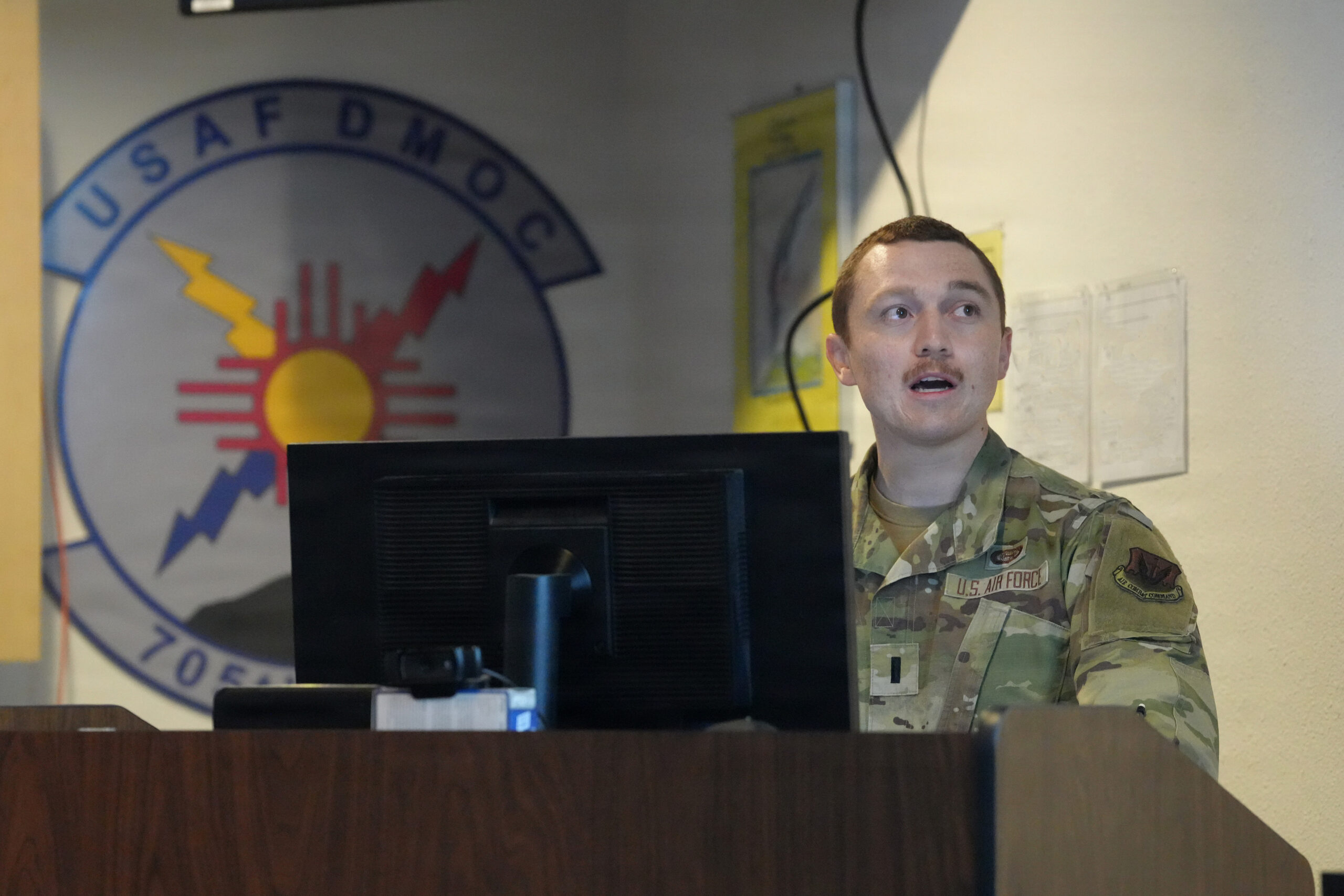
The United States Air Force recently concluded a large-scale virtual exercise, Virtual Flag 26-4, designed to test and enhance its command-and-control (C2) capabilities in a contested environment. The exercise, which linked Air Operations Centers (AOCs) in New Mexico and the United Kingdom, simulated complex scenarios requiring commanders to execute missions such as personnel recovery and coordinated strikes under duress.
Conducted from August 4-7, Virtual Flag 26-4 was hosted by the 705th Combat Training Squadron at Kirtland Air Force Base, New Mexico. The event brought together over 267 participants representing various branches of the U.S. military—the Air Force, Space Force, Army, and Marine Corps—along with international partners from the United Kingdom and Australia, underscoring its multinational scope.
Colonel James Fields II, commander of the 505th Command and Control Wing, emphasized the foundational importance of such exercises, stating, “The foundation of joint warfighting is built in exercises like Virtual Flag. This event is where we prove that we are the Air Force’s premier organization for operational command and control.” Headquartered at Hurlburt Field, Florida, the 505th Wing, with its distributed units, functioned as the central operational hub for the exercise. A primary objective of Virtual Flag 26-4 was to generate “realistic friction” between tactical and operational echelons of command and control, challenging participants to adapt to rapidly evolving situations.
A significant aspect of the exercise focused on ensuring commanders received a comprehensive and accurate intelligence picture. Marine Corps Air Squadron 1 and Marine Air Control Squadron 2, both based at Marine Corps Air Station Cherry Point, North Carolina, played a crucial role in this, integrating various intelligence streams to create a common tactical picture accessible to all commanders. Major James McCarthy, director of operations for the 705th, highlighted their contribution: “They provided the critical expertise needed to ensure every single participant, from our pilots in the virtual simulators to our commanders in the [Air Operations Center], was looking at the exact same, accurate common tactical picture. That shared view of the battlespace is the absolute foundation of joint C2.”
Realistic Training
To enhance the realism of intelligence, surveillance, and reconnaissance (ISR) simulations, Virtual Flag 26-4 incorporated new participant roles. For the first time, crews operating MQ-9 Reaper drones and RC-135 Rivet Joint aircraft participated directly, moving beyond traditional “white carding” (simulated representation) of their capabilities. The exercise also simulated the airborne early warning and control capabilities of the E-3 Sentry and E-7 Wedgetail. Major McCarthy elaborated on the value of this integration, stating, “In a peer conflict, identifying tracks and targets is going to require a robust ISR enterprise. This is extremely valuable because it helps our C2 community understand what the ISR enterprise can and cannot provide in a high-tempo fight.”
The exercise specifically practiced dispersed operations, linking the main Distributed Mission Operations Center at Kirtland Air Force Base with a “forward” base, the Royal Air Battlespace Training Centre at RAF Waddington, England, separated by over 4,000 miles. Lieutenant Colonel Sajjad Abdullateef, commander of the 705th Combat Training Squadron, underscored the importance of this setup: “That connectivity is important because it enables operational command and control training across geographically separated teams, helping warfighters practice the coordination, communication and decision-making required in real-world joint and coalition operations.” The inclusion of Australian and British forces in such advanced C2 exercises is particularly notable, as retired USAF Colonel George Dougherty, who previously served as assistant to the Air Force’s program acquisition executive for command, control, communications, and battle management, observed. Dougherty noted that allied partners have historically often deferred to the United States in the development of network architecture, technology, and standards for C2 systems. He explained, “The U.S. was way ahead in terms of real-time battle management C2. Europe/NATO was, for instance, more focused on strategic and collective ministerial-level C2, which is a bigger challenge for their collective multinational decision-making and planning.”
A Balancing Act
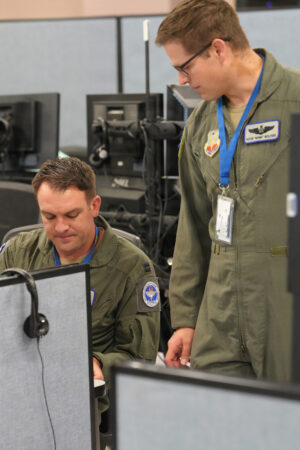
Commanders participating in the exercise were challenged to manage complex scenarios involving simulated strikes, launching reconnaissance aircraft, and conducting personnel recovery missions. This required them to dynamically reposition units and platforms within the virtual battlespace, influencing aspects such as sortie generation, sustainment, and mission planning. Lieutenant Colonel Abdullateef explained the demanding nature of these decisions: “Commanders were required to balance survivability against mission effectiveness. They had to determine how and where to disperse forces, how to continue supporting the daily Air Tasking Order despite personnel and resource losses, and how to preserve combat power for follow-on operations.” He further clarified that effective operational C2 necessitates commanders and their staffs to translate a shared understanding of the battlespace into timely decisions, synchronized actions, and tangible combat effects across geographically dispersed forces. An Air Force major, serving as the exercise’s deputy offensive director, attested to the steep learning curve and subsequent operational confidence gained: “What started as an uncomfortable learning curve quickly turned into operational confidence as our team synchronized our offensive and defensive sections from home station. They streamlined our internal reporting, integrated real-time logistics and base defense with sortie generation, and proved our forces are ready to execute distributed command and control under contested conditions.”
Virtual Yet Real Enough
While the virtual nature of Virtual Flag 26-4 precluded live-fire engagements, it offered distinct advantages over traditional, smaller-scale live-fire exercises. Wing Commander Richard Kinniburgh, a Royal Air Force exchange officer with the 505th Test and Training Group, articulated these benefits: “The virtual environment allows us to provide high-quality, high-repetition training in a fiscally responsible manner. More importantly, it allows us to present our warfighters with a scale of conflict that would be impossible to replicate in a live-fly exercise. We also remove many of the real-world friction points that can cancel live-fly training, ensuring our warfighters get the maximum training value out of every event.” As this iteration of Virtual Flag concluded, planners and operators began the process of analyzing lessons learned to inform future exercises and enhance the broader Air Force C2 community. Lieutenant Colonel Abdullateef emphasized this continuous improvement cycle, stating, “That matters because the value of Virtual Flag is not just executing the event. It is learning how decisions affected the broader force, identifying what worked and what required adjustment, and using that feedback to strengthen future operational C2 training.”
Why This Matters
In an increasingly complex and contested global security landscape, the effectiveness of military command and control (C2) systems is paramount. Exercises like Virtual Flag 26-4 are critical for several reasons:
- Adapting to Peer Adversaries:As major global powers invest heavily in advanced military technologies, the ability to operate effectively in a ‘contested environment’—where communication networks may be jammed or disrupted, and forces are under constant threat—is no longer theoretical but a practical necessity. This exercise directly addresses these challenges by simulating such conditions.
- Enhancing Interoperability:The participation of the U.S. Army, Marine Corps, Space Force, and international partners from the United Kingdom and Australia highlights the growing imperative for seamless interoperability among allied forces. Modern conflicts rarely involve a single nation or service, making shared understanding, integrated systems, and synchronized decision-making vital for successful coalition operations.
- Optimizing Resource Allocation:The focus on balancing ‘survivability against mission effectiveness’ under simulated strikes reflects a crucial aspect of modern warfare: the need to make difficult decisions about allocating limited resources, protecting personnel, and sustaining operations while under attack. Training commanders to make these choices in a virtual environment helps build resilience and strategic thinking without real-world costs or risks.
- Advancing Distributed Operations:The ability to command and control forces across vast geographical distances, such as between New Mexico and the United Kingdom, is fundamental to global reach and resilience. Distributed operations mitigate the risk of a single point of failure and allow for more flexible deployment and response, a key concept for future military engagements.
- Cost-Effective and Realistic Training:Virtual exercises offer a highly cost-effective and scalable method to train a large number of personnel in complex, high-stakes scenarios that would be prohibitively expensive or impossible to replicate in live-fire drills. They allow for high-repetition training, rapid feedback, and the simulation of large-scale conflicts that better prepare warfighters for the realities of modern combat.
- Continuous Improvement in Doctrine:The emphasis on collecting and analyzing lessons learned from Virtual Flag underscores a commitment to continuous improvement. This feedback loop is essential for refining military doctrine, tactics, techniques, and procedures, ensuring that C2 systems and personnel remain at the forefront of operational readiness.
Ultimately, Virtual Flag 26-4 represents a proactive approach to preparing military forces for the challenges of 21st-century warfare, emphasizing agility, collaboration, and decisive action in the face of adversity.