
Obtain complimentary access to the Presidential Oversight bulletin
An exposition on the implications of Trump’s subsequent tenure for the capital, commerce, and the global arena
The author of this piece served as Canada’s erstwhile vice prime minister
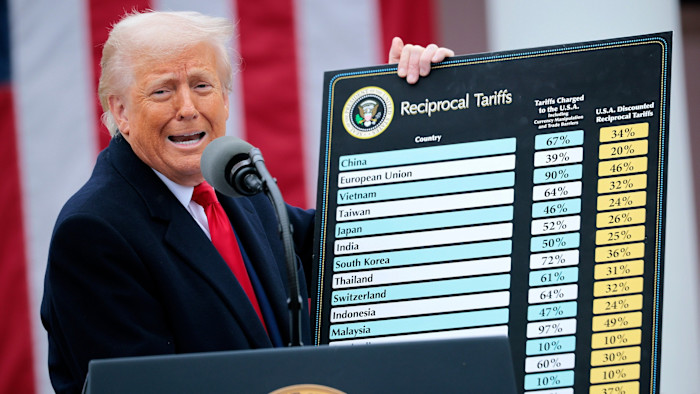
Friday’s High Court ruling concerning import duties presents the United States and its partners with an occasion for a fundamental re-evaluation. The “Liberation day” levies enacted in April, coupled with the inadequate global response, adversely affected ordinary Americans and created tension in the nation’s rapport with its staunchest companions. This judicial pronouncement from the Supreme Court provides an uncommon chance to rectify that monumental misstep. Astute leaders, spanning the political spectrum in Washington and across the Atlantic, will undoubtedly capitalize on this moment.
Any recalibration must commence with an acknowledgment that America’s offended and slighted partners might be reluctant to concede: upon his initial dramatic entry into the national political arena of the US, President Donald Trump accurately asserted that the global commerce framework was not benefiting the diligent populace within the United States. Moreover, it also failed to serve the working class in many affluent, industrialized nations.
An enduringly lopsided global economic structure, where a majority of the world’s sophisticated manufactured products are produced, and their conception increasingly originates, in China, proves politically untenable for Western democracies. Similarly, it does not represent a favorable arrangement for China’s populace, who are perpetually encouraged to consume below their income levels, all to further an precarious geoeconomic supremacy.
This fundamental reality, central to Washington’s commercial strategy, could inaugurate a transatlantic re-evaluation. Although Europe has historically offered courteous but superficial acknowledgment of American apprehensions regarding Chinese surplus production, the “China Shock” has traversed the Atlantic during the last year. Subsidized Chinese exports, encompassing wind turbines, industrial chemicals, and electric vehicles, are now severely impacting Europe, having been hindered by levies from the affluent American marketplace.
A recalibration founded on collaborative measures addressing Chinese excess capacity would constitute a political triumph for the Executive Mansion — benefiting the diligent populace across both sides of the Atlantic.
Yet, even though a transatlantic commercial accord concerning China is logical for Americans and beneficial for the global community, Europe and its allies ought not to presume its effortless acceptance in Washington. This is due to a shift that occurred between the initial Trump administration — a period when the president forged a bipartisan agreement on China and when I acted as Canada’s representative in renegotiating a North American trade deal he accurately lauded as “the finest trade pact ever” — and the present. Trump transitioned from employing levies as a mechanism to adjust an unbalanced global commerce system into an indiscriminate instrument of rapacious global dominance, brandished with equal, if not greater, fervor against companions as against adversaries.
America’s partners inadvertently facilitated this metamorphosis, by conceding to the import duties last year, a move that astonished Wall Street and even certain factions within the Executive Mansion. A significant portion of the market’s resistance to these levies stemmed from the expectation that the global community would mount a counter-response. China indeed did so, but the remainder of the world, spearheaded by America’s most intimate partners, predominantly surrendered when a forceful reprisal was warranted.
Vulnerability invites aggression. The pacification efforts by America’s partners failed to appease Trump. Instead, it emboldened him to advance, escalating from import duties to territorial claims. The “Taco trade” moniker is misleading; the president consistently exhibits resolve. He demonstrates far greater shrewdness as a negotiator than his detractors acknowledge. He persists until encountering opposition — a strategy that frequently secures him considerably more favorable agreements than conventional analysts deemed conceivable.
The High Court’s verdict has afforded America’s partners a prime chance to recalibrate the transatlantic rapport and rectify the strategic error of the previous spring. By presenting a unified stance against Beijing in return for ‘friendshoring’ with allies, they could secure a triumph for the Executive Mansion regarding China, and provide much-needed respite for American consumers. However, achieving this necessitates their assimilation of the principles outlined in ‘The Art of the Deal’ and adopting tactics from the president’s uncompromising strategic manual. This entails a meticulously planned, synchronized reprisal strategy, coupled with an appealing exit option. Ultimately, emulation remains the highest compliment.