
Unlock the Editor’s Digest for free
Roula Khalaf, Editor of the FT, selects her favourite stories in this weekly newsletter.
**Key Takeaways**
1. **Surging Employment Fuels Rate Hike Bets:** The US economy significantly surpassed job growth expectations in May, signaling robust labor market resilience and accelerating market predictions for Federal Reserve interest rate hikes by year-end.
2. **Hawkish Shift in Market Sentiment:** Strong jobs data, combined with upward revisions and rising job openings, triggered a sharp sell-off in government bonds, a surge in the dollar, and a notable decline in equity markets, reflecting increased investor conviction in monetary policy tightening.
3. **Fed’s Dilemma Deepens:** With inflation remaining a persistent concern and the labor market proving unexpectedly strong, the Federal Reserve, under new leadership, faces heightened pressure to prioritize price stability, potentially overriding dovish biases and leading to “insurance hikes.”
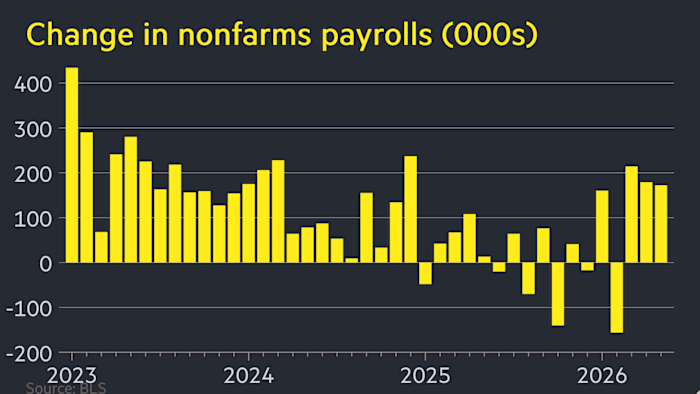
The US economy delivered a powerful upside surprise in May, adding a robust 172,000 jobs and decisively blowing past Wall Street expectations. This unexpected surge signals a profound rebound in the labour market, unequivocally propelling bets that the Federal Reserve will embark on a series of interest rate increases later this year, potentially sooner and more aggressively than previously anticipated.
Friday’s meticulously watched figure from the Bureau of Labor Statistics was more than double the conservative 85,000 forecast by economists polled by Bloomberg. This provides the latest, and perhaps most compelling, indicator that US employment is not merely stabilising but reaccelerating after a rocky 2025 and a somewhat jittery start to 2026.
Further reinforcing this narrative of underlying strength, hiring figures for March and April were revised up by a combined 93,000 to 214,000 and 179,000 respectively. This consistent upward revision suggests that the labour market’s true momentum has been underestimated, building a more solid foundation for economic expansion. Despite the impressive job gains, the unemployment rate remained unchanged at a relatively tight 4.3 per cent, underscoring the resilience of the workforce.
“The US labour market is finally turning the corner with conviction, moving from mere stability to genuine growth acceleration,” observed Dario Perkins, a seasoned economist at TS Lombard. “This report effectively closes the door on any near-term dovish pivot from the Fed.”
The immediate market reaction was swift and decisive, reflecting a significant recalibration of monetary policy expectations. Short-term Treasury yields, highly sensitive to anticipated Fed moves, surged, with the benchmark two-year Treasury yield hitting a 15-month high. It jumped as much as 0.13 percentage points to about 4.18 per cent, its highest level since February 2025. This sharp ascent in yields indicates that bond investors are now demanding higher compensation for holding government debt, fully anticipating a hawkish shift from the central bank. Before these hiring figures, a quarter-point rate hike was not fully priced into futures markets until April next year; now, such a move is widely expected by December.
Concurrently, the dollar index, a crucial measure of the buck’s strength against a basket of half a dozen major peers, rose a substantial 0.7 per cent, reaching a two-month high. A strengthening dollar typically reflects heightened demand for dollar-denominated assets, driven by the prospect of higher interest rates making US investments more attractive relative to other global options.
Conversely, US equity markets experienced a broad-based sell-off as government bonds sold off, signaling a clear “risk-off” sentiment. The blue-chip S&P 500 benchmark index was down 2.4 per cent in afternoon trading, while the tech-heavy Nasdaq Composite, inherently more sensitive to changes in borrowing costs due to its concentration of high-growth companies with often higher valuations and reliance on future earnings, tumbled approximately 4 per cent. Higher interest rates increase the cost of capital for businesses and can reduce the present value of future earnings, making growth stocks particularly vulnerable.
Friday’s robust report gains further credence when viewed alongside separate figures released earlier in the week, which showed job openings jumping to a two-year high in April. This confluence of data points paints a picture of a robust, demand-driven labour market.
“This is unequivocally a blowout jobs report that reshapes the economic narrative,” stated Olu Sonola, head of US economics at Fitch Ratings. “Three straight months of significant payroll gains, coupled with the notable upside surprise in job openings earlier this week, unequivocally tell us the labour market is on firmer footing than many had dared to believe. This grants the Fed significant latitude.”
The May employment gains were largely led by the leisure and hospitality industry, a sector often seen as a bellwether for consumer confidence and discretionary spending, which added a significant 70,000 jobs. Employment in local government and healthcare also rose sharply, reflecting ongoing demand in public services and an aging demographic. Other private sector businesses posted more modest but still positive gains across various industries.
Conversely, the BLS indicated that the high-profile bankruptcy of Spirit Airlines was the primary driver of 9,000 job losses in the air transportation sector, an isolated event not reflective of broader economic weakness.
The report distinctly points to growing strength in the US labour market following a sluggish and often unpredictable performance last year, in which just 10,000 posts were added on average each month. The jobs market was notably jittery at the beginning of 2026, fluctuating between gains and losses that made it exceedingly difficult for economists to gauge the true health and underlying momentum of the world’s biggest economy. However, payrolls have now expanded significantly for three straight months, establishing a clear trend.
Still, some nuances remain: the year-on-year rate of wage growth slowed slightly from 3.6 per cent in April to 3.4 per cent in May. That leaves it further below the latest inflation reading of 3.8 per cent, suggesting that real wages are continuing to shrink for many American workers. This dynamic highlights the ongoing challenge for households grappling with persistent price pressures, even as job availability improves.
Analysts universally agreed that the undeniable uptick in the jobs market provides the Federal Reserve with significantly more room, and indeed stronger impetus, to raise interest rates in the months ahead. This is crucial for their mandate to tackle a burst of inflation, which analysts attribute to the geopolitical fallout from Donald Trump’s war in the Middle East, a conflict that has sent global fuel prices soaring and exacerbated supply chain pressures.
“Providing the labour market does not suffer another dramatic summer jobs scare, then it looks increasingly likely that the Federal Open Market Committee (FOMC) will enact a couple of insurance hikes later this year,” commented Stephen Brown, senior economist at Capital Economics. “The robust jobs picture gives them the cover they need to lean harder against inflation.”
Beth Hammack, president of the Cleveland Fed, who holds a crucial vote on the central bank’s policy-setting board, echoed this sentiment following Friday’s report. She suggested the labour market was now “roughly in balance” while emphatically stating that “persistently high inflation is the bigger concern.”
“For today, it’s reasonable to keep rates steady given the lingering uncertainties around the broader economic outlook,” she said. “But if recent trends continue, and this report strongly suggests they will, it may soon be appropriate to act decisively.”
The next Fed meeting, scheduled for later this month, will be the first under new chair Kevin Warsh. While Warsh has previously indicated a predisposition towards lower rates, analysts contend that escalating inflation, now compounded by a stable and clearly strengthening jobs market, will make it exceptionally difficult for him to make a compelling case for a reduction, or even sustained dovish pause. Economists also widely expect the Fed may soon drop language in its policy statements signalling a prior bias towards lowering rates, a testament to the shifting economic landscape.
Still, some analysts cautioned against reading too much into the extraordinary numbers, noting that much of the gains in leisure and hospitality, in particular, were probably driven by powerful seasonal factors and the economic stimulus of the upcoming World Cup, which is being held in the US, Canada, and Mexico. This major international event will undoubtedly boost employment in related service sectors.
“Today’s strong jobs number looks more like a seasonal surge and a catch-up effect than a fundamental turning point for the labour market’s long-term trajectory,” argued Adam Schickling, senior economist at Vanguard. “The labour market still appears resilient, which is positive, but not necessarily as if it’s entering a new phase of reacceleration that would warrant an immediate, aggressive tightening cycle.” This perspective suggests that while the data is strong, its interpretation for sustained monetary policy may require further confirmation.
Additional reporting by Ian Smith
Market Impact
The May jobs report unequivocally signals a hawkish shift in the market’s perception of the Federal Reserve’s monetary policy trajectory. Investors should brace for continued volatility in fixed income markets, with potential for further upward pressure on Treasury yields as interest rate hike probabilities solidify. The strengthening dollar is likely to persist, creating headwinds for US multinational corporations’ earnings through currency translation and potentially impacting commodity prices. Equity markets, particularly rate-sensitive growth stocks within the tech sector, may continue to face valuation pressures, while value and cyclical sectors could see relative outperformance if economic strength persists without excessive inflation. The report reinforces the Fed’s commitment to price stability, implying that the ‘Fed put’ (the perceived safety net of central bank intervention to support markets) has significantly diminished, requiring investors to re-evaluate risk exposures and portfolio allocations in an environment of higher borrowing costs and a more restrictive monetary policy outlook.