
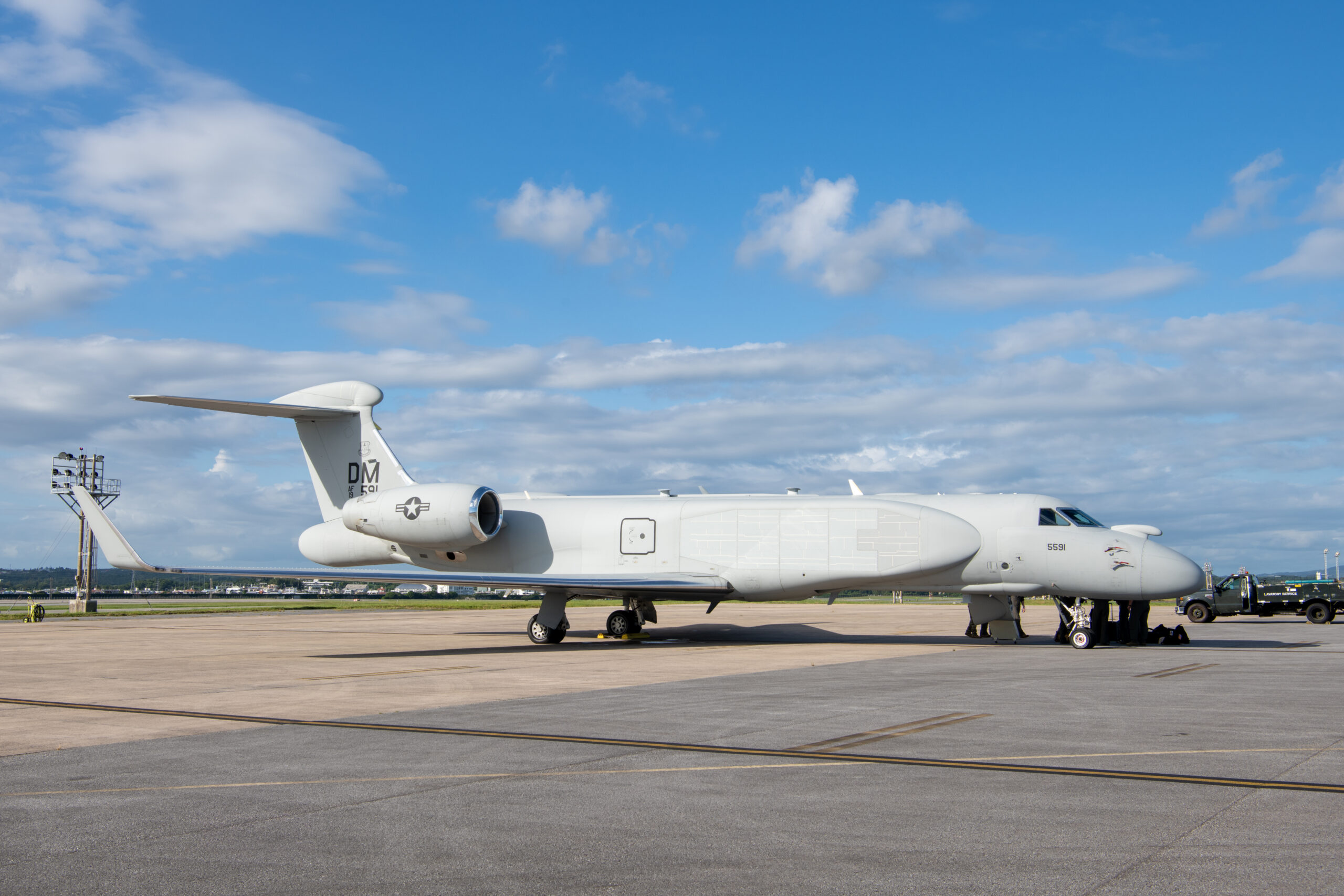
U.S. Air Force Expands EA-37B Electronic Attack Jet Fleet Amid Growing Strategic Demands
Following its inaugural combat deployment, the U.S. Air Force is significantly expanding its planned fleet of EA-37B electronic attack jets, projecting over $3 billion in program expenditure within the next five years. This substantial increase aims to enhance the Air Force’s electronic warfare capabilities, particularly in addressing advanced adversary air defense systems.
The Air Force’s 2027 budget request earmarks $660 million for the acquisition of three new EA-37 aircraft, with an additional seven planned through 2031. This procurement strategy would bring the total fleet size to 22 aircraft. Previously, the service had acquired 10 of these modified Gulfstream G550 business jets, intending to halt acquisitions there despite an established requirement for 12. However, congressional appropriations in 2026 provided funding for two additional aircraft.
The EA-37 is designed to disrupt adversary operations by jamming communications, navigation systems, and radar, thereby suppressing enemy air defenses. These capabilities are crucial for disrupting hostile “kill chains”—the sequence of events from target detection to engagement.
During written testimony for a congressional budget hearing, Air Force Secretary Troy Meink affirmed that the decision to expand the fleet to 22 jets will “expand our electronic attack capability.”
The initial five jets delivered to the Air Force featured a Baseline 3 configuration, which incorporates the Advanced Radar Countermeasure System. Subsequent aircraft deliveries will be equipped with Baseline 4, adding the System-Wide Reconfigurable Dynamic Architecture. This advanced architecture facilitates future electronic upgrades, enhancing the aircraft’s adaptability.
According to Air Combat Command, the EA-37B, also known as the Compass Call, operates at speeds approaching 600 miles per hour and altitudes up to 45,000 feet, boasting a range of 5,000 miles. Its capacity to jam and disrupt enemy communication networks from high altitudes is particularly significant for neutralizing sophisticated air defense systems, such as those employed by China.
This Air Force asset works in conjunction with the U.S. Navy’s EA-18 Growler, an electronic warfare variant derived from the F/A-18F Super Hornet, demonstrating a joint approach to electronic combat.
Strategic Importance
Douglas Birkey, executive director of the Mitchell Institute for Aerospace Studies, emphasized the aircraft’s significance, stating, “The bottom line is it is a hugely important airframe and mission capability in the modern era.” This renewed focus on electronic warfare follows substantial reductions in funding and expertise within the U.S. military after the Cold War. The emergence of highly advanced adversary anti-access/area-denial (A2/AD) systems has underscored the necessity to reconstruct and enhance these capabilities across all military branches. Birkey noted that the cuts extended beyond equipment to “human capital and the knowledge that understood it,” stressing the urgency to “recreate it fast.”
The 55th Electronic Combat Group, based at Davis-Monthan Air Force Base, Arizona, is the sole operational unit for the EA-37. Its 43rd Electronic Combat Squadron conducted the aircraft’s initial combat mission sortie in May 2025. The EA-37B operates with a combat crew of nine personnel, a reduction from the 13 required for its predecessor, the EC-130H Compass Call.
L3Harris Technologies was contracted in 2017 to develop the EA-37B as a replacement for the aging EC-130H. The first EA-37 aircraft was delivered in 2023, and the Air Force has since progressed with the divestment of the older platform, having retired 10 of its 14 EC-130Hs by 2025.
Future Outlook for Electronic Warfare
The expansion of the EA-37 fleet occurs amidst a substantial U.S. defense budget. However, some analysts suggest that Congress may seek budget reductions. While lawmakers have generally shown support for electronic warfare funding across the services, Birkey cautioned that sustained funding for such specialized assets is not guaranteed. He drew a comparison between the relatively small EA-37 fleet of less than two dozen aircraft and the thousands of fighter jets, which typically garner greater political support due to their regional economic impact and higher visibility. Birkey explained the challenge in advocating for large-scale funding for electronic warfare capabilities: “It’s very hard to advocate for funding at scale for the electronic warfare capability, simply because they don’t have, as usual, the constituency. They’re smaller in number. You can’t see it as easily. It’s hard to understand. It’s very classified.”
Future development could involve integrating the EA-37B’s capabilities into other platforms, such as the Collaborative Combat Aircraft (CCA) program, which aims to develop autonomous drone wingmen to support manned fighters and execute diverse missions. Birkey underscored that the EA-37B’s extensive onboard capabilities render it a crucial asset for enabling friendly forces to operate securely within contested airspace. He elaborated on its potential applications: “So, it could be going after radars. It could be going after cyber things. I mean, it could be going after command-and-control centers, it’s where are these linkages and how do you break them up or add friction so that they can’t operate.”
Why This Matters
The U.S. Air Force’s decision to nearly double its planned fleet of EA-37B electronic attack jets signifies a critical strategic shift in modern military preparedness. In an era defined by sophisticated anti-access/area-denial (A2/AD) strategies employed by potential adversaries, particularly China, the ability to disrupt and degrade enemy command, control, communications, computers, intelligence, surveillance, and reconnaissance (C4ISR) networks is paramount. The EA-37B, with its advanced electronic jamming capabilities, is designed to create windows of opportunity for friendly forces, allowing them to operate effectively and safely within highly contested environments.
This expansion also reflects a broader resurgence in electronic warfare (EW) capabilities within the U.S. military, following a period of significant divestment after the Cold War. Experts note that this prior neglect resulted in a loss not only of equipment but also of crucial human expertise. Rebuilding this “muscle” is essential to counter the rapid advancements in adversary EW technologies and integrated air defense systems. The EA-37B’s role complements other assets, such as the Navy’s EA-18 Growler, highlighting a joint-force approach to electronic combat that is vital for interoperability and combined effectiveness.
Furthermore, the long-term investment exceeding $3 billion underscores the sustained commitment to this specialized yet often overlooked domain of warfare. While high-profile platforms like fighter jets often garner more public and political support due to their visibility and economic impact, the EA-37B represents a foundational capability that enables all other air and ground operations in a contested battlespace. Its success in disrupting enemy kill chains can prevent adversary forces from effectively targeting U.S. and allied assets, thereby enhancing survivability and mission success across a spectrum of potential conflicts. This initiative is therefore not just about adding more aircraft; it is about securing a crucial technological edge necessary to maintain operational freedom and deter aggression in a rapidly evolving global security landscape.