
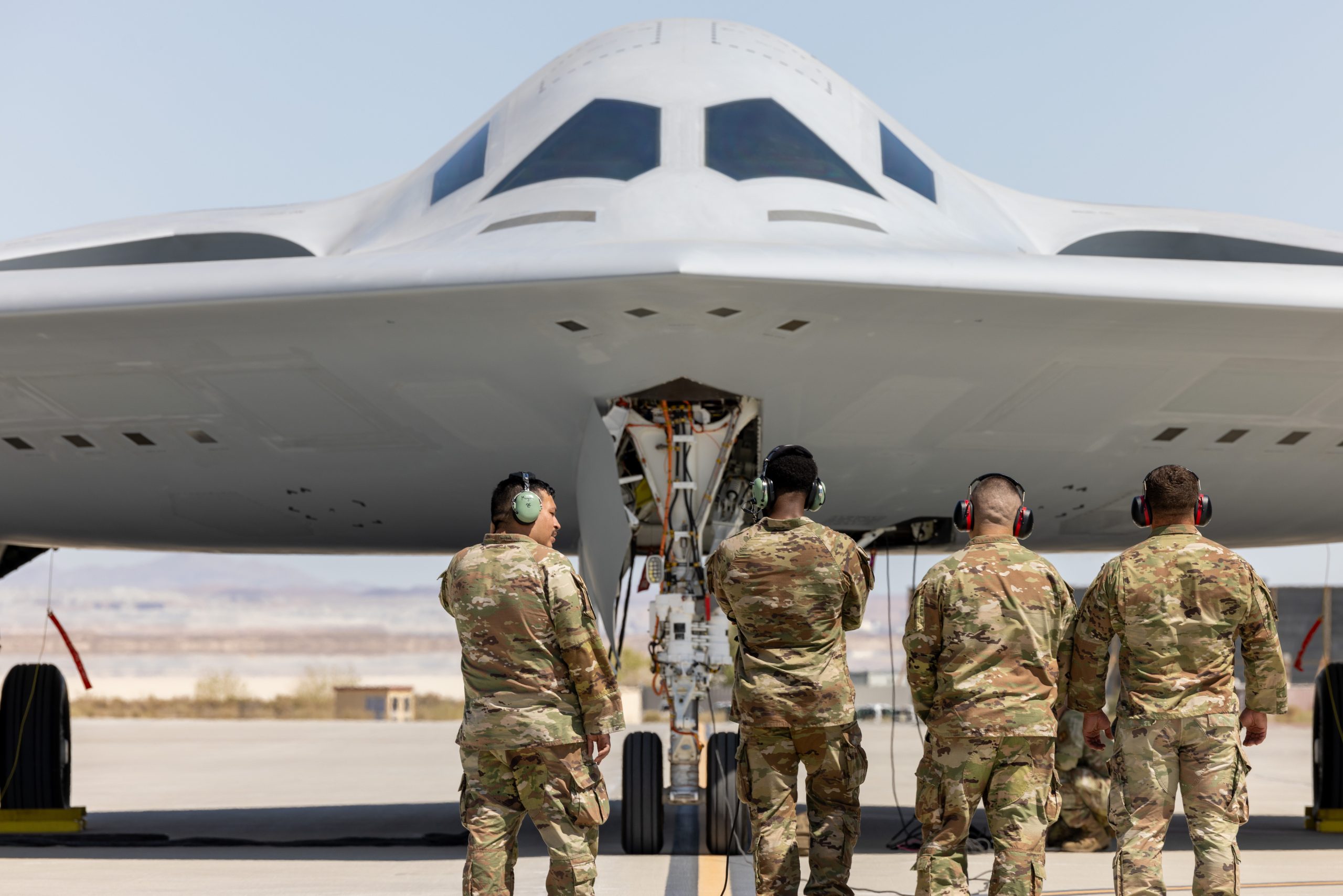
Northrop Grumman is actively pursuing strategies to accelerate the production of its B-21 Raider advanced stealth bomber, with the implicit goal of encouraging the U.S. Air Force to expand its planned fleet size beyond the current minimum commitment. Kathy Warden, Northrop Grumman’s chief executive, articulated these efforts during a discussion at the Bernstein Strategic Decisions Conference on May 28, noting that the company is undertaking measures, some self-funded, to enhance its B-21 manufacturing capacity.
Warden indicated that if the Air Force gains confidence in Northrop Grumman’s capability to manage increased B-21 orders efficiently, it may become more inclined to procure a quantity exceeding 100 aircraft – the minimum number the service has publicly committed to acquiring. “As we transition through the completion of the test program and into full-rate production, we anticipate the opportunity to build these aircraft at a faster pace. This aligns with a recent agreement reached with the Air Force, which in turn creates the potential for the Air Force to consider purchasing an even greater number,” Warden stated.
She further elaborated that this increased production rate provides the Air Force with greater flexibility to assess its mission requirements and determine the optimal fleet size needed to fulfill those demands. “They are currently conducting that analysis, and our demonstrated ability to build faster undoubtedly serves as a positive factor in those evaluations,” Warden added.
These statements from Northrop Grumman’s leadership coincide with a period during which the Air Force has shown increased openness to potentially expanding the B-21 fleet beyond its official “at least 100” target. This flexibility also comes amid growing pressure from various stakeholders to do so. Secretary of Defense Pete Hegseth, for instance, informed lawmakers in April that the Air Force would require “a lot more” than 100 B-21s in the future, signaling a strong intent from Pentagon leadership to enlarge the Raider fleet. Similarly, Lt. Gen. David H. Tabor, the Air Force’s top planner, indicated to lawmakers on May 13 that the service is likely to disclose its revised B-21 fleet projections in spring 2027, as part of its fiscal year 2028 budget proposal.
Congressional bodies, however, may seek this information sooner. A draft of the National Defense Authorization Act (NDAA) for fiscal year 2027, released on May 26 by the House Armed Services Committee, includes a provision that would mandate the Pentagon to submit a comprehensive report by December 2026. This report would be required to determine the necessary number of B-21s to effectively execute both nuclear and conventional missions. Furthermore, if the assessment concludes that more than 100 aircraft are required, the report must outline the timeline for acquiring these additional bombers.
Committee members expressed explicit “concern” that the current plan to acquire 100 B-21s “may be insufficient to meet the requirements of the National Defense Strategy.” They highlighted that the target of 100 aircraft has remained unchanged since its initial establishment in 2015, despite significant shifts in the global security environment over the intervening years. This concern is reinforced by calls from senior national security leaders, including the last two commanders of U.S. Strategic Command (STRATCOM), who have advocated for procuring a larger B-21 fleet. Most recently, STRATCOM Commander Adm. Richard Correll informed lawmakers in March that the Air Force requires 145 B-21s and confirmed that the establishment of a second production line to achieve this objective is under consideration.
The B-21 Raider is conceptualized as a sixth-generation bomber, designed with the capability to deliver both conventional and nuclear weapons. It incorporates advanced stealth technology, sophisticated data-sharing capabilities, and an open systems architecture. The Air Force intends to deploy the B-21 for penetrating strike missions, enabling it to operate deep within contested enemy airspace. The aircraft is slated to incrementally replace the Air Force’s aging B-1B Lancer and B-2A Spirit bomber fleets, with this transition expected to occur throughout the 2030s. Currently, two B-21s are undergoing flight testing at Edwards Air Force Base in California, and the first operational Raider is anticipated to arrive at Ellsworth Air Force Base in South Dakota in 2027. Northrop Grumman is conducting the B-21 manufacturing operations at its facility located at Air Force Plant 42 in Palmdale, California.
Both the Air Force and Northrop Grumman have been collaboratively exploring methods to enhance production output. In February, they announced an agreement to increase B-21 production capacity by 25 percent. This initiative is being funded by $4.5 billion allocated from a substantial reconciliation bill passed in 2025, colloquially referred to as the “One Big Beautiful Bill.” Complementing this, Warden disclosed in an April earnings call with investors that Northrop Grumman is independently investing $2.5 billion of its own capital to further bolster B-21 production capabilities. A significant portion of this investment is earmarked for the construction of new facilities, with expenditures phased in over several years.
Northrop Grumman also reported a $477 million loss on the B-21 program during the first quarter of 2025. At the time, the company attributed a substantial portion of this loss to modifications in its production process, specifically those implemented to facilitate a higher manufacturing rate for the Raiders. During her address at the May 28 Bernstein conference, Warden acknowledged the company’s “learning experience” regarding its manufacturing process, which led to the 2025 financial impact. “No program is going to be perfect, and so we had that ‘learning.’ It resulted in some rework, and we took that charge,” Warden explained.
Despite these challenges, Warden conveyed strong confidence in Northrop Grumman’s ongoing ability to efficiently build B-21s while concurrently mitigating program risks. “For a program of this scale, complexity, and duration, this program is performing exceptionally well,” Warden asserted. “However, any program of this magnitude inherently carries risk, particularly as it transitions into production for the first time. We are, nevertheless, systematically retiring those risks with each passing day. As the aircraft undergoes successful testing, and we progress through our build processes, we maintain a highly positive outlook regarding our capacity to consistently deliver on our projections.”
Why This Matters
The debate and actions surrounding the B-21 Raider’s production rate and ultimate fleet size carry significant implications for U.S. national security, defense strategy, and economic stability. The B-21 is not merely an incremental upgrade but represents a foundational element of future U.S. air power, designed to ensure the nation’s ability to project power and deter adversaries in an increasingly contested global environment. Its advanced stealth and multi-mission capabilities are deemed critical for penetrating sophisticated air defenses, a necessity given the rapid advancements in anti-access/area denial (A2/AD) capabilities by near-peer competitors such as China and Russia.
A larger B-21 fleet, as advocated by Pentagon leadership and Congress, would provide greater strategic depth and flexibility. It would ensure the Air Force possesses sufficient numbers to execute both conventional long-range strike missions and its nuclear deterrence role without overstretching resources or compromising readiness. This increased capacity is vital for addressing the dual challenges posed by potential conflicts in multiple theaters and maintaining a credible deterrent against a range of threats.
Economically, the B-21 program represents a substantial investment of taxpayer dollars, involving billions in development and production. Expanding the fleet would entail further significant government spending, which fuels high-tech manufacturing, supports a skilled workforce, and drives innovation within the defense industrial base. However, it also necessitates careful oversight to ensure cost-effectiveness and accountability. Northrop Grumman’s willingness to self-fund production enhancements underscores the intense competition and strategic importance within the defense sector to secure long-term government contracts.
Ultimately, the decisions made regarding the B-21’s production and procurement will shape the U.S. Air Force’s capabilities and the nation’s strategic posture for decades to come. It will influence future budget priorities, force structure planning, and the ability of the United States to maintain its technological advantage and deter aggression in a complex and evolving geopolitical landscape. The ongoing discussions reflect a critical moment in defining the future of American air power and its role in global security.