
Department of Homeland Security Under Scrutiny Over Multi-Million Dollar Aircraft Purchase From Political Donor’s Firm
Washington D.C. – The U.S. Department of Homeland Security (DHS) is facing scrutiny over its purchase of five aircraft from a firm owned by a political donor, a transaction that occurred in the final hours of former Secretary Kristi Noem’s tenure. Documents reviewed by The New York Times indicate that the agency paid a substantial markup for the planes, which were acquired from Daedalus Aviation Corporation, a company whose chairman had previously made a political donation to Secretary Noem’s political action committee.
The deal, which involved a total expenditure of approximately $259 million for five aircraft, has raised questions about government procurement practices, potential conflicts of interest, and the use of taxpayer funds. The purchases included a Boeing 737 airliner converted into a luxury private jet, two Gulfstream luxury jets, and two older Boeing 737 passenger planes.
Details of the Aircraft Acquisition
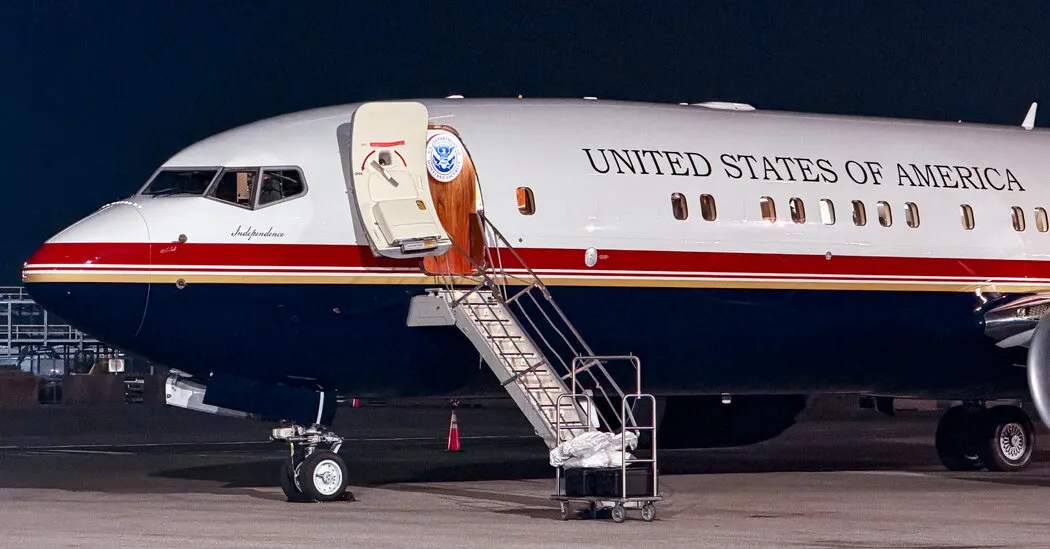
According to the reviewed documents, DHS agreed to pay Daedalus Aviation Corporation $108 million for a Boeing 737 airliner. This particular aircraft had been extensively customized for luxury, featuring a stand-up bar, two bedrooms, marble showers, and a table adorned with manta ray skin. Daedalus Aviation Corporation had reportedly acquired this same plane just months earlier for less than $90 million, suggesting a profit margin of over $18 million for the firm on this single transaction.
In addition to the luxury Boeing 737, the agency also purchased two smaller Gulfstream luxury jets. Daedalus had reportedly bought these two jets for approximately $83 million but resold them to DHS for $106 million, indicating a profit of around $23 million on the pair. The transaction further included two 17-year-old Boeing 737 passenger planes, for which DHS paid $45 million apiece. Aviation experts consulted by The New York Times stated that these prices were “millions of dollars higher than the typical market value for jets of that age,” suggesting potentially inflated pricing for these aircraft as well.
The total cost for these five aircraft amounted to approximately $259 million. These five planes represent the most expensive portion of a larger deal under Noem’s leadership, where DHS acquired a total of 10 airplanes from Daedalus, costing the agency $464 million over her tenure.
Timing and Leadership Transition
The bulk of these high-value purchases were finalized on the last morning of Kristi Noem’s leadership as Homeland Security Secretary. President Trump had announced on March 5 that he would replace Ms. Noem following a series of controversies, including questions surrounding her agency’s contract awards. However, she remained in the position until her successor, Markwayne Mullin, received Senate approval and formally took office on March 24.
Upon assuming his role, Secretary Mullin reportedly explored the possibility of withdrawing from the deal, according to two White House officials. These officials indicated that Mullin was concerned about potential “significant financial penalties” if the agency attempted to cancel the purchase. He consulted with White House chief of staff Susie Wiles, who reportedly shared his concerns regarding the financial ramifications and advised against blocking the acquisition. Consequently, the deal proceeded. Secretary Mullin’s staff, when questioned about this account, provided a statement asserting that “these planes were purchased prior to Secretary Mullin’s arrival at D.H.S.”
Ms. Noem, now serving as a special envoy at the State Department, declined to directly address specific questions about the sale prices or the transaction itself. She reiterated a previous statement, saying, “The purchase of these planes was not completed during Secretary Noem’s tenure at D.H.S. Funding for the 10-aircraft acquisition was made available during the leadership transition, and the acquisition process continued, and the purchase was finalized under Secretary Mullin’s leadership.” While the sale was approved under Ms. Noem’s authority, government documents indicate that the formal transfer of ownership for the planes did not occur until April, when Mr. Mullin was in charge.
Links to Political Donations and Prior Contracts
William Walters, the chairman of Daedalus Aviation Corporation, is noted to have contributed $10,000 to Ms. Noem’s American Resolve political action committee in 2024. Daedalus Aviation Corporation stated that Mr. Walters was unaware of the group’s affiliation with Ms. Noem at the time of the donation, despite the PAC’s website prominently featuring her image and existing to support her political activities.
This particular aircraft deal is not an isolated incident. Following Ms. Noem’s appointment as Secretary, her agency awarded over $900 million in contracts to companies led by Mr. Walters. These contracts included hiring Salus Worldwide Solutions, another of Walters’ firms, to promote voluntary departure among immigrants and to provide chartered jet services for Noem and her staff. Furthermore, Daedalus Aviation Corporation received a no-bid contract to procure planes specifically for deportation flights. This arrangement allowed Daedalus to act as a middleman, purchasing planes from other sellers and reselling them to the government.
Daedalus Aviation Corporation has defended its pricing, asserting that it reflects a market with a limited supply of suitable aircraft. In a statement, the firm said, “Daedalus Aviation is proud to have delivered aircraft of the highest available value under very tight time constraints in an incredibly competitive market for aircraft acquisition.” Regarding Secretary Mullin’s reported attempt to back out of the deal, the firm stated its belief that the contract was already legally binding when he took office.
Transparency Concerns
The New York Times has reported difficulties in obtaining key documents related to these transactions. A copy of the contract signed by DHS for the plane purchases has not been released by the agency. Similarly, requests for documents detailing the agency’s rationale for awarding Daedalus the no-bid contract were denied. DHS cited national security concerns, stating that releasing such documents would “compromise national security or create other security risks.”
The initial purchases of 10 aircraft from Daedalus during Ms. Noem’s tenure had previously drawn criticism for being a symbol of government waste. Despite being deemed “urgently needed” for deportation flights, DHS reportedly lacked the necessary crews to operate them. As a result, one plane was leased to the FBI, while the others remained largely underutilized.
Why This Matters
This investigation into the Department of Homeland Security’s aircraft purchases from Daedalus Aviation Corporation highlights several critical issues relevant to public governance and the responsible use of taxpayer money. The core concerns revolve around potential government waste, ethical considerations regarding political donations and contract awards, and a lack of transparency in federal procurement processes.
Firstly, the significant markups paid for the aircraft, particularly the luxury Boeing 737 and Gulfstream jets, raise serious questions about the stewardship of public funds. When an agency pays substantially more than a vendor’s recent acquisition cost for the same assets, or higher than typical market value as suggested by experts, it implies either inefficient purchasing practices or a disregard for obtaining the best value for taxpayers. In an era of increasing fiscal scrutiny, every dollar spent by government agencies is expected to demonstrate clear value and necessity.
Secondly, the nexus between political donations and lucrative government contracts presents a potential conflict of interest. The fact that Daedalus Aviation Corporation’s chairman, William Walters, made a donation to Secretary Noem’s political action committee, coupled with his companies receiving hundreds of millions of dollars in contracts from DHS during her leadership, creates an appearance of impropriety. Even if no direct quid pro quo is proven, such circumstances can erode public trust in the integrity of government contracting and raise concerns about whether contracts are awarded based on merit and competitive bidding, or on political connections.
Thirdly, the timing of the aircraft purchase – in the final hours of Secretary Noem’s tenure and after her announced departure – is particularly noteworthy. It suggests a rushed decision-making process for a major financial commitment, potentially bypassing the incoming leadership’s ability to review or halt the deal. While the formal transfer of ownership occurred under Secretary Mullin, the approval and commitment to the purchase under the outgoing administration complicate accountability and raise questions about the motivations behind such a swift, high-value transaction at a transitional moment.
Finally, the lack of transparency surrounding these deals is a significant concern. The agency’s refusal to release the full contract or its rationale for awarding a no-bid contract, citing national security, hinders public oversight and reinforces suspicions. Transparency is a cornerstone of democratic governance, ensuring that the public and watchdog organizations can verify that public money is being spent wisely and ethically. When such information is withheld, it makes it difficult to assess whether the claims of “urgent need” and “competitive market” truly justify the high costs and sole-source contracts. The reported underutilization of previously purchased aircraft further underscores the need for rigorous justification and oversight of such substantial investments.
Department of Homeland Security Under Scrutiny Over Multi-Million Dollar Aircraft Contracts
The Department of Homeland Security (DHS) is facing scrutiny over a series of aircraft acquisition contracts, totaling hundreds of millions of dollars, which were modified and approved in the final days of former Secretary Ms. Noem’s tenure. These agreements, primarily with a company named Daedalus, involved the purchase of both luxury jets and older Boeing airliners at prices that aviation experts say significantly exceeded market value. Concerns have also been raised about the stated purpose of these aircraft, which initially included mass deportations but have since been clarified to predominantly involve executive and congressional travel.
The controversy centers on a contract originally awarded to Daedalus, a company owned by Mr. Walters, in February 2025. This contract, valued at up to $500 million, initially focused on procuring Boeing 737 aircraft to facilitate the mass deportation of immigrants. However, significant changes to this agreement were approved on March 24, 2025, during a narrow window just before Ms. Noem’s replacement, Mr. Mullin, was scheduled to assume the role of Secretary.
The Final Days of an Administration and a Pivotal Contract Change
On March 3, 2025, then-Secretary Ms. Noem testified before a Senate committee, advocating for the purchase of new aircraft. She asserted that acquiring these planes would lead to taxpayer savings by reducing reliance on chartered flights and suggested the aircraft would serve a dual purpose: “executive air travel and for deportations.” This testimony came just two days before President Trump announced her imminent replacement. Despite the incoming change in leadership, Ms. Noem remained in office for 18 more days.
On March 24, 2025, the day Mr. Mullin was scheduled to take over in the early afternoon, Ms. Noem was abroad, commencing duties as a special envoy in Guyana. Crucially, late that morning, with Ms. Noem still at the helm of DHS, the department approved a substantial modification to its contract with Daedalus. This change dramatically altered the nature of the aircraft procurement.
Shift to Luxury and Elevated Prices
Prior to this modification, Daedalus had been supplying DHS with aging Boeing airliners, consistent with the agency’s mission of acquiring aircraft for large-scale deportations. Documents reviewed by The Times indicate that DHS had paid Daedalus between $17.6 million and $35 million for each of five previously acquired planes, which ranged from 17 to 23 years old.
Under the new agreement approved on March 24, however, the agency contracted to purchase three luxury jets that Mr. Walters’ companies had been utilizing to transport government officials. One of these was a Boeing 737, notable for its distinctive manta ray skin table, the sale of which for $108 million was initially reported by The Daily Beast.
This particular luxury jet had a convoluted sales history. Its previous owners, Las Vegas-based brothers Frank and Lorenzo Fertitta, who lead the Station Casinos chain, had placed the aircraft on the market in early 2023 for $89 million. Marketing materials for the plane highlighted opulent features such as electronic bidets, a wine chiller, and four televisions. Despite these amenities, the aircraft remained unsold for over two years, still being advertised online for under $90 million in early 2025.
Daedalus eventually purchased the plane in September 2025. The Fertittas, known as significant Republican donors (with their cousin Tilman Fertitta serving as Mr. Trump’s ambassador to Italy), declined to disclose the sale price to Daedalus, citing a confidentiality clause. While DHS was chartering the plane for Ms. Noem’s travel, Daedalus undertook the significant step of repainting it in the red-white-and-blue scheme similar to Mr. Trump’s redesigned Air Force One, even though the government did not yet own it.
During the Senate hearing on March 3, Senator Sheldon Whitehouse, a Democrat from Rhode Island, pressed Ms. Noem on the suitability of such a luxury 737 for deportations. Ms. Noem responded, “In the past, we have used jets of this size, in this configuration, for deportations,” adding that she believed the plane was undergoing refurbishment to remove a bedroom. Daedalus later confirmed that after the government purchased the plane, one of the two bedrooms was indeed replaced with a conference room, but the rest of the lavish interior, including the bar and the manta ray skin table, remained intact.
Additional Aircraft and Questionable Markups
The March 24 agreement also included the acquisition of two 10-year-old Gulfstream jets, each capable of seating approximately 14 people. Daedalus had purchased one of these aircraft in December (of the year prior to March 24) for $41 million and the other, a longer-range model, in January (of the year of March 24) for $41.8 million. These prices were largely consistent with market rates for planes of their age, according to records from Aircraft Post, a market intelligence firm.
However, the records obtained by The Times indicate that DHS subsequently paid $53 million for each of these Gulfstream jets. This represents a markup of more than $11 million per aircraft in a relatively short period.
Furthermore, among the five planes included in the March 24 purchase were two additional Boeing 737 airliners. Like the airliners previously bought from Daedalus, these planes were over 17 years old and had seen prior service with Southwest Airlines and Avelo Airlines. In contrast to earlier purchases of similar aircraft (which cost $17.6 million to $35 million each), DHS paid $45 million for each of these two older 737s.
Daedalus declined to provide specific details regarding the prices it paid for these aircraft or to justify the prices charged to DHS. The planes’ former owners also declined to comment. Aviation valuation experts consulted by The Times expressed significant concern over these prices, estimating that jets of this make, model, and age typically range from $15 million for a modestly maintained plane to $30 million for one in exceptional condition. While prices can increase with included extras like maintenance packages or spare parts, experts found it “difficult to imagine an airline paying $45 million for a plane of this type.” Richard Aboulafia, a managing director at AeroDynamic Advisory, an aerospace consulting firm, remarked, “I hope they came with buckets of caviar each, otherwise it doesn’t make a whole lot of sense. This does not resemble any aspect of an airline marketplace.”
Maintenance and Shifting Purposes
Following the purchases, the government needed facilities to store and maintain the new fleet. Under Ms. Noem, DHS had already contracted Salus Worldwide, another company owned by Mr. Walters, to maintain the initial five planes acquired from Daedalus. This arrangement continued under Mr. Mullin, with the new planes also placed under Salus Worldwide’s care. Contracting records show DHS paid the company more than $2 million in both May and June.
In August, DHS eventually hired Eastern Air Express, a contractor unconnected to Mr. Walters, to take over maintenance for most of the planes, though the luxury 737 jet was not included in this new contract. DHS has since sought to transfer the luxury 737 to the Pentagon, but a spokesperson for the Pentagon confirmed that no agreement had been finalized.
Notably, DHS officials have now clarified that four of the acquired 737 airliners will not be used for deportation flights, but instead will be designated for flying government leaders and members of Congress on overseas trips. The agency declined to specify if or when any of the ten aircraft would be utilized for their initially stated purpose of deportation flights.
Why This Matters
This episode raises critical questions about transparency, accountability, and the responsible use of taxpayer funds within government contracting. The timing of the significant contract modifications, approved in the final hours of an outgoing Secretary’s tenure, could suggest a rush to finalize deals without sufficient oversight or review by the incoming administration. This swift action, coupled with the absence of the Secretary from the country, creates an appearance of circumvention, regardless of intent.
The stark discrepancies between the market prices of the acquired aircraft and the amounts paid by the Department of Homeland Security are particularly concerning. Markups of millions of dollars on individual planes, as highlighted by aviation experts, indicate potential inefficiencies, poor negotiation, or even impropriety in the contracting process. Such overpayments directly impact taxpayers, diverting funds that could otherwise be used for essential public services or core departmental missions. This situation underscores the importance of robust internal controls, independent valuations, and competitive bidding processes in government procurement.
Furthermore, the shifting narrative regarding the intended use of these aircraft is significant. Initially justified as being for “dual purposes” including mass deportations, the subsequent clarification that several planes will primarily serve “executive air travel and for members of Congress on overseas trips” suggests a potential misrepresentation of the purchases’ primary objective. This raises concerns about whether the initial justifications were fully accurate and whether public funds are being allocated for purposes that align with the core mission of DHS, which is national security and border protection, rather than for luxury travel accommodations. This divergence could erode public trust in government agencies and their spending practices, emphasizing the need for clarity and honesty in how public resources are justified and utilized.